Indonesia's Soybean Stockpile Holds at 475,000 Tons as Tofu and Tempeh Makers Stay Cautious
Indonesia is holding a soybean stockpile of 475,000 tons, a volume described as adequate for current demand, according to Bisnis Indonesia. Tofu and tempeh producers nonetheless remain cautious, citing supply certainty and price stability as the conditions they need for uninterrupted production.
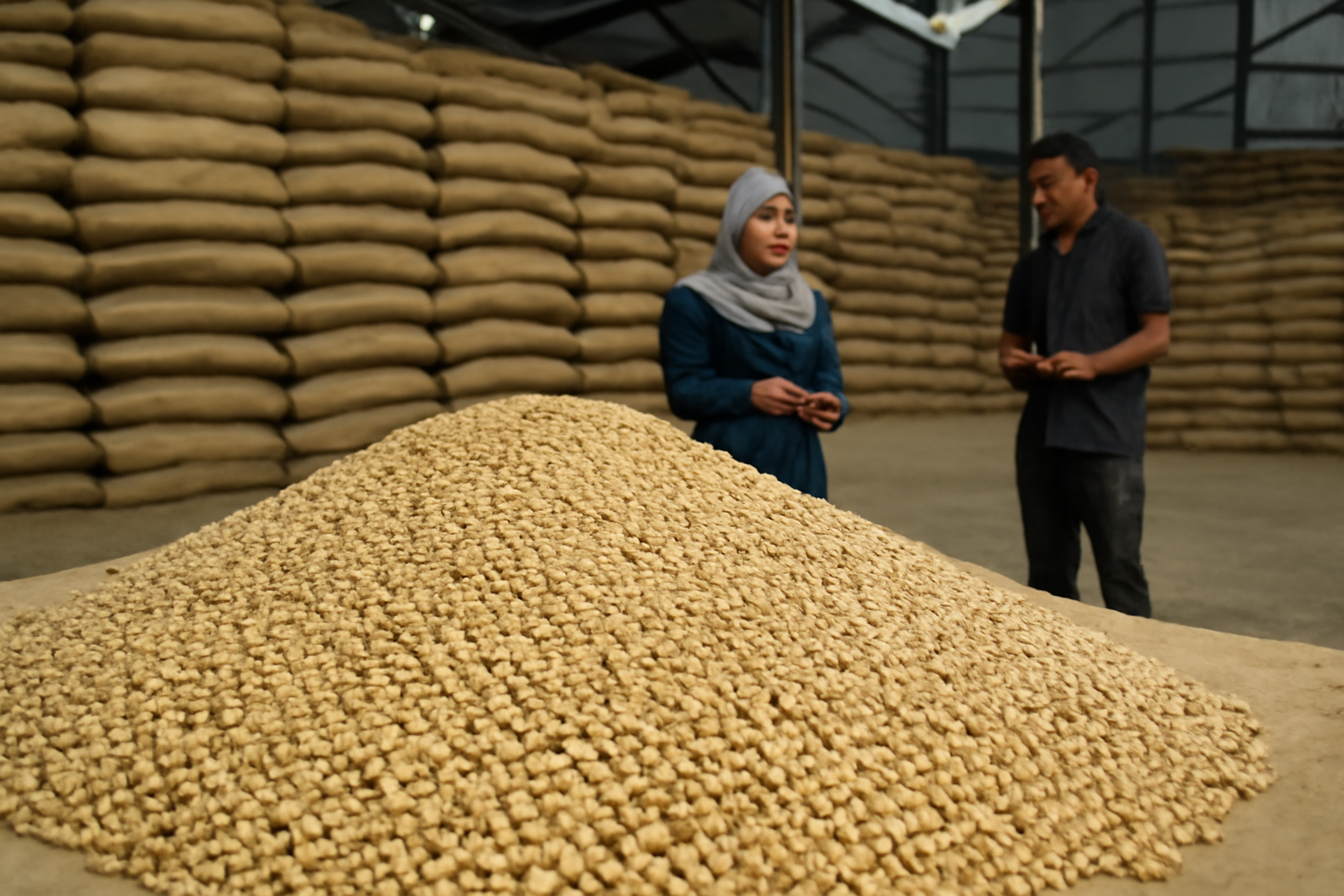
Indonesia's soybean stockpile stands at 475,000 tons, a level reported as sufficient to cover current requirements, according to Bisnis Indonesia. The figure is the reference point for an industry in which soybeans are not primarily a feed or crushing input but the direct raw material for two staple foods consumed daily across the country: tofu and tempeh.
Despite the reported adequacy of the stock, producers remain cautious. Bisnis Indonesia reports that operators in the tofu and tempeh trade are watching both supply certainty and price levels, and regard stability in each as the precondition for sustained production.
Why a Volume Figure Alone Does Not Settle the Question
A stock level answers only one of the two questions the sector is asking. Volume describes what is available now; it does not describe the cost at which that volume converts into finished product, nor the reliability of the flows that will replace it once it is drawn down. Bisnis Indonesia frames the industry's caution in exactly those terms — certainty of supply and stable prices are cited as what matters for production to continue without interruption.
That distinction is material for the businesses involved. Tofu and tempeh production in Indonesia is dominated by small-scale workshops operating on thin margins and short working-capital cycles. These are price-taking businesses with limited ability to hedge, little storage capacity of their own, and customers who resist price increases on a staple food. For such operators, a national stock number is a signal about the near term rather than a guarantee about the months that follow.
The Structure Behind the Caution
The sensitivity of Indonesian tofu and tempeh makers to soybean supply and pricing reflects the structure of the market they buy in. Their raw material reaches them through a chain of importers and distributors, and their purchasing decisions are made in small lots at prevailing prices rather than through long-term contracts. That leaves the pass-through from raw material cost to workshop gate fast and largely unbuffered.
Against that background, the 475,000-ton figure functions as a reassurance about immediate availability. What it does not do is remove the questions that operators raise about what happens next. The Bisnis Indonesia report does not detail the composition of the stockpile, the period it is expected to cover, or the price levels currently prevailing.
What Market Participants Will Be Watching
- Whether the reported 475,000-ton stock is maintained, drawn down, or replenished in the period ahead.
- The price at which soybeans reach small-scale tofu and tempeh workshops, as distinct from the headline availability figure.
- The consistency of arrivals, given that supply certainty is cited by producers alongside price as a determinant of continued output.
- Any change in sourcing arrangements that alters how quickly cost movements reach the workshop level.
A Staple Food Market, Not a Commodity Trade Story
The stakes in this market are set by consumption patterns rather than by trade volumes alone. Tofu and tempeh are among the most widely eaten protein sources in Indonesia, purchased daily and at low unit prices. Disruption in the raw material feeding them is felt immediately at the household level, which is why availability and price in this segment are treated as matters of food supply rather than as ordinary commodity fluctuations.
For now, the picture described by Bisnis Indonesia is one of sufficiency paired with unresolved caution: a stock level that covers present needs, and an industry that is explicit about needing more than a single volume figure before it treats its input supply as settled.