Indonesia Launches 25-Hectare Soybean Pilot in Bogor as Imports Cover 95% of Demand
Indonesia's Coordinating Ministry for Food Affairs has launched a pilot soybean planting project on 25 hectares in Cariu District, Bogor Regency, with expansion to 100 hectares planned for 2027. Domestic production reached about 79,000 tonnes in 2025 against national demand of 2.72 million tonnes, leaving imports at roughly 95 percent of consumption. Cooperative association Gakoptindo will act as off-taker for the harvest.
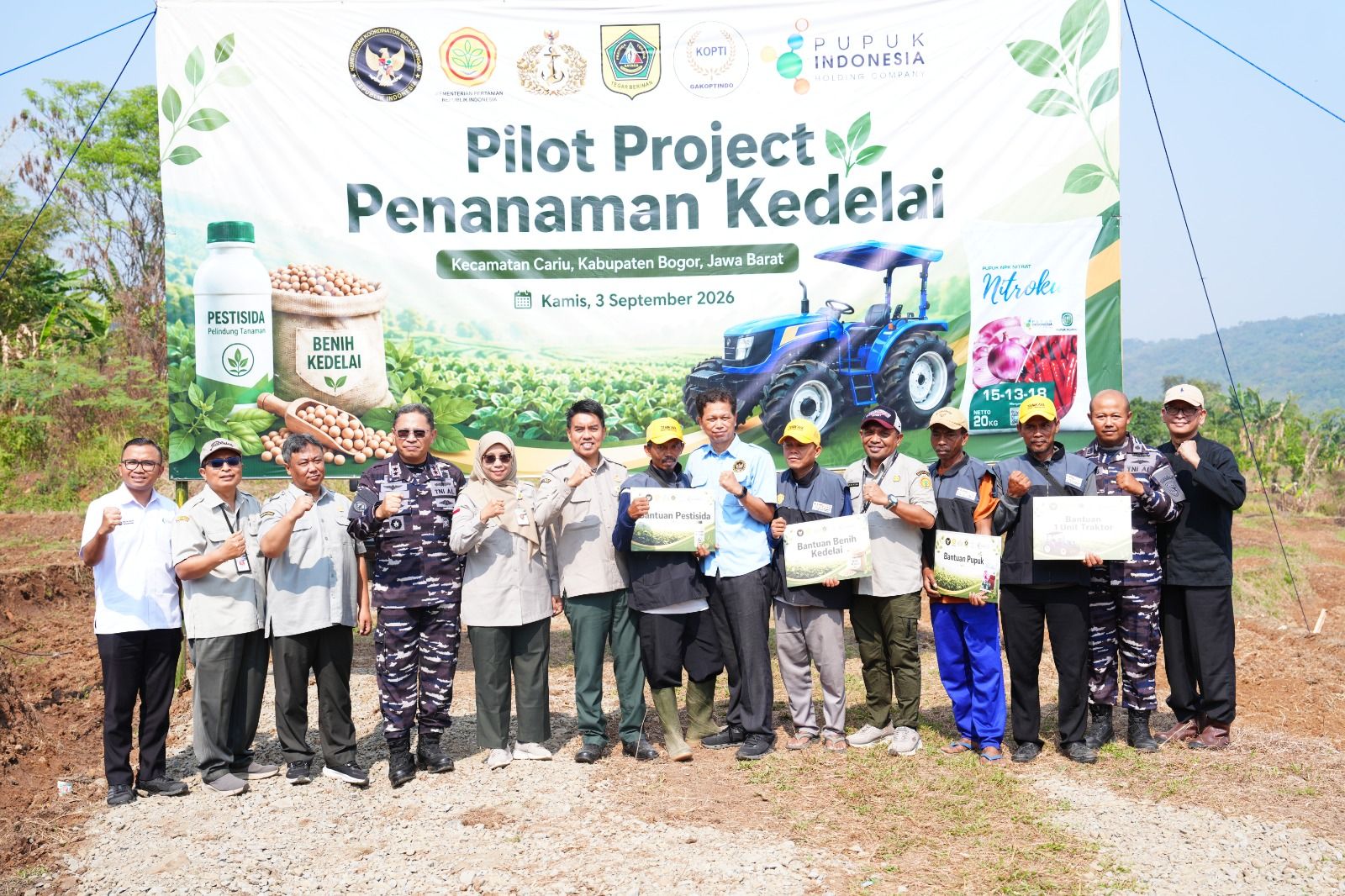
Indonesia has begun a state-backed effort to expand domestic soybean cultivation, launching a pilot planting project in Cariu District, Bogor Regency. The programme targets an import dependence that still accounts for roughly 95 percent of national soybean consumption, according to suarapemerintah.id.
The initiative was coordinated by the Coordinating Ministry for Food Affairs (Kemenko Pangan) together with the Ministry of Agriculture, the Indonesian Navy (TNI AL), the Bogor Regency government, state fertiliser producer PT Pupuk Indonesia (Persero) and the Indonesian Tempe and Tofu Producers Cooperative Association (Gakoptindo). Within Kemenko Pangan the work runs through the Assistant Deputy for Competitiveness of Food Crop Products, under the Deputy for Coordination of Food and Agriculture Business.
A 25-hectare start, 100 hectares planned for 2027
The pilot is being planted on 25 hectares, an area projected to rise to 100 hectares in 2027. It is framed not as a production programme in its own right but as the first stage of an integrated soybean development model covering the chain from cultivation through to processing. Participating growers receive production inputs and machinery:
- improved seed varieties
- fertiliser
- pesticides
- water pumps
- tractors
One of the stated primary objectives is to produce and expand the availability of quality soybean seed capable of supporting wider planting in later years. That makes seed multiplication, rather than immediate tonnage, the pilot's central deliverable.
Domestic output covers under 3 percent of requirements
Indonesian soybean production reached around 79,000 tonnes in 2025 against national requirements of 2.72 million tonnes, suarapemerintah.id reported. The resulting shortfall of roughly 2.64 million tonnes is met by imports. The output figure is consistent with the roughly 95 percent import share cited by the ministry: domestic supply covers under 3 percent of what the country consumes.
Requirements are projected to keep climbing, from about 2.79 million tonnes in 2026 to about 3 million tonnes in 2029. The increment between those two years alone is roughly 210,000 tonnes — about 2.7 times Indonesia's entire 2025 harvest. Simply holding import volumes flat over the period would require domestic production to absorb that increase in full.
Gakoptindo secured as off-taker
Output from the Cariu pilot will be absorbed by Gakoptindo as off-taker partner, either for redevelopment as seed stock or as raw material for the tofu and tempe industry. Gakoptindo groups cooperative producers of both products.
The arrangement is intended to give growers market certainty alongside upstream input support, so that farmers have an assured buyer as well as assistance during cultivation. Downstream demand certainty has been presented by the ministry as a condition for the programme's success rather than a secondary feature.
Replication is the stated goal
Kemenko Pangan said it expects the Cariu pilot to become a model for integrated and sustainable national soybean development, with the collaboration format replicated in other regions holding soybean potential in order to raise domestic production gradually and strengthen national food self-sufficiency. No target area, output volume or timeline beyond the 2027 expansion to 100 hectares was disclosed.