PTPN Starts 1,000-Hectare Soybean Pilot to Test Indonesia’s Import-Reduction Plan
PTPN IV PalmCo has begun a 1,000-hectare soybean cultivation pilot across 20 locations using land awaiting oil palm replanting. The project will test whether the model can be expanded in a market where imports supplied 97% of the average soybean deficit over the past five years.
Planting begins across 20 locations
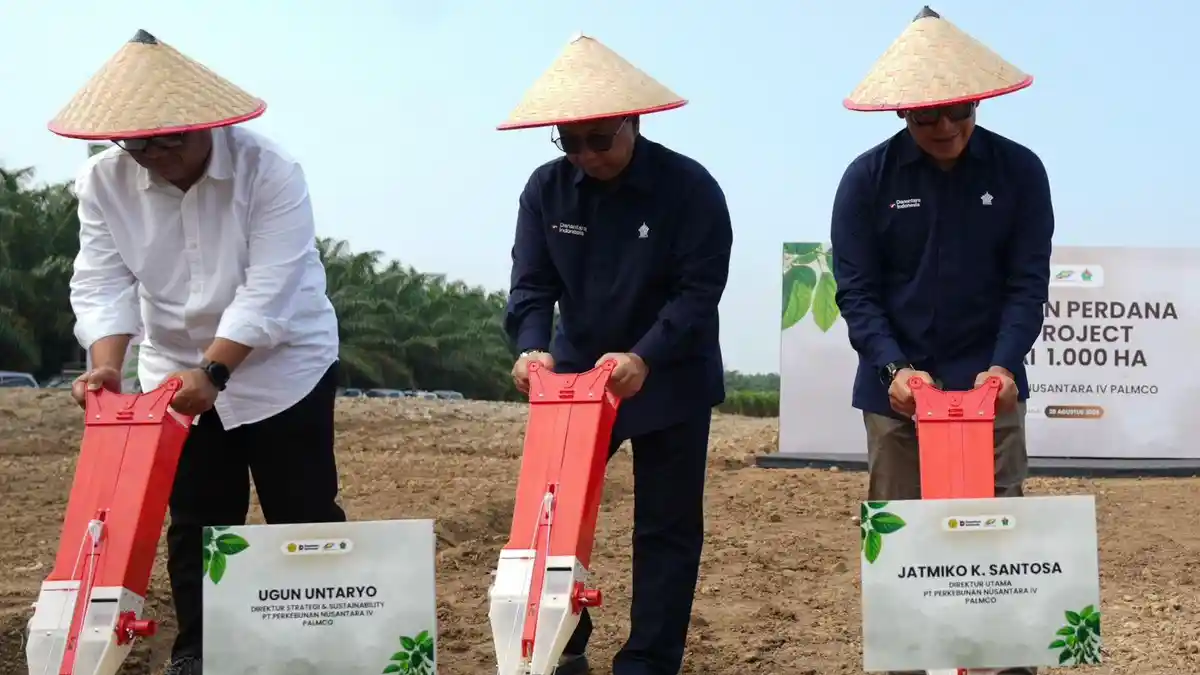
Indonesia’s state-owned plantation group PTPN has launched a 1,000-hectare soybean cultivation pilot intended to support national food security and reduce the country’s dependence on imports. The program is being implemented by PT Perkebunan Nusantara IV PalmCo, a subholding under PTPN III, across 20 locations in the group’s operating areas.
The first planting was centered at the Adolina Estate Regional 2 in Serdang Bedagai Regency, North Sumatra. VIVA reported that the site was connected online with regional management teams carrying out the same activity in six other provinces, indicating coverage across seven provinces. Tribunnews described planting as taking place simultaneously in six provinces on August 28, 2026. Both reports place the initial program at 1,000 hectares.
Soybeans to occupy land awaiting palm replanting
All land assigned to the pilot is located in PTPN’s oil palm replanting or conversion areas. According to PTPN IV PalmCo President Director Jatmiko K. Santosa, the company plans to grow soybeans during an approximately six-month interval before oil palms are planted again. The approach allows PTPN to use temporarily available plantation land without permanently replacing its core palm acreage.
The pilot also marks a new crop for the company. Jatmiko said PTPN IV had not previously cultivated soybeans and was therefore starting with 1,000 hectares. Any broader rollout will depend on whether the trial succeeds and demonstrates feasibility across the relevant operating and investment criteria. Danantara has instructed the company to apply investment caution before moving to a substantially larger area.
Imports dominate Indonesian soybean supply
Indonesia imported 2.56 million tonnes of soybeans in 2025, according to Central Statistics Agency data cited by Tribunnews. Around 90% of those imports came from the United States, with the remainder supplied by countries including Brazil, Argentina and Canada. Domestic production has remained insufficient to meet demand.
Jatmiko said Indonesia’s average soybean deficit over the past five years was 2.5 million tonnes annually, equivalent to an import share of 97%. Against that scale, the 1,000-hectare program is an agronomic and commercial test rather than an immediate substitute for imported volumes. The sources did not disclose expected yields, production costs, seed varieties, purchasing arrangements or a timetable for deciding whether to expand the project.
Scalability will determine the trade impact
The Ministry of Agriculture has presented the planting as part of the national food self-sufficiency program. Arief Muliawan, representing the ministry’s Directorate General of Food Crops, said the initiative could become an example for other Indonesian companies if it succeeds. Government backing gives the pilot a potential route to replication, but no additional companies or future acreage targets were identified.
For soybean processors and importers, the near-term supply picture therefore remains largely unchanged. A meaningful reduction in import dependence would require the model to move well beyond 1,000 hectares and deliver reliable yields during the short window between palm cycles. The trial’s main value is that it will produce practical evidence on whether replanting land can support soybeans at sufficient scale and acceptable cost before PTPN commits more capital.