India produces 25% of the world’s milk but accounts for only 0.5% of dairy exports
India is the world’s largest milk producer, supplying 25% of global output, but its share of international dairy exports is only 0.5%. Low per-capita consumption and gaps in processing constrain the industry’s ability to convert production scale into a stronger trade position.
Production leadership has not translated into trade power
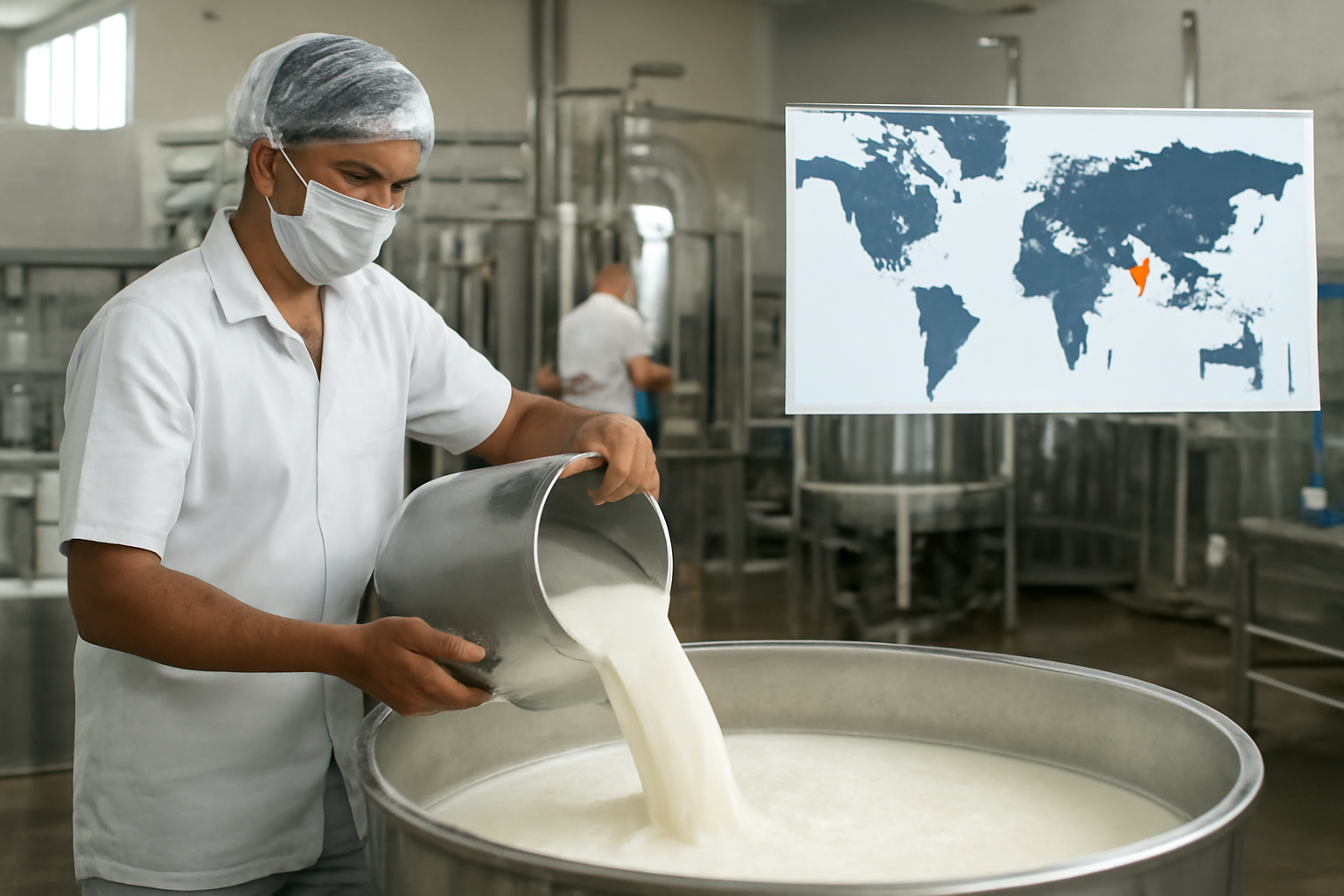
India produces 25% of the world’s milk, making it the largest milk producer globally and reinforcing its position at the center of the international dairy industry. Yet the country accounts for only 0.5% of global dairy exports. The contrast shows that a large raw-milk base does not automatically create a major export industry.
India’s production position is continuing to strengthen, according to the material provided for this report. Its participation in international dairy trade, however, remains negligible relative to that scale. The gap matters for farmers, processors and investors because export competitiveness depends on more than the volume collected at farm level. Milk must also move through reliable collection, cooling, processing, quality-control and distribution systems before it can reach distant markets.
Processing capacity is the critical link
Processing gaps are one of the main constraints separating Indian production from global trade. Fresh milk is perishable, while export markets generally require products that can travel farther and remain stable for longer. Converting milk into suitable dairy products therefore determines how much of the country’s output can realistically enter international commerce.
For processors, the 25% production share represents a substantial supply base. The 0.5% export share indicates that only a very small portion of that advantage is reflected in overseas sales. Additional processing alone would not guarantee exports, but weak processing capacity limits the range and volume of products that producers and traders can offer. It can also reduce flexibility when domestic demand does not absorb available milk on commercially attractive terms.
Domestic consumption remains part of the equation
Per-capita milk consumption in India remains low, according to the supplied source description. This creates a second challenge alongside the export gap. A large national population can support a sizeable domestic dairy market, but low consumption per person means that production growth must be matched by wider access, stronger distribution and products suited to different consumer groups.
The domestic and export markets are connected. A deeper local market can give processors dependable volumes and help justify investment in collection and manufacturing. Export channels, meanwhile, can provide an additional outlet and reduce reliance on a single market. For farmers and processors, the central issue is whether India can build enough capacity to serve both without compromising quality or commercial viability.
Industry focus shifts from volume to market access
India’s figures define the scale of the opportunity and the limitation: one-quarter of global milk production, but one two-hundredth of dairy exports. Closing that gap will depend on how effectively the industry turns raw milk into marketable products and connects producers with buyers. The relevant measures of progress will therefore extend beyond output growth to include processing, domestic consumption and access to international dairy markets.
For importers and global dairy competitors, India’s current export share means its production dominance has only a limited presence in cross-border supply. For Indian producers, traders and investors, it leaves significant room to develop commercial channels. The decisive question is not whether India can produce milk at scale; the 25% share already answers that. It is whether the value chain can convert that scale into consistent domestic sales and a larger role in global trade.