India expands domestic production drive to reduce reliance on Chinese imports
India is building domestic capacity in critical minerals, solar equipment, pharmaceuticals, semiconductors and railway machinery. The initiative targets sectors where Chinese supplies account for as much as 90-100% of Indian demand.
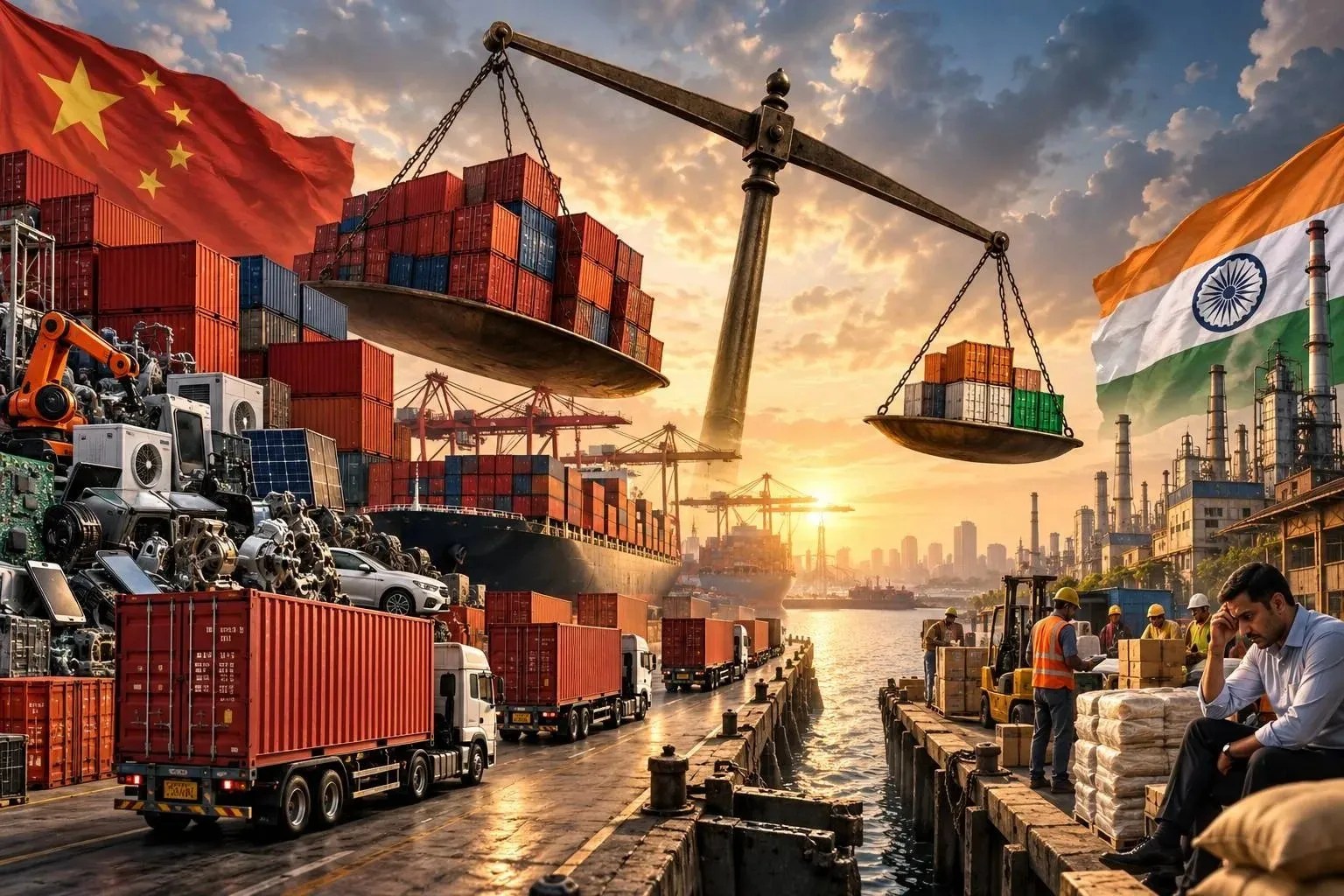
India targets concentrated supply risks
India has accelerated efforts to reduce its dependence on Chinese imports across critical minerals, solar equipment, pharmaceuticals, electronics and heavy machinery. Patrika reports that India remains 90-100% dependent on China in 59 product sectors, leaving manufacturers and infrastructure projects exposed to potential supply interruptions during periods of border or trade tension. The next phase of Make in India combines production-linked incentives, domestic processing plants, overseas mining agreements and measures protecting local manufacturers.
The policy push comes alongside a wide bilateral trade imbalance. According to Patrika, India imported goods worth $131.63 billion from China in 2025-26 and exported about $19.47 billion, producing a deficit of roughly $112.16 billion. Machinery restrictions have added urgency. China announced on October 19 that exporters of tunnel-boring and certain other specialized construction machines would require licenses under its dual-use export-control system from November 18. Indian imports of Chinese tunnelling machinery have already fallen from $18 million annually to only $800,000 over four years.
Minerals, solar equipment and pharmaceuticals
India’s dependence on China for lithium, cobalt and nickel is estimated at 95-100%. These minerals are essential for electric-vehicle batteries, electronics and some military capabilities. India has acquired five lithium blocks in Argentina, while agreements for lithium and cobalt mining in Australia and Chile are in their final stages. The government has also restricted exports of battery waste so that recoverable lithium and nickel remain available domestically. Two lithium-processing and two nickel-processing plants have been approved.
Chinese supplies account for as much as 95% of India’s wafers, polysilicon and other materials used in solar panels and display boards. India has introduced production-linked incentives for solar panels, high-efficiency modules and polysilicon, supported by basic customs duties, an approved list of models and manufacturers, and higher anti-dumping duties on Chinese solar panels. In pharmaceuticals, dependence reaches 90-100% for certain ingredients, antibiotics and intermediates, including streptomycin. More than ₹50 billion has been committed to 40 domestic manufacturing projects. Production of penicillin G has restarted in Kakinada, Andhra Pradesh, while antibiotic capacity has increased in Kathua, Jammu and Kashmir.
Chips, displays and railway machinery
China’s share exceeds 90% in some LED and OLED display categories, while India’s dependence on imported display panels reaches 95%. Three semiconductor plants have started operations in India, and more than 13 agreements have been concluded with Japanese and Taiwanese companies. A separate package under the second phase of Make in India is intended to support fully domestic manufacturing, although the dependence of displays on rare minerals makes localization a longer-term project.
Heavy equipment is another focus. China supplied 90.3% of India’s imported freight-wagon wheels and axles in 2024-25, while dependence on Chinese hydraulic and electronic machinery stood at 95%. India has established a plant in Tiruvallur, Tamil Nadu, and upgraded facilities in Durgapur and Raebareli. A ₹130 billion program targets 50% domestic production of hydraulic excavators, cranes and tunnel-boring machines. These measures could create opportunities for Indian component producers and alternative suppliers, but the scale of current dependence means Chinese inputs will remain important while new mines, processing plants and factories move toward commercial output.