India's Ethanol Industry Faces Nearly 7 Billion Litre Capacity Surplus
Nearly 7 billion litres of Indian ethanol production capacity currently has no clear market, according to Millennium Post. Producers are searching for new buyers, with exports and industrial demand the main alternatives to domestic fuel offtake. The imbalance also affects the sugar and grain markets that supply the sector's feedstock.
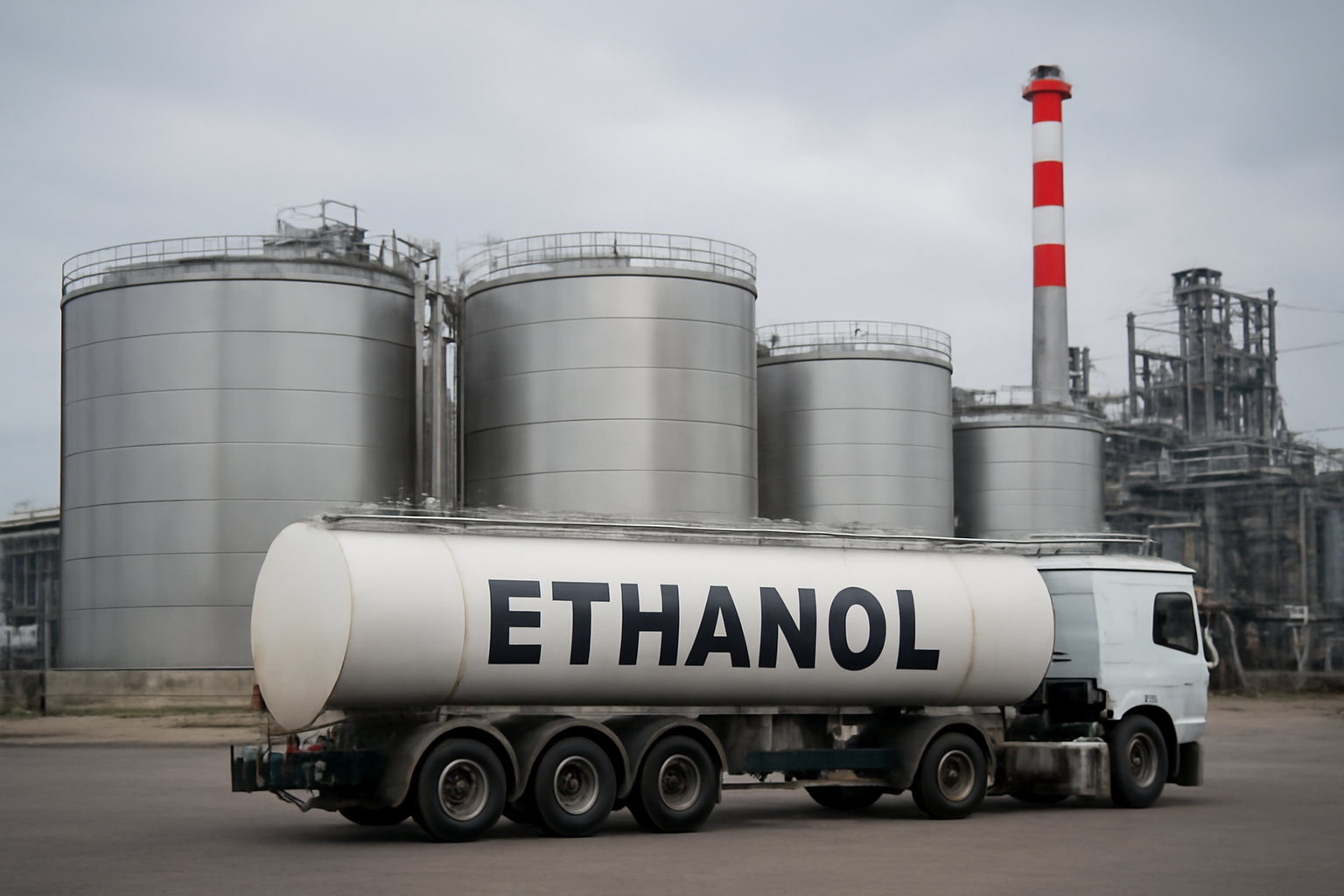
Capacity without a buyer
Nearly 7 billion litres of India's ethanol production capacity currently has no clear market, Millennium Post reported, describing a supply-demand imbalance that has pushed distillers to look for buyers outside their existing arrangements. The figure describes installed capacity rather than ethanol already produced and unsold. That distinction matters: a capacity gap shows up first as idle plant time and low utilisation, not as physical stocks sitting in tanks.
It also changes how the problem is carried. A distillery is a capital-heavy asset financed against expected offtake over many years. Plants running below design volume still service debt, retain staff and hold feedstock relationships, so the cost of an unplaced surplus lands on operating margins and coverage ratios well before it shows up in product prices.
Where producers are looking next
Producers are exploring new buyers for the volumes they cannot place, according to Millennium Post. The report does not identify which markets are under consideration. In practice, the routes available to a distiller with spare capacity fall into a limited set:
- Export sales, which move volume quickly but expose producers to international price benchmarks they do not set.
- Industrial and chemical demand, where ethanol is used as a solvent and as a feedstock for downstream chemistry.
- Potable and pharmaceutical-grade alcohol, which pays more per litre but absorbs comparatively small quantities.
- Newer fuel applications that require additional processing and separate certification.
- Reduced running or toll production for third parties, which limits losses without solving the demand shortfall.
The routes are not interchangeable. Each carries its own specification, logistics and certification requirements, and the higher-value channels are generally the smallest by volume. Capacity built for a fuel-blending market does not transfer to speciality demand without cost.
What the reporting leaves open
Several variables that determine the severity of the imbalance are not set out in the reporting. The surplus is not broken down by feedstock, so the split between sugar-based and grain-based capacity is unclear, a distinction that drives cost structures, plant flexibility and the alternative uses of the raw material. No timeline is given for when the gap emerged or how long it is expected to persist, and no figure is provided for current utilisation rates or for capacity still under construction. Nor does the account state whether the surplus is measured against present demand or against demand projected for a future period.
Read-through for adjacent markets
The imbalance does not stay inside the ethanol sector. Ethanol capacity in India draws on agricultural feedstock, and weaker offtake pushes that raw material back towards its original uses: cane and molasses towards sugar production, grain towards food and feed channels. Any material shift in that direction affects domestic supply balances for those commodities and, by extension, the volumes available for export.
For importers and international traders, the immediate question is whether surplus Indian capacity translates into export offers, and at what price. That depends on production economics relative to world prices, on policy governing outbound sales, and on how quickly producers can qualify their output for foreign specifications. For investors and lenders exposed to the sector, the near-term indicators are utilisation rates, new project approvals and any slowdown in capacity additions. A surplus of this size persists only as long as building continues faster than demand.