Maize supplies largest share as India shifts ethanol production away from sugarcane
Grain supplied 67% of the ethanol delivered to Indian oil marketing companies by June 2026, while sugarcane-based sources accounted for 33%. Maize alone produced 2.58 billion liters, making it the largest individual feedstock and creating a major new outlet for Indian grain.
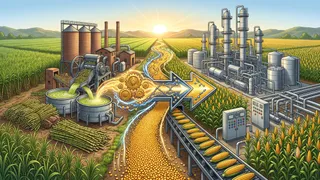
Grain captures two-thirds of ethanol supply
India’s ethanol blending program is moving rapidly from a sugarcane-led system toward maize and other grains. By June 2026, oil marketing companies had received 7.17 billion liters of ethanol, according to Jagran. Grain-based plants supplied 67% of that volume, while sugarcane-based feedstocks accounted for 33%.
The All India Distillers Association said contracts covered 10.48 billion liters, meaning deliveries through June had reached 68% of the contracted volume. Grain sources provided 4.80 billion liters and sugarcane sources supplied 2.38 billion liters. The figures indicate that grain is no longer merely a supplementary raw material for the blending program but its dominant supply base.
Maize was the largest individual source, producing 2.58 billion liters, or about 35% of total ethanol deliveries. Surplus food grain from the Food Corporation of India contributed 1.77 billion liters, while damaged grain supplied another 450 million liters.
Maize surpasses major sugarcane feedstocks
Sugarcane juice produced 1.44 billion liters and B-heavy molasses contributed 820 million liters. Maize output therefore exceeded the combined 2.26 billion liters obtained from those two sugarcane feedstocks. The comparison marks a significant change for distillers, grain processors and sugar mills competing to supply India’s fuel market.
The shift accelerated in 2023 after a weak monsoon affected sugarcane production. The government temporarily restricted ethanol production from sugarcane juice to preserve domestic sugar availability. Maize and broken rice were then made available for ethanol production on a larger scale, and several distilleries began converting sugarcane-based units to grain-based operations.
Procurement prices reinforce that change. The current purchase rate is 71.86 rupees per liter for maize ethanol, compared with 65.61 rupees for sugarcane-based ethanol and 60.32 rupees for rice-based ethanol. The premium gives distillers a stronger incentive to process maize and offers farmers an additional market beyond food and animal feed.
New demand reshapes grain and sugar markets
The transition has implications across agricultural supply chains. Sustained ethanol demand can strengthen maize prices, encourage production and support investment in rural processing capacity. It can also increase competition for grain among distillers, feed manufacturers and food processors. Importers and exporters will need to monitor whether domestic supply expands fast enough to meet this additional industrial demand.
For the sugar industry, greater maize use reduces the pressure to divert sugarcane juice into fuel when cane output is constrained. Jagran reports that this helps protect sugar availability during periods of weak monsoon rainfall and rising domestic demand. It also gives ethanol suppliers a broader feedstock mix rather than tying fuel output to one crop and one harvest cycle.
Water use is another factor behind the strategy. Sugarcane requires more water than maize, making heavy dependence on cane riskier amid climate change, groundwater stress and El Niño conditions. Maize is cultivated across several Indian regions, which can widen the geographic base of ethanol production and make year-round supply easier.
The program is therefore extending beyond the immediate E20 blending objective. A market once centered on sugar mills is increasingly linking fuel demand with maize farming, grain storage and rural distillation. For commodity traders, the key question is whether higher procurement prices and processing investment produce enough additional maize to prevent tighter balances in food and feed markets.