India’s ethanol mandate creates guaranteed demand as capacity outpaces E20 needs
India’s mandatory blending policy has made fuel the country’s largest ethanol market, providing sugar mills and distilleries with government-backed demand. Production capacity now exceeds 20 billion litres a year, compared with about 11 billion litres required for E20, raising concerns about surplus capacity, feedstock pressure and consumer costs.
Mandate becomes the main source of demand
India’s mandatory fuel-blending programme has become the country’s largest source of ethanol demand, creating a regulated market for sugar mills and distilleries. Oil marketing companies are instructed to purchase specified volumes, while the government largely determines procurement prices. Without this purchasing system, a substantial share of existing production capacity would lack a market, according to Bhadas4Media.
The policy is intended to reduce India’s exposure to imported crude oil. The country imports more than 90% of its crude requirements and spends about $150 billion to $200 billion annually on those purchases. The government says ethanol blending saved approximately ₹1.55 lakh crore in foreign exchange over the past decade. However, experts cited by Bhadas4Media estimate that even at a 20% blending rate, the actual reduction in the overall oil import bill is only around 2% to 3%.
The programme has nevertheless transformed the economics of the sugar industry. A decade ago, many mills were struggling with excess sugar production, weak prices, heavy debt and delayed payments to farmers. Fixed-price purchases by oil marketing companies, easier loans for distillation plants and progressively higher blending targets gave mills an additional and relatively predictable revenue stream.
Capacity growth raises surplus risk
India’s annual ethanol production capacity has risen above 20 billion litres and could reach about 24 billion litres by 2027, based on assessments cited by Bhadas4Media. Annual ethanol demand for the E20 programme is approximately 11 billion litres. Pharmaceutical, chemical and beverage industries together consume another 3 billion to 3.5 billion litres.
Those figures leave roughly 7 billion litres of capacity without an identified market after current demand is covered. If the blending target does not rise further, producers may face persistent overcapacity. The exposure is particularly significant for facilities financed on the assumption that mandatory procurement and expanding blending requirements would continue to absorb new output.
The gap also raises questions about the next stage of India’s fuel policy. Additional blending could provide an outlet for producers, but any increase would need to be assessed against vehicle compatibility, feedstock availability and the limited contribution ethanol makes to reducing the total crude import bill. An independent cost-benefit analysis would clarify how gains are distributed among farmers, processors, consumers and public finances.
Maize use and vehicle efficiency add costs
Ethanol was previously produced mainly from molasses, a sugarcane by-product. Rising demand has accelerated the use of maize and other grains. India was among Asia’s major maize exporters several years ago, but maize imports have increased more recently, Bhadas4Media reported. Greater competition for grain could tighten supplies for food and animal feed, replacing part of the country’s oil dependence with new pressure in agricultural markets.
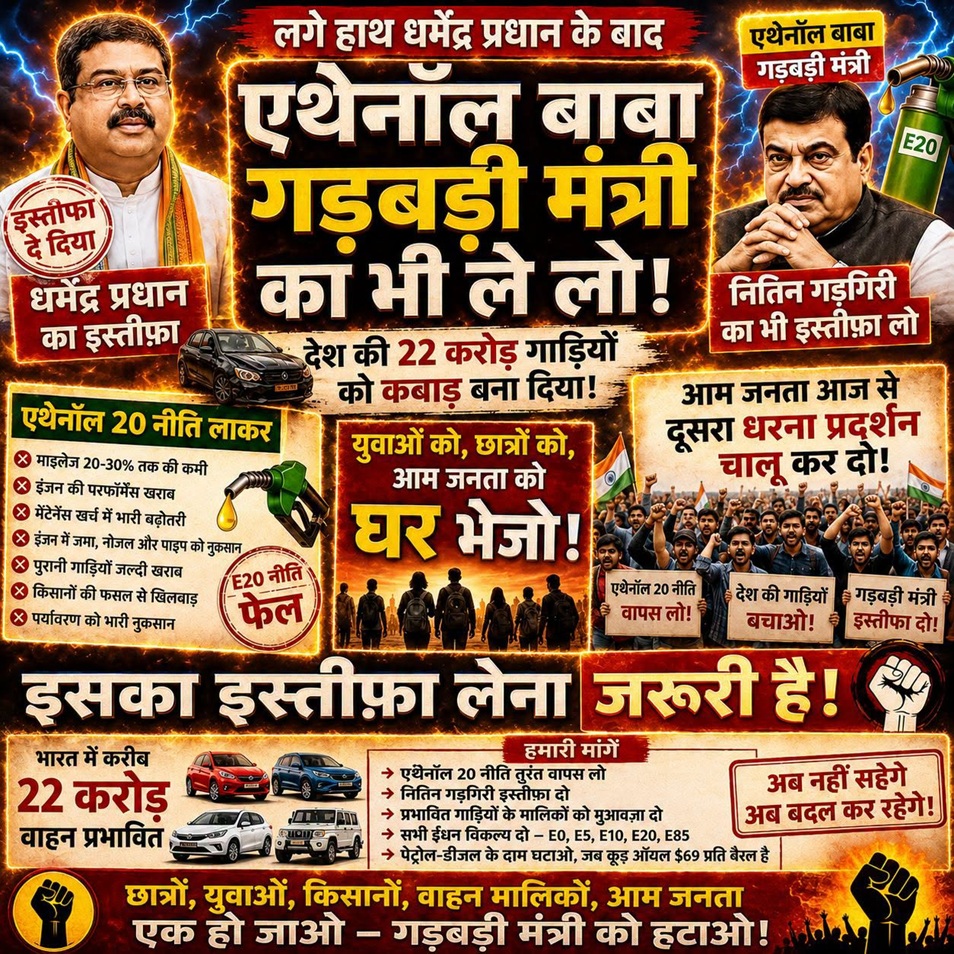
Consumer costs are another unresolved issue. Millions of vehicles operating in India were not originally designed for E20 fuel. NITI Aayog’s ethanol-blending roadmap indicated that using E20 in older vehicles could reduce mileage by an average of 6% to 7%. It recommended pricing E20 petrol at a discount to offset that loss, but no such price differential was introduced. The policy debate therefore extends beyond foreign-exchange savings to fuel expenditure, maintenance costs, agricultural inputs and the financial sustainability of more than 20 billion litres of installed capacity.