India Leads Global Coconut Output as Product Exports Rise 62% to $794.70 Million
India accounted for 31.24% of global coconut production and harvested around 20,301.22 million nuts in 2024-25. Coconut product exports rose 62% to Rs. 7,038.35 crore ($794.70 million) in FY26 as the industry expanded into higher-value processed goods.
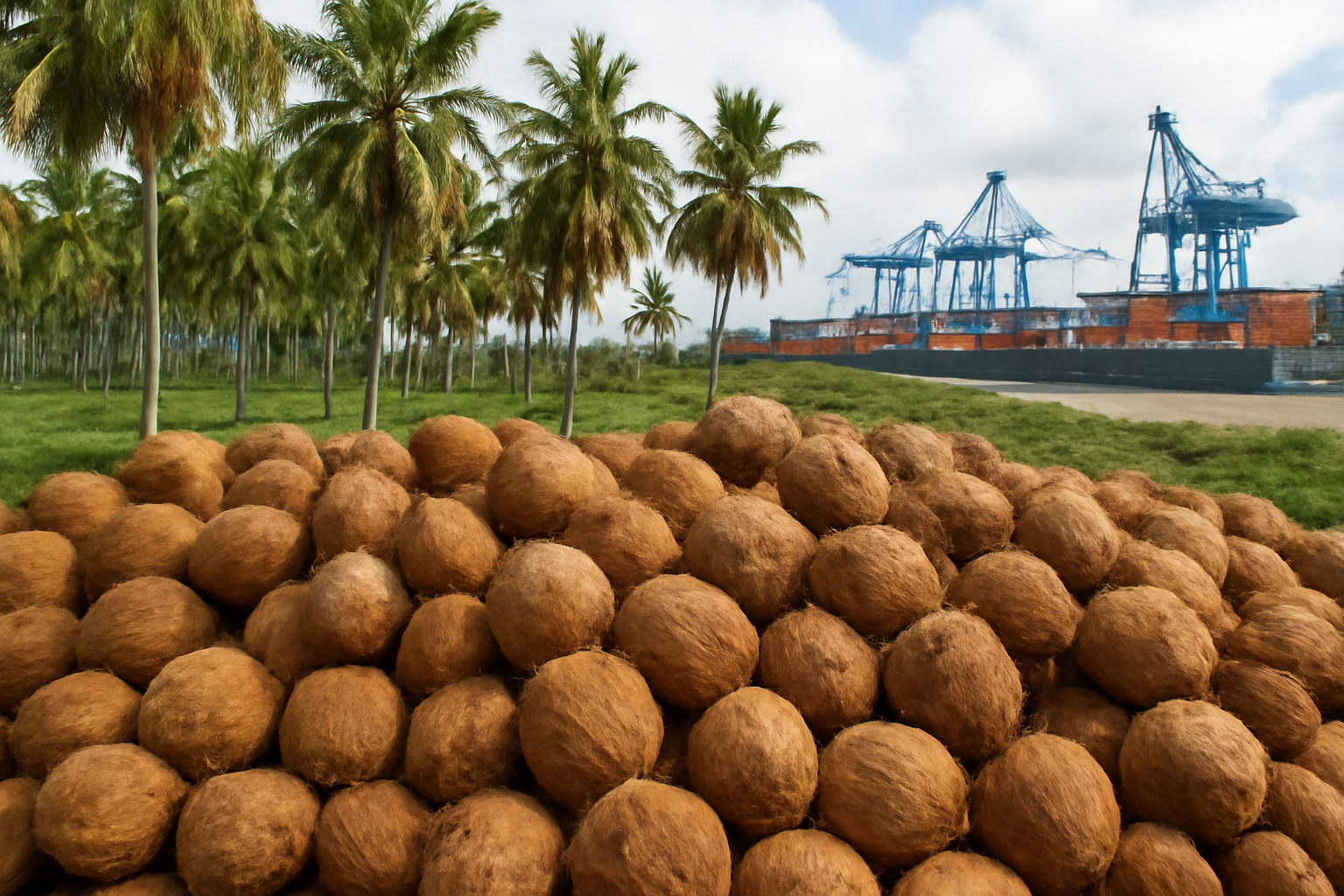
India holds 31.24% of global output
India has become the world’s largest coconut producer, accounting for 31.24% of global production, according to the India Brand Equity Foundation. The country harvested around 20,301.22 million nuts in 2024-25 from 2.19 million hectares. Its coconut industry supports nearly 30 million livelihoods, including those of around 10 million farmers.
The figures underline the sector’s importance to rural employment and agricultural processing. India’s position is based not only on planted area but also on the volume generated across its main coconut-growing regions. The country ranks third globally by cultivation area, with 17.90% of the world total. Production is concentrated in southern and coastal states, where coconut cultivation feeds local food markets and an increasingly diversified processing industry.
Exports shift toward value-added products
India’s coconut product exports increased 62% to Rs. 7,038.35 crore ($794.70 million) in FY26, from Rs. 4,349.03 crore in the previous year, IBEF reported. The increase shows that export growth is moving beyond shipments of basic agricultural material. India’s export basket now includes virgin coconut oil, coconut milk, coconut water, activated carbon, fresh and frozen coconut, copra and other processed products.
This broader product mix allows processors to serve food, beverage and industrial markets while extracting more value from each harvested nut. Virgin oil, packaged water and coconut milk provide access to consumer markets, while activated carbon has industrial applications. Fresh and frozen coconut and copra remain part of the trade alongside these newer categories. By July 31, 2026, the Coconut Development Board had registered 8,700 exporters of coconut products, indicating a large and increasingly formal supplier base.
Public funding targets farms and processing
Government programmes are supporting planting material, productivity, plantation renewal and downstream processing. During 2025-26, Rs. 147.21 crore ($16.65 million) was released for activities under the Coconut Development Board. Eleven Demonstration cum Seed Production Farms produced 241,000 quality seedlings. Around 2,175 hectares entered new coconut cultivation, supported by Rs. 632.77 lakh ($0.72 million) for plantation establishment and maintenance.
The Productivity Improvement through Coconut-based Cropping System programme covered 18,800 hectares and benefited 48,696 farmers. Separately, the Replanting and Rejuvenation of Coconut Gardens programme covered 25,517 hectares over five years. These measures address both expansion and the renewal of older plantations, which is essential for maintaining reliable supplies to processors and exporters.
Expansion depends on consistent raw-material supply
The Union Budget 2026-27 announced a Coconut Promotion Scheme within a Rs. 350 crore allocation for high-value agriculture. The scheme covers quality planting material, plantation expansion, rejuvenation, crop-health management and integrated processing. Its focus links farm-level output with the capacity needed to manufacture export-ready products.
For producers, stronger processing demand can widen sales channels beyond the domestic fresh-nut market. For processors and exporters, the central issue will be securing consistent quality and volume as the number of registered suppliers grows. India’s 31.24% share of global production gives it a substantial raw-material base, while the 62% export increase demonstrates demand for its product mix. Sustaining that growth will depend on plantation productivity, renewal programmes and the industry’s ability to convert output into standardized, higher-value goods for international buyers.