India and China’s synthetic diamonds intensify pressure on African producers
India’s polished synthetic-diamond exports exceeded natural stones by volume in March and April 2026, while China expanded integrated laboratory production. Falling synthetic and natural diamond prices are increasing pressure on Botswana and other African producers to strengthen marketing and local processing.
Synthetic stones overtake natural diamonds by volume
Asian synthetic-diamond production is reshaping a global market traditionally led by natural-stone suppliers including Botswana, Russia and Canada. Benin Web TV reports that India and China have become the principal centers for manufacturing and processing laboratory-grown diamonds, intensifying price competition and weakening the market position of established African producers.
In India, exports of polished synthetic diamonds exceeded natural-diamond shipments by volume in March and April 2026. Data from the Gem & Jewellery Export Promotion Council, cited by analyst Edahn Golan and reported by Benin Web TV, show that India exported 1.4 million carats of synthetic stones in April, compared with 1.3 million carats of natural diamonds.
The value comparison remains markedly different. Synthetic stones accounted for less than 9% of India’s total diamond export revenue because their unit prices are substantially lower. The figures illustrate the market’s central divide: laboratory-grown diamonds are gaining physical volume rapidly, while natural stones continue to command a much larger share of sales value.
Surat and Henan anchor the Asian supply chain
Surat, historically the world’s leading cutting center for natural diamonds, has also become the main processing hub for laboratory-grown stones. That existing base of cutters, equipment and commercial expertise allows Indian companies to handle growing synthetic volumes while retaining a central role in the wider diamond supply chain.
China’s production is concentrated largely in Henan province. Integrated groups including Zhongnan Diamond and Henan Huanghe Whirlwind control operations ranging from the manufacture of synthesis presses to final polishing. This control across multiple production stages supports large-scale output and increases competitive pressure on suppliers that depend on scarce mined resources.
The resulting price decline has already affected corporate strategies. De Beers announced on May 8, 2025, that it would close Lightbox, the synthetic-diamond jewelry brand launched in 2018 with transparent pricing of $800 per carat. The South African-British group said wholesale laboratory-diamond prices had fallen 90% since the brand’s launch, citing Chinese competition and the spread of low-cost supply.
African producers defend natural-diamond value
Benin Web TV describes the first half of 2026 as difficult for established natural-diamond producers, with prices continuing to weaken. The exposure extends beyond Botswana to Angola, Namibia, the Democratic Republic of the Congo and South Africa, as well as non-African suppliers Russia and Canada.
African producing countries have collectively committed 1% of their annual revenue to promotional campaigns emphasizing the rarity and natural origin of mined diamonds. The initiative seeks to preserve differentiation as mass-produced synthetic stones become more widely available, but it also places an additional funding demand on governments and producers already facing weaker prices.
Exceptional stones retain a separate market
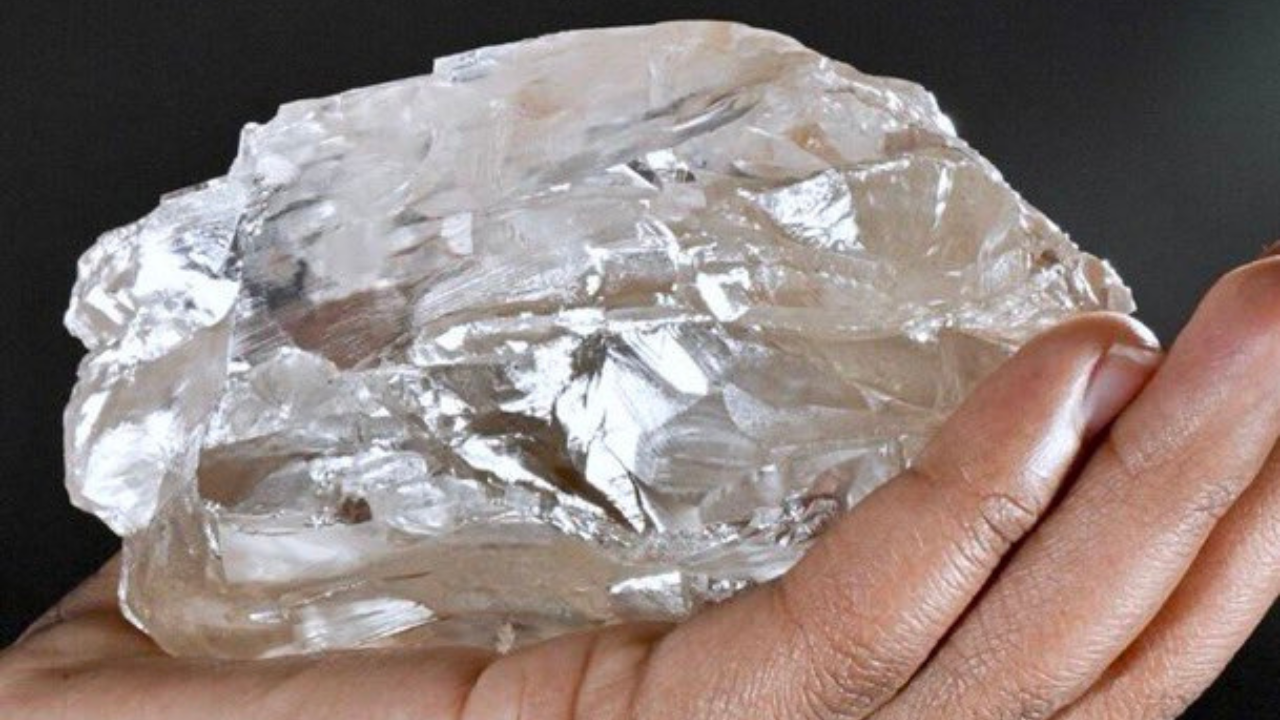
Botswana’s Motswedi diamond shows that exceptional natural stones can still attract buyers. The 2,488-carat rough diamond, recovered by Lucara Diamond from the Karowe mine in August 2024, was sold nearly twenty-two months after its discovery. The sale was announced on August 13, 2026, and completed during the second quarter of 2026, although neither the buyer nor the price was disclosed.
Motswedi is the largest diamond discovered in Botswana and the second-largest gem-quality rough diamond in history, behind the 3,106-carat Cullinan found in South Africa in 1905. Such stones occupy a rarefied segment that laboratory output cannot directly replicate, but they do not remove the pressure facing the broader natural-diamond market.
Rather than competing directly with Chinese and Indian suppliers on price, several industry analysts cited by Benin Web TV advocate greater African investment in cutting and local processing. Capturing more value after extraction could reduce dependence on rough-stone sales. India’s dominance in processing, however, means that building comparable capacity would require African producers to develop skills, equipment and commercial networks alongside efforts to protect the identity of natural diamonds.