India approves 23,731 crore rupee Gobardhan scheme to make Bio-CNG from dung and crop residue
India's central government has approved the Gobardhan scheme with an outlay of 23,731 crore rupees, roughly $2.8 billion, to produce Bio-CNG from cattle dung and crop residue. Indian explainers have framed it as the next step after E20 petrol, but upgraded biomethane is chemically the same methane already sold as CNG. The constraint is feedstock logistics rather than technology.
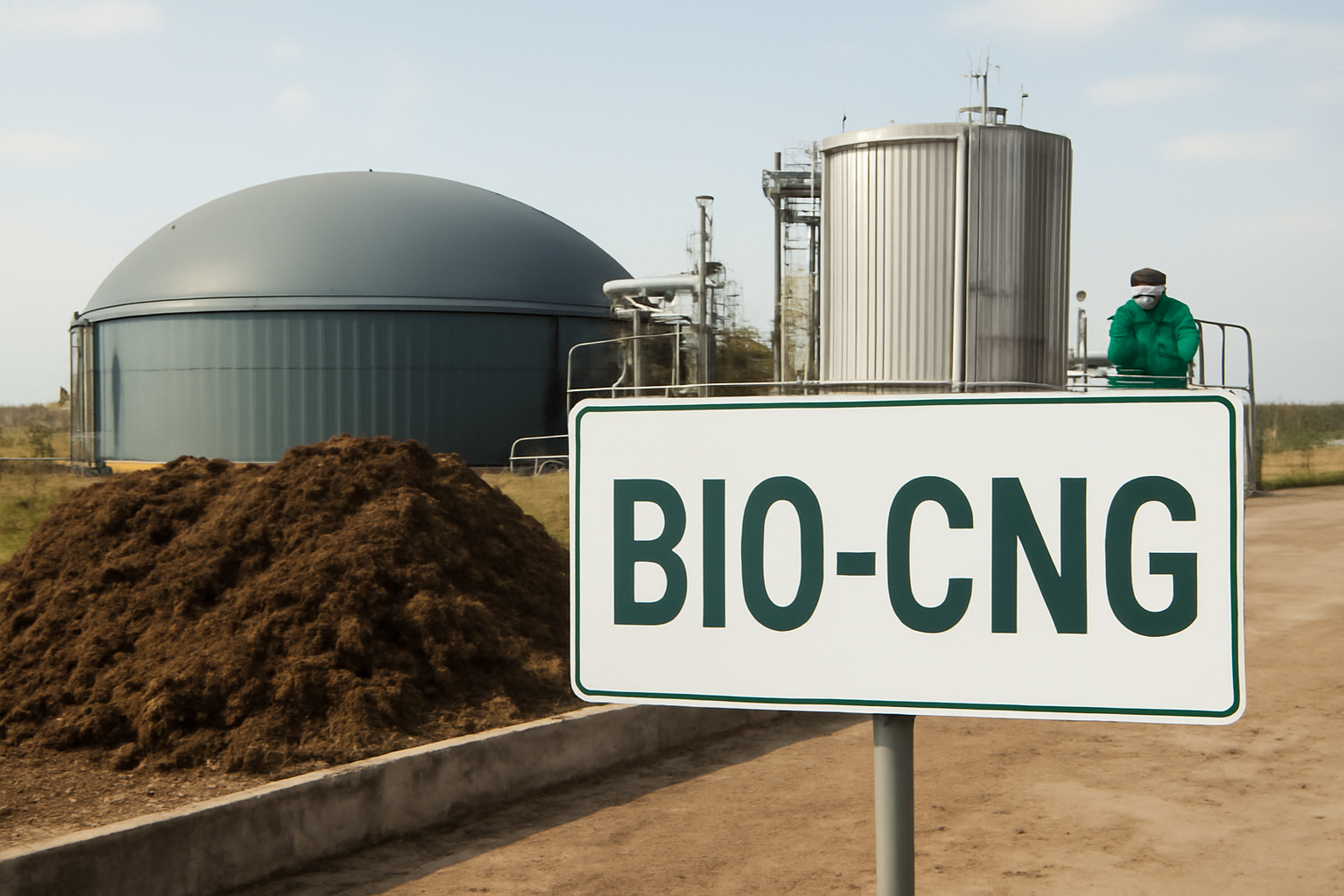
What has been approved
India's central government has cleared the Gobardhan scheme with an outlay of 23,731 crore rupees — about 237 billion rupees, or roughly $2.8 billion — to turn crop residue and cattle dung into Bio-CNG. Indian media explainers have presented the decision as the sequel to E20 petrol, the 20 percent ethanol blend now sold at fuel stations, and have asked whether compressed natural gas is the next fuel to be blended.
The comparison is useful for framing but misleading on the chemistry. Ethanol is a different molecule from petrol, which is why E20 raised questions about engine compatibility and fuel economy in older vehicles. Bio-CNG is upgraded biomethane: once carbon dioxide and impurities are stripped out, it is the same methane that makes up the bulk of fossil CNG. A vehicle running on it needs no modification, and the fuel dispensed at the pump does not change specification.
From dung and stubble to pipeline-grade methane
The production route is anaerobic digestion. Cattle dung and crop residue — parali, the paddy and wheat stubble widely burned after harvest in northern India — are fed into sealed digesters, where bacteria break down organic matter without oxygen. The raw biogas that comes off is a mixture of methane and carbon dioxide, with traces of hydrogen sulphide and water vapour. An upgrading stage removes the carbon dioxide and contaminants, leaving a high-methane gas that can be compressed and dispensed as Bio-CNG or injected into a city gas grid.
The process leaves a second output: digested slurry, which can be sold as organic fertiliser or soil conditioner. That matters for plant economics, because a digester earning only on gas carries a thinner margin than one selling both gas and fertiliser.
What it means for the CNG chain
For city gas distributors, domestically produced biomethane is a molecule that does not have to be imported. India covers part of its gas demand with imported LNG, and volumes injected from Bio-CNG plants displace that at the margin while moving through existing pipelines, compressors and retail stations. No new dispensing infrastructure is required, and no new vehicle fleet.
On the farm side, the scheme puts a price on two materials that today carry little or negative value. Stubble burning is a seasonal air-quality problem across northern India; dung is handled as waste on most smallholdings. A paid offtake route changes the disposal calculus, provided collection actually reaches the farm gate.
That is where the harder part sits. Feedstock is bulky, wet and scattered across millions of holdings, and haulage cost rises quickly with collection radius. Plants need year-round supply, while crop residue arrives in sharp seasonal peaks after harvest. Digesters also need consistent feed quality to hold gas yield.
Open questions
- How the 23,731 crore rupees is split between capital support, operating support and offtake arrangements.
- Whether pricing for biomethane injected into city gas grids is fixed or indexed to another benchmark.
- How feedstock aggregation is organised — through cooperatives, contractors or plant-level procurement.
- How quickly approved capacity converts into commissioned and running plants.
Until those are settled, the sanctioned amount is a statement of intent rather than a volume forecast. The technology is proven and the fuel is fungible with what CNG vehicles already burn; the constraint is logistics, not combustion.