Hokkaido onion processor Greens Kitami grows additive-free soup exports to six markets
Greens Kitami, an onion-processing company backed by JA cooperatives in Hokkaido's Okhotsk district and the city of Kitami, is expanding exports of soups made from locally grown onions. Shipments began in 2020, after the pandemic wiped out the firm's souvenir sales, and now reach six countries and territories. The additive-free line is one of the products carrying the expansion.
Greens Kitami, an onion-processing company backed by Japan Agricultural Cooperatives (JA) organisations in Hokkaido’s Okhotsk district and by the city of Kitami, is increasing exports of processed foods made from locally grown onions, The Japan Agricultural News reported. Shipments began in 2020 and now reach six countries and territories.
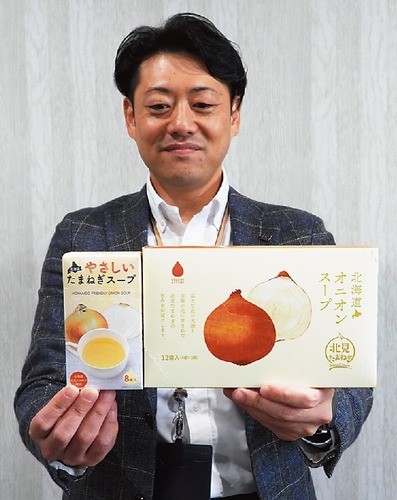
The export range is built around two soups:
- “Hokkaido Onion Soup”, the company’s established core product;
- “Hokkaido Yasashii Tamanegi Soup” (Hokkaido Gentle Onion Soup), produced without food additives.
A souvenir business forced overseas
The move into exports was not a long-planned diversification. According to The Japan Agricultural News, the trigger was the coronavirus pandemic that spread worldwide in 2020. Sales had been growing steadily until then, but the souvenir channel — the company’s main outlet — slumped, and production fell with it.
The mechanics of that shock are specific to Japan’s gift-food sector. Souvenir products are sold through airports, railway stations, roadside stations and tourist facilities, and their volumes track visitor numbers almost one for one. When travel stopped, the shelf space did not shrink gradually — it disappeared. For a processor that had sized its onion intake and its production planning around that channel, the only fast alternative to idle capacity was a different set of buyers.
Additive-free as a trade specification
The prominence of the additive-free line in the export range is commercially significant. Food-additive rules are among the most common non-tariff frictions in processed-food trade: permitted substances, maximum levels and labelling requirements differ between jurisdictions, and a recipe cleared in one market can require reformulation, retesting or relabelling in another. A product formulated without additives removes much of that problem at source and shortens the work needed to register it in an additional country.
It is also a claim that carries across borders with little translation risk, and it aligns with the clean-label positioning that dominates premium retail in most developed food markets. For a soup, however, it is a harder specification than it sounds: without flavour enhancers, the taste has to come from the onion itself. That puts the weight back on raw-material quality — precisely what a processor part-owned by the growers’ cooperatives is structured to control.
The raw material base
Kitami and the surrounding Okhotsk district are among Japan’s best-known onion-growing areas, and the shareholder structure of Greens Kitami ties the plant directly to that supply base. Local JA organisations and the municipality hold stakes, which means the company is not simply a buyer of onions but an outlet co-owned by the cooperatives that grow them and by the local authority.
That structure changes how export growth should be read. A privately held processor can switch sourcing or shift product mix when returns fall. A cooperative-backed venture exists largely to absorb regional production and add value to it locally, so the relevant measure is less the margin on each pack than the volume of regional onions the business keeps moving — and how stable that offtake is when domestic demand turns.
What the report does not specify
- the identity of the six destination countries and territories;
- export volumes or value, in absolute terms or as a share of total sales;
- the rate of export growth;
- how far the souvenir channel has recovered since 2020.
Without those figures the scale of the business cannot be assessed, and the export operation may still be small relative to domestic sales. The direction, however, is documented: a regional, cooperative-backed processor that lost its main channel in 2020 now sells in six markets, with an additive-free product line among the goods carrying that expansion.