High prices cut South Korean meat spending as imported pork sales rise 44.3%
South Korean households reduced meat spending last year despite a rise in overall real expenditure, with the steepest decline among households earning no more than 1 million won a month. Imported pork sales volume rose 44.3% in the first half of this year as consumers became more price-sensitive.
Meat loses share of household budgets
Persistent high prices are reshaping animal-protein demand in South Korea, reducing household spending on meat while supporting sales of imported pork and eggs. Edaily reported the changes from a third-quarter 2026 livestock industry analysis prepared by NH Investment & Securities at the request of the Korea Institute for Animal Products Quality Evaluation.
Real household expenditure among households with at least two members increased 0.9% last year, but average monthly meat spending per household fell 1.7%. Spending on dairy products and eggs declined 0.7%. Meat accounted for 2.2% of household expenditure, down from 2.6% in 2021, while the share for dairy products and eggs decreased from 1.15% to 1.01% over the same period.
The report linked the trend to weaker purchasing power under high inflation, a shift toward better-value foods and growth in the number of one- and two-person households. The figures indicate that consumers are not cutting every food category equally: products seen as expensive or discretionary face greater pressure than lower-cost protein sources.
Low-income households make the deepest cuts
The contraction was most pronounced among households earning no more than 1 million won a month. Their average monthly meat expenditure dropped 13.7% year on year. Spending fell 1.1% for households earning 1 million to 2 million won, 0.4% for those earning 2 million to 3 million won, 4.0% in the 3 million-to-4 million-won bracket and 3.7% among households earning more than 4 million won.
By contrast, dairy and egg spending among households in the lowest income group declined only 0.3%. The report said eggs were serving as a substitute because they provide protein and nutrition at a comparatively low cost. Price has also become a more prominent purchasing criterion. The weighted share of consumers who checked price first when buying livestock products rose from 15.2% in 2024 to 17.7% last year, according to an analysis of the Korea Rural Economic Institute’s food consumption survey. Among households earning no more than 1 million won, the proportion reached 24.0%.
Imported pork and eggs gain ground
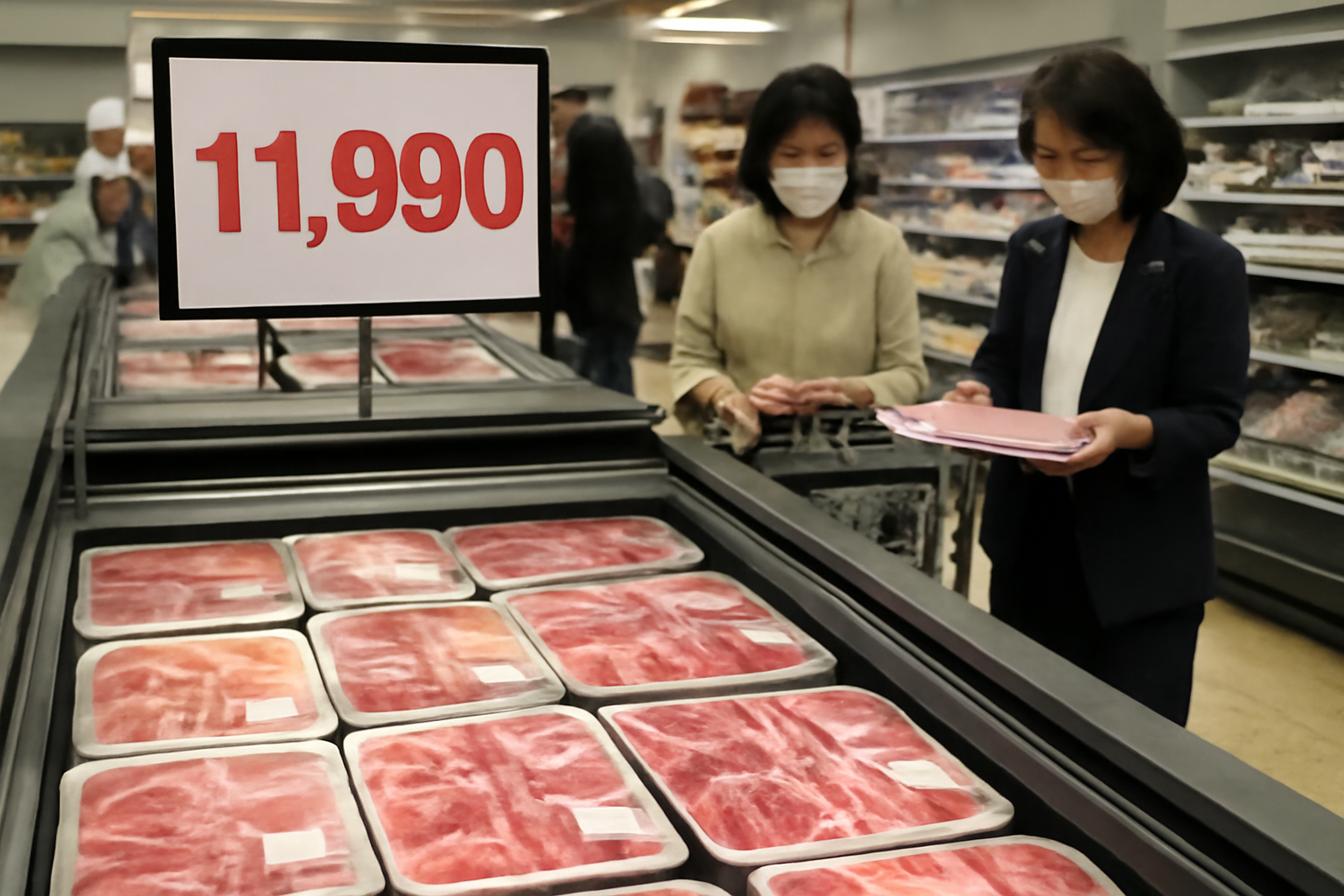
Price sensitivity was particularly visible in pork. Imported pork sales volume increased 44.3% year on year during January-June, while sales value rose 45.5%, according to data from the Korea Institute for Animal Products Quality Evaluation cited by Edaily. Domestic pork recorded much smaller increases of 0.7% in volume and 3.1% in value. Online sales of pork from the United States, Canada and Spain expanded as domestic prices rose and supply conditions changed.
In July, consumer prices for domestic pork belly and front leg were respectively 5.9% and 5.3% higher than a year earlier. Beef performed more weakly: first-half sales volumes declined for both domestic and imported beef. In May alone, total beef sales volume fell 11.3% year on year and sales value decreased 6.4%. Domestic tenderloin cost 15,079 won per 100 grams, compared with last year’s average of 13,224 won.
Egg sales volume rose 3.0% in the first half and sales value increased 12.9%, reflecting higher prices as well as continued demand for a meat substitute. In last year’s consumer survey, 65.2% of respondents said they bought eggs in trays of 30, while 39.7% reported purchasing them once every two weeks. The report expects the market to divide further between value products and premium domestic meat. It recommended emphasizing quality, freshness and safety for Korean beef and pork, while diversifying online sales models, including subscriptions, for eggs and imported pork.