Hebei and Vietnam target two-way agricultural trade through direct rail links
Hebei and Vietnam are seeking to expand two-way agricultural trade by combining complementary production with a direct freight railway between northern China and Hanoi. Market access will depend on cold-chain reliability, quarantine compliance, traceability and approved growing-area and packing-facility codes.
Complementary agricultural supply
Hebei province and Vietnam are exploring deeper agricultural trade and supply-chain cooperation as improving rail connections create another route between northern China and Southeast Asia. The plans were discussed on August 19 at the 2026 Hebei-Vietnam Agricultural Cooperation Promotion Program, organized by Vietnam’s Agricultural Trade Promotion Center under the Ministry of Agriculture and Environment.
Li Dan, head of international cooperation at Hebei’s Department of Agriculture and Rural Development, described a large provincial production base spanning about 188,800 square kilometers, with 73.78 million residents and roughly 6 million hectares of cultivated land. Hebei has developed large-scale, standardized agriculture around grain and vegetable oil, vegetables, fruit, medicinal plants, dairy and livestock. That production profile differs from Vietnam’s strength in tropical crops, creating scope for trade in both directions rather than a single export flow.
Hebei production supports wider market reach
Hebei’s agriculture, forestry and fisheries sector generated value added of 451.45 billion yuan in 2025, ranking sixth in China, according to Thoi Bao Tai Chinh Vietnam. Grain output remained above 35 billion kilograms for a 14th consecutive year. Vegetable production exceeded 58 million tonnes, while fruit output reached 12.544 million tonnes. The province is particularly strong in pears, chestnuts, sea buckthorn, grapes, dairy products and livestock.
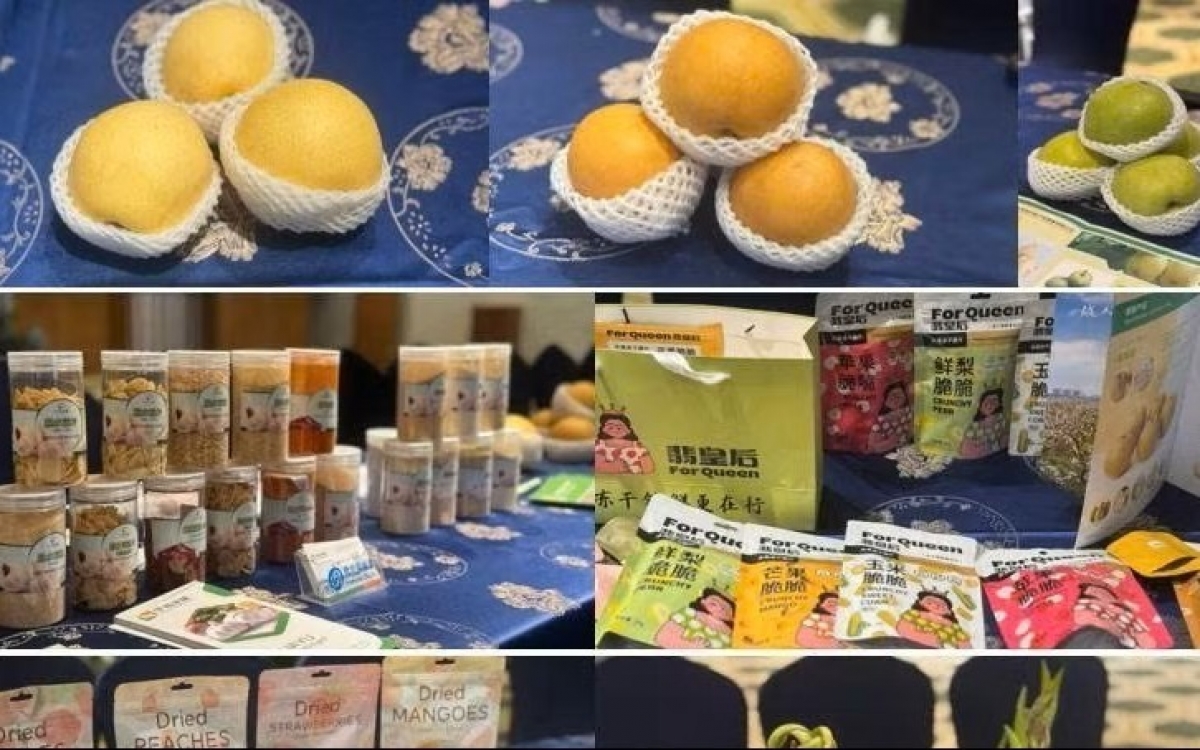
Hebei exported $2.57 billion of agricultural products to 174 countries and territories in 2025. Provincial officials see Vietnam as both a destination for Hebei’s vegetables, pears, mushrooms, grain and other temperate products and a supplier of tropical produce to northern China. Chinese demand is already important for Vietnamese agriculture, especially tropical fruit, while Vietnamese buyers require a range of Chinese temperate agricultural goods. A broader corridor could therefore diversify supply for importers and extend the commercial reach of producers on both sides.
Direct railway changes the logistics equation
The ASEAN freight train linking the Beijing-Tianjin-Hebei region directly with Hanoi began operating in March 2025. Its departure point is Jize in Handan, Hebei, and the service supports return journeys. The route gives agricultural traders another transport option and is intended to shorten delivery times. For perishable cargo, however, the practical value of the railway will depend on storage conditions, predictable schedules and stable connections before and after the rail leg.
Nguyen Minh Tien, director of the Agricultural Trade Promotion Center, said transport time, preservation capacity and logistics stability are particularly important for agricultural products. Hoang Van Du, the center’s deputy director, identified fruit and vegetable supply chains connecting Vietnam, China and Hebei as an area for deeper development. Participants also stressed that logistics alone will not secure market access. Businesses must meet requirements covering quality, food safety, quarantine, traceability, growing-area codes and packing-facility codes. These controls will determine whether the proposed corridor can support regular, long-term trade rather than occasional shipments.