Green Ammonia Projects Bring Fertilizer Production Closer to Agricultural Regions
Projects in the United States, Denmark, China and France are testing local production of green ammonia using renewable electricity, atmospheric nitrogen and water. The model could reduce exposure to natural gas prices and transport costs, but its competitiveness depends on cheap power, industrial-scale infrastructure and regulatory approval.
Renewable power challenges the gas-based fertilizer model
Agricultural cooperatives and energy companies are developing green ammonia plants near major farming regions, seeking to reduce fertilizer producers’ dependence on natural gas and international supply chains. According to AgroNotizie, the emerging model is not based on individual farms operating small fertilizer machines. Instead, it centers on industrial installations serving cooperatives, consortia or entire agricultural districts.
Conventional ammonia production combines atmospheric nitrogen with hydrogen through the Haber-Bosch process. It requires large amounts of energy and is generally most competitive where low-cost natural gas is available. That dependence exposes fertilizer users to energy-price movements, geopolitical tensions and disruptions involving gas-exporting regions such as Russia, the Persian Gulf and North Africa.
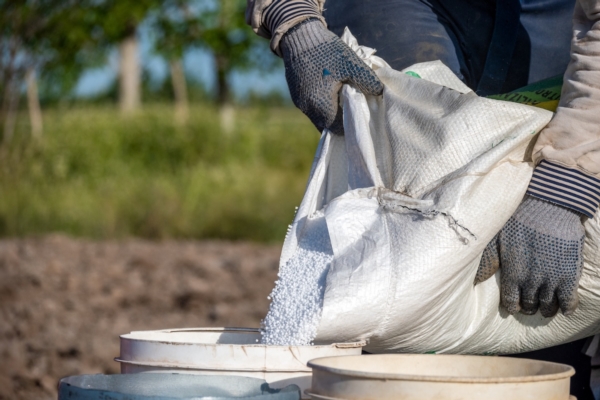
Green ammonia substitutes hydrogen produced from natural gas with hydrogen obtained by electrolyzing water. Nitrogen is separated from the air, while renewable electricity powers electrolysis and ammonia synthesis. The resulting ammonia can be applied directly to soil, as is common in the United States, or processed into urea, ammonium nitrate and other nitrogen fertilizers.
Minnesota project targets cooperative demand
In Minnesota, TalusAg, agricultural cooperative Central Farm Service and environmental traceability organization CleanCounts are promoting a project involving two modular production systems. AgroNotizie reports that each unit would be capable of producing up to 20 tonnes of ammonia per day using air, water and electricity supplied by wind-power producer Blue Earth Light & Water.
Together, the installations could cover more than two-thirds of Central Farm Service’s annual ammonia sales and supply approximately 40,000 hectares. The project remains conditional on receiving public support from Minnesota’s Renewable Development Account.
Local output could reduce fertilizer transport requirements and limit farmers’ exposure to international market volatility. In the United States, anhydrous ammonia can be carried in pressurized tanks and injected directly into the soil, typically in autumn or spring. After contact with soil moisture, it converts into ammonium and provides a nitrogen reserve for crops.
The operating model is less straightforward in Europe, where direct application of ammonia is considerably less common. European projects are therefore more likely to treat green ammonia as an intermediate product for manufacturing urea and nitrate fertilizers.
Projects test different scales and technologies
At Ramme in northwestern Denmark, Topsoe, Skovgaard Energy and Vestas have started what they describe as the first dynamic green ammonia plant. The facility uses 62 megawatts of solar and wind capacity and can produce about 5,000 tonnes of ammonia annually, according to AgroNotizie.
Its process can adjust to changes in wind and solar generation, unlike conventional ammonia plants designed for continuous operation. The demonstration is intended to determine whether flexible production can reduce the need for expensive electricity or hydrogen storage.
China is pursuing the concept on a much larger scale. Envision Energy’s complex at Chifeng in Inner Mongolia began its first phase in 2025 with declared annual capacity of 320,000 tonnes of green ammonia. Integrating wind power, solar generation, electrolysis and ammonia synthesis, the development is designed eventually to reach 1.52 million tonnes per year.
Elsewhere in Europe, Swedish startup NitroCapt has partnered with French agricultural cooperative Vivescia. Following a pilot phase in Sweden, the companies plan a demonstration installation in Champagne-Ardenne. If agronomic trials and scaling are successful, subsequent plants could supply the fertilizer requirements of at least 750,000 hectares, with the first units expected to operate by 2028.
Power costs and industrial requirements remain decisive
Despite the emphasis on agricultural self-sufficiency, even modular ammonia facilities require hydrogen production, air separation, high-pressure and high-temperature equipment, water, power connections, storage tanks, fire protection and specialist staff. Ammonia and hydrogen also require extensive safety controls, while each facility is regulated as an industrial chemical plant.
Economies of scale therefore favor large cooperatives, industrial groups and partnerships with energy companies rather than individual growers. AgroNotizie notes that the economics depend primarily on access to inexpensive electricity, particularly in regions with strong wind or solar resources or renewable output that cannot be absorbed by the grid.
Where those conditions are absent, green fertilizer may remain more expensive than conventional material. The likely outcome is consequently not complete self-sufficiency at farm level, but regional fertilizer hubs capable of converting locally generated renewable power into a strategic agricultural input.