Greece forms nuclear energy committee to assess national program within 24 months
Greece has established a government committee to examine whether nuclear power should enter the country’s energy strategy. The body, chaired by Deputy Environment and Energy Minister Nikos Tsafos, must deliver its final report within 24 months.
Government opens formal nuclear review
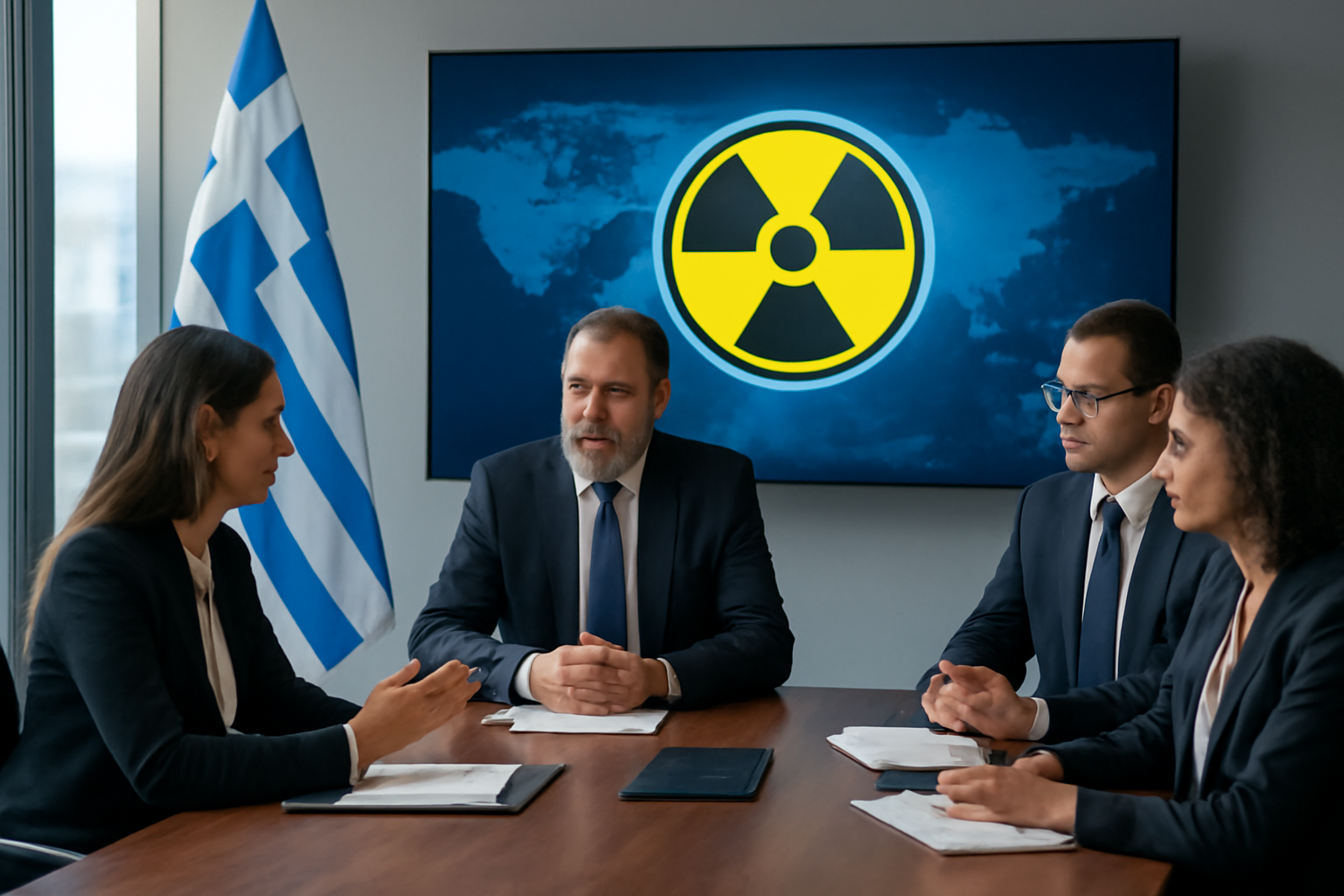
Greece has established a Government Committee for Nuclear Energy to investigate whether the country should launch a national nuclear power program. The committee was created by a decision of the prime minister and the cabinet, according to Energypress, marking the first formal institutional step in Greece’s assessment of the technology.
Deputy Environment and Energy Minister Nikos Tsafos will chair the committee. Its members include the relevant secretaries-general from government ministries, including the Ministry of National Defence and the Ministry of Foreign Affairs, as well as the heads of the Greek Atomic Energy Commission and the Demokritos research center and a vice-president of the Regulatory Authority for Waste, Energy and Water.
The committee may also invite the heads of electricity transmission operator IPTO, distribution operator HEDNO, the Centre for Renewable Energy Sources and Saving, the Technical Chamber of Greece and the Hellenic Federation of Enterprises. Experts may participate by invitation, giving the review access to technical, industrial and power-market perspectives.
Final recommendation due within 24 months
The new body will act as Greece’s Nuclear Energy Programme Implementing Organization under procedures established by the International Atomic Energy Agency. It will manage Phase 1, the IAEA’s exploratory phase, and submit a final report to the cabinet within 24 months of its formation. That report will recommend whether Greece should proceed with a national nuclear energy program.
The work program covers 19 categories identified by the IAEA. It includes an analysis of institutional gaps, preliminary feasibility studies, a cost-benefit assessment and a roadmap setting out the actions and timetable required if the government decides to proceed. The final document must summarize the feasibility work and provide a technical recommendation for or against starting the program.
Energypress reported that the committee will meet regularly every two months. It can also hold extraordinary meetings when requested by its chair or the environment and energy minister. The body will coordinate participating institutions, commission preparatory studies, brief the cabinet when requested and represent Greece on nuclear issues before the IAEA, European Union bodies, the International Energy Agency and other international institutions.
Costs, safety and technology enter the assessment
The committee’s mandate does not constitute a decision to build a nuclear plant. It is designed to determine whether nuclear generation fits Greece’s energy mix, under what assumptions it could reduce consumer costs, and whether potential benefits for energy security justify the financial and operational risks. Financing, governance, legal requirements, regulation and a realistic implementation timetable are all within its remit.
The review can compare conventional reactors with small modular reactors, assessing their cost, safety, technological maturity and compatibility with the Greek power system. It may also examine potential nuclear applications in shipping, non-interconnected islands, microgrids, industry and data centers. Fuel-cycle management and possible amendments to the National Energy and Climate Plan are included in the committee’s responsibilities.
Tsafos said the committee has two immediate purposes: improving public discussion through evidence from other countries and answering the practical questions that would determine whether a Greek program is viable. For power companies, industrial consumers and potential investors, the next 24 months are therefore an evaluation period rather than a procurement or construction phase. The report will establish whether Greece advances to the next stage and what institutional work would be required before any investment decision.