Global pork trade fragments as weaker Chinese demand intensifies competition
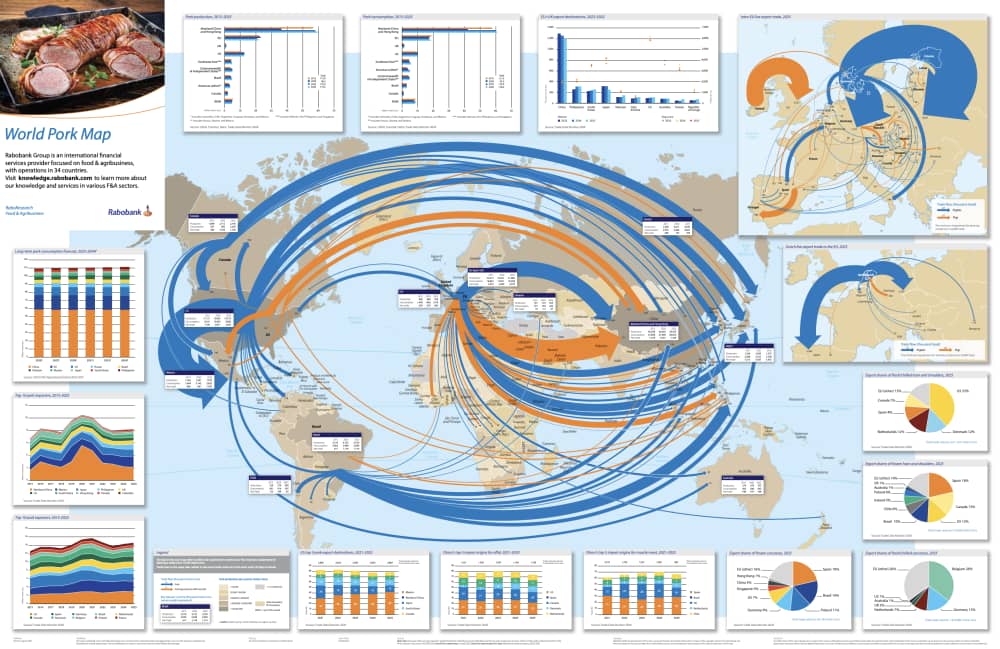
Reduced Chinese buying is pushing pork exporters to diversify their destinations, according to Rabobank’s World Pork Map 2026. The shift is fragmenting global trade and increasing competition among producing regions.
Chinese buying loses its central role
Global pork trade is becoming more fragmented as reduced demand from China forces exporters to seek a broader range of destinations, according to Rabobank’s report “World Pork Map 2026: Competition intensifies in a more fragmented pork market.” The findings, reported by Eurocarne, point to a market in which access to several buyers is becoming more important than reliance on one dominant destination.
China has been a central outlet for internationally traded pork, giving changes in its purchasing an influence that extends across producing regions. Rabobank’s assessment indicates that weaker Chinese buying is now changing that pattern. Exporters must distribute more volume among alternative markets, while suppliers that previously occupied different commercial channels increasingly compete for the same customers.
Exporters diversify their destinations
Diversification can reduce dependence on a single market, but it also makes commercial execution more demanding. Producers and processors need to match products with the specifications, consumer preferences and sales channels of multiple destinations. Traders must maintain a wider network of buyers and respond to a market in which demand is spread more broadly.
The shift may be particularly significant for companies whose production, processing or product mix was developed around Chinese demand. Finding another buyer does not necessarily reproduce the same commercial result. Different markets may require other cuts, packaging formats or customer relationships, and competition for those outlets becomes stronger when several exporting regions pursue them simultaneously.
For importers outside China, the fragmented trade environment could create more opportunities to source pork from competing suppliers. Their negotiating position may strengthen where exporters need additional outlets. However, the outcome will depend on whether products available from international suppliers correspond to local demand and market-access requirements.
Competition spreads across producing regions
Rabobank’s report frames intensifying competition as a defining feature of the changing pork market. The pressure is no longer concentrated solely on winning access to China. Exporters must defend positions across a larger collection of destinations, making market access, customer relationships and the ability to place different products increasingly important.
This broader rivalry also connects domestic production decisions with conditions in multiple foreign markets. When a major destination buys less, volumes must be redirected, absorbed at home or otherwise balanced through production and processing decisions. Companies with diversified sales portfolios may be better placed to manage that adjustment than businesses concentrated on a narrow set of customers.
A less concentrated trade system
The emerging structure does not mean that China has ceased to matter. It means that exporters can no longer assume Chinese demand will play the same role in absorbing internationally available pork. Rabobank’s map instead describes a trade system with more destinations, overlapping suppliers and stronger competition between producing regions.
For industry professionals, the central issue is therefore not only total export volume but where each product can be sold and which suppliers are competing for that demand. Producers, processors and traders will need to monitor destination-level conditions more closely as the global pork market becomes less concentrated and commercial advantages are tested across a wider set of buyers.