Ghana’s tomato shortfall and ginger collapse push up food import costs
Ghana spends more than US$230 million annually on tomato imports, while local output covers only 15% to 18% of demand, CSIR researchers said. A bacterial wilt outbreak has also reduced ginger production to roughly 10 tonnes and left the country more than 99% dependent on imports.
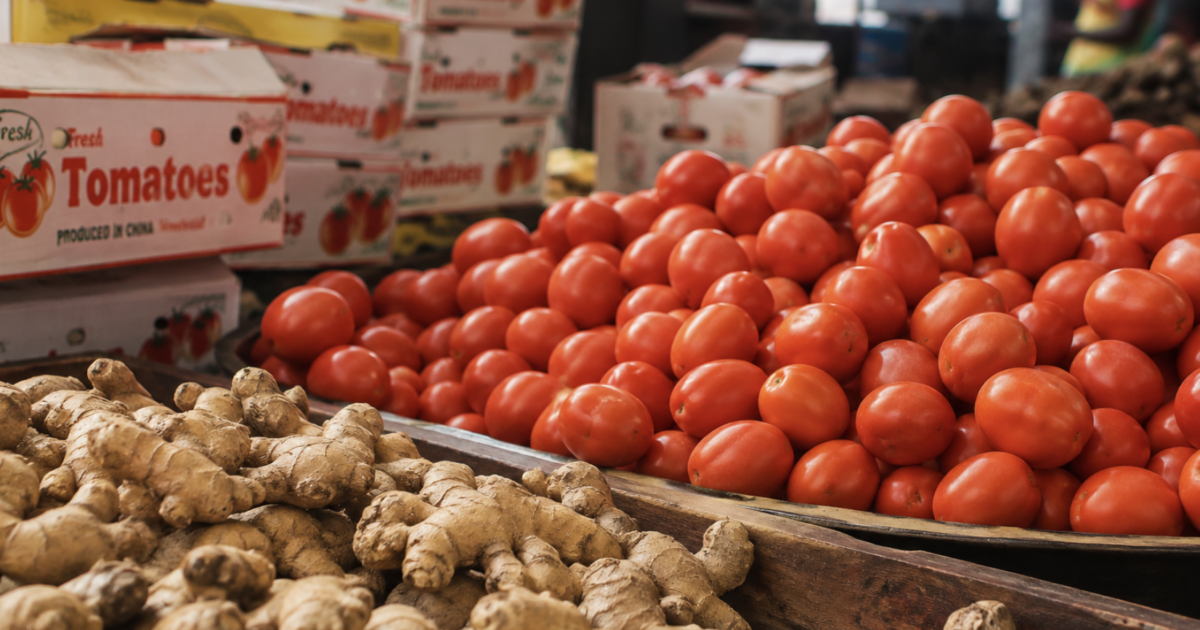
Tomato deficit exceeds 1 million tonnes
Ghana’s domestic tomato industry supplies only a fraction of national requirements, increasing dependence on fresh and processed imports. Speaking during the 2026 Ministry of Environment, Science, Technology and Innovation Visibility Webinar Series, researchers from the Council for Scientific and Industrial Research said annual demand for fresh and processed tomatoes exceeded 1.4 million metric tonnes.
Dr Michael Kwabena Osei of the CSIR Crop Research Institute estimated local production at 120,000 to 180,000 metric tonnes a year from 25,000 to 30,000 hectares, meeting about 15% to 18% of demand and leaving a deficit of roughly 1.1 million metric tonnes. MyJoyOnline also reported an estimate from Dr Richard Yaw Agyare of the CSIR Savannah Agricultural Research Institute that national output had stagnated at about 360,000 tonnes annually for nearly a decade. The researchers used different production estimates, but both described a large and persistent supply gap.
Ghana imports an estimated 100,000 to 120,000 metric tonnes of fresh tomatoes annually, mainly from Burkina Faso, at a cost of about US$18 million. Processed tomato imports, largely from China and Europe, are equivalent to 400,000 to 450,000 metric tonnes of raw tomatoes and cost about US$150 million. Dr Osei said combined tomato imports exceeded US$230 million a year but covered only about 40% of the shortfall.
Low yields and seasonal supply pressure
More than 60% of fresh tomato imports arrive between November and April, when Ghana’s dry season sharply reduces domestic supply. Average yields remain between seven and 10 tonnes per hectare despite potential yields of 20 to 80 tonnes with improved varieties and agronomic management. Dr Agyare put national productivity at about 7.8 tonnes per hectare, compared with 94 tonnes in Morocco and 17 tonnes in Burkina Faso.
The constraints include weak seed systems, bacterial wilt, nematodes, acidic and depleted soils, heat stress, limited extension services and inadequate irrigation. Only about 9,000 hectares of the 15,000 hectares served by 22 public irrigation schemes are currently in use. Although more than 400,000 hectares of arable land are considered suitable for tomatoes, temperatures above 32 degrees Celsius can cause crop failure and restrict dry-season production.
About 89% of tomato farmers cultivate between five and 20 acres, while some use seed taken from ripe fruit or recycle hybrid seed that has lost vigour. More than 85% of planted tomato seed is expensive commercial hybrid seed. Processing capacity is also weak: the state-owned Pwalugu Tomato Factory, established in 1961 with capacity of 500 tonnes per day, has been non-functional for years, while private processors rely heavily on imported concentrate.
Ginger output falls to roughly 10 tonnes
Ghana’s ginger sector suffered a sharper collapse after an outbreak of bacterial wilt in 2022. National demand rose from about 18,000 tonnes in 2020 to 30,000–32,000 tonnes in 2025, but production fell from about 102 tonnes to roughly 10 tonnes. The country is now more than 99% dependent on imported ginger and spends about US$500,000 annually on supplies mainly from China, Nigeria and Burkina Faso.
The shortage has pushed the price of a sack of ginger from about GH¢250 in 2022 to GH¢4,000 in 2025 and GH¢6,000 or more at the time of the webinar. CSIR’s recovery proposals include resistant varieties, disease-free planting material produced through tissue culture, certified seed and rhizomes, surveillance, integrated pest management, solar-powered boreholes and better soil management. Researchers also proposed establishing a Tomato Board by 2028 and a dedicated Horticultural Research Institute by 2030 to coordinate research, production, processing and finance.