Ghana's food import bill reached GH¢36.46 billion in 2025, led by cereals and frozen chicken
Ghana spent GH¢36.46 billion on food imports in 2025, according to the Ghana Statistical Service's Annual International Merchandise Trade Statistics Report. Processed cereal grains, frozen chicken, animal offal and rice together accounted for 30 percent of the bill. Cocoa products, cashew nuts, tuna and shea-based goods lead the export side.
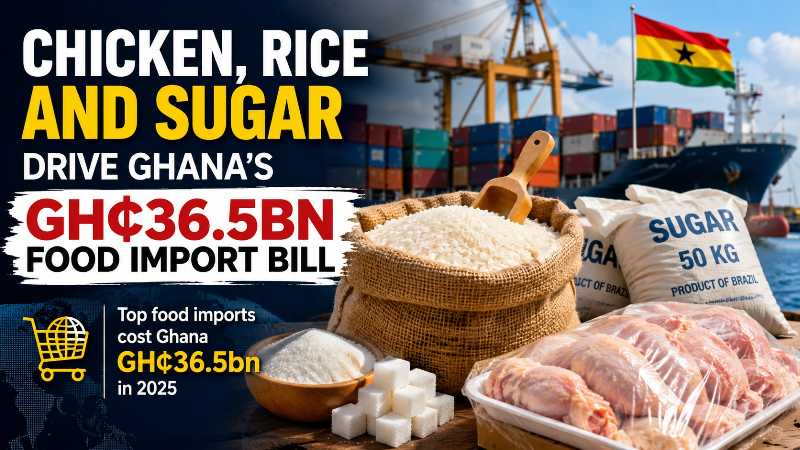
Ghana spent GH¢36.46 billion on food imports in 2025, according to the latest Annual International Merchandise Trade Statistics Report from the Ghana Statistical Service. Cereal grains, frozen chicken, animal products and rice accounted for the largest share of that spending, underlining continued reliance on foreign supplies to meet domestic demand for staple foods and protein.
The figures were reported by businessghana.com, which described the bill as more than GH¢36.5 billion while citing the statistical service's valuation of GH¢36.46 billion. The report frames the total as evidence of persistent food import dependence, even as Ghana expands agricultural production and pursues import substitution.
Four product lines account for 30 percent
Processed cereal grains were the single largest food import at GH¢2.94 billion, equal to 8.1 percent of total food imports. Frozen chicken ranked second at GH¢2.84 billion, followed by animal guts, bladders and stomachs at GH¢2.72 billion. Semi-milled or wholly milled rice came in at GH¢2.39 billion, with broken rice adding a further GH¢1.19 billion.
The leading items break down as follows:
- Processed cereal grains — GH¢2.94 billion, or 8.1 percent of food imports
- Frozen chicken — GH¢2.84 billion
- Animal guts, bladders and stomachs — GH¢2.72 billion
- Semi-milled or wholly milled rice — GH¢2.39 billion
- Broken rice — GH¢1.19 billion
Taken together, processed cereal grains, frozen chicken, animal products and rice made up 30 percent of Ghana's food import bill. Sugar, frozen fish, palm oil, mangoes and shea nuts were also listed among the country's major food imports.
Protein and staples drive the exposure
The composition of the bill points to two distinct pressure points. The first is grain: processed cereal grains plus the two rice categories represent the bulk of Ghana's imported carbohydrate supply, a segment where domestic output and milling have not matched consumption. The second is animal protein, where frozen chicken and animal offal together were valued at GH¢5.56 billion, ahead of the GH¢3.58 billion spent on milled and broken rice combined.
Frozen fish, sugar and palm oil sit alongside these as recurring import lines, spreading the exposure across several commodity groups rather than concentrating it in one. For importers and distributors, that mix means demand is broad-based; for domestic processors, it defines where substitution capacity would have to be built.
Export side rests on cocoa, cashew, tuna and shea
On the export side, the Ghana Statistical Service report points to growing opportunities in value-added agriculture and agro-processing. Processed cocoa products, cashew nuts, tuna and shea-based products are identified as important contributors to Ghana's food export profile.
The contrast is direct: Ghana earns from processed and semi-processed cash crops while paying out for staples and protein consumed at home. The report identifies stronger domestic production, agro-processing and value addition as critical to reducing import dependence and improving the resilience of the agricultural economy.
Shea appears on both sides of the ledger, with shea nuts among the major imports and shea-based products among the exports. That split suggests processing capacity, rather than raw material availability alone, determines where value is captured in Ghana's agricultural trade.