Germany Ranks Third in Industrial Robot Density as SME Adoption Lags
Germany had 449 industrial robots per 10,000 manufacturing employees, behind only South Korea and Singapore. Yet adoption remains uneven, while falling automotive orders and a weaker economic outlook are weighing on the domestic automation industry.
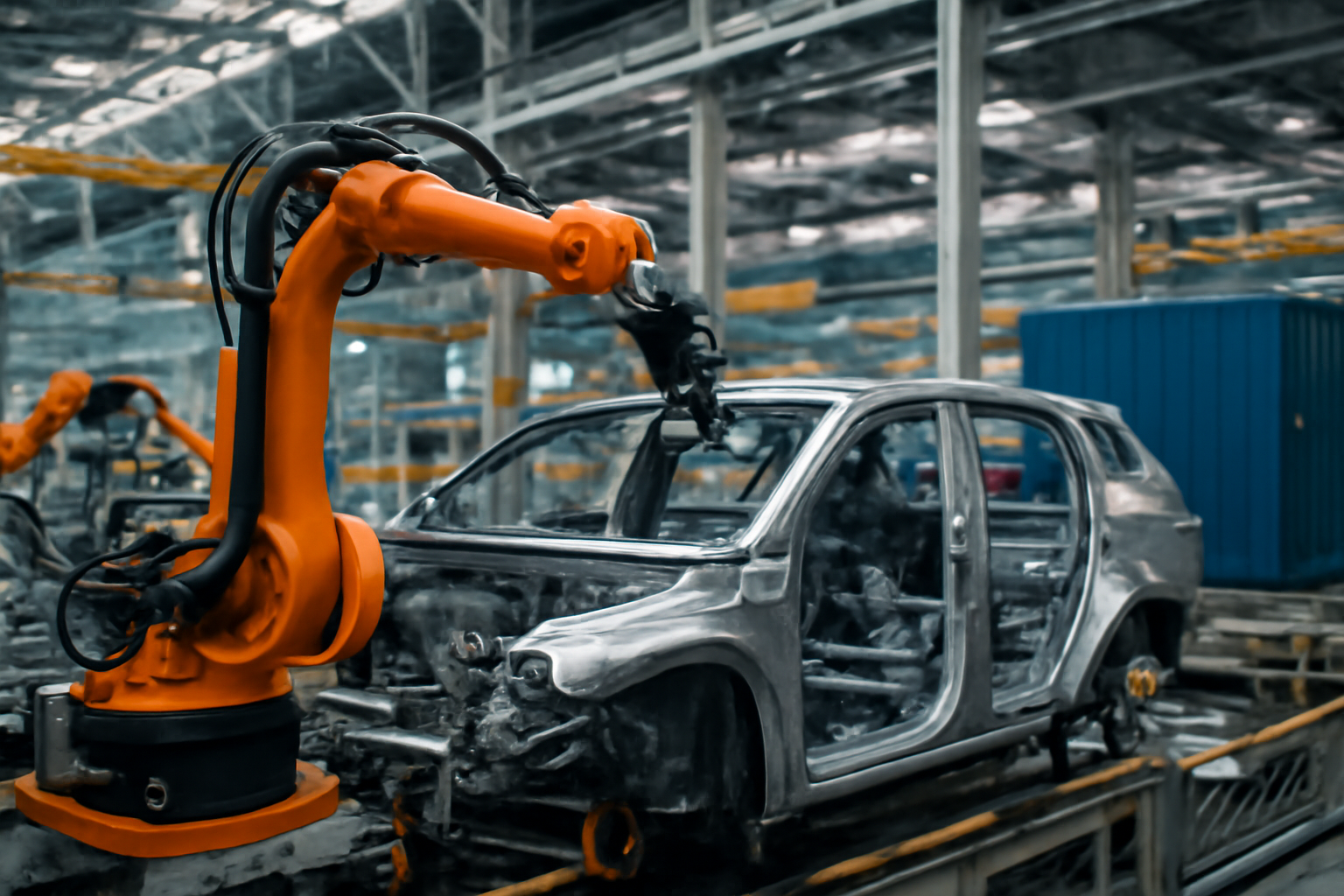
Germany holds 40% of the EU robot fleet
Germany ended 2024 with 278,900 industrial robots operating in its factories, 4% more than a year earlier, according to Leipziginfo.de, citing data from the International Federation of Robotics and Germany’s Federal Statistical Office. The country accounted for about 40% of all factory robots in the European Union. Around 27,000 units were newly installed during 2024, the second-highest annual total recorded in Germany.
Robot density reached 449 units per 10,000 manufacturing employees. Only South Korea and Singapore recorded higher levels, with density reaching as many as 818 units, while Japan followed Germany with 446. The EU average stood at 231 and the global average at 132. Germany ranked fifth for annual installations and represented about 5% of worldwide new business. Asia dominated global demand, receiving 74% of 2024 installations, compared with Europe’s 16%.
Domestic production falls as automotive demand weakens
German manufacturers produced 31,200 industrial robots in 2024, down 10% from 2023. That output covered 6% of global demand. The decline came as the automotive industry, traditionally the largest customer for robot suppliers, ordered only 6,900 units, 25% fewer than in the previous year. Vehicle manufacturers reduced installations by 15% to 4,300, while suppliers cut them by 34% to 2,700.
The automotive sector consequently represented 26% of Germany’s new installations. Its result was the weakest in 15 years, although one year of data is insufficient to establish whether the shift away from automotive demand will be permanent. The figures nevertheless expose a near-term challenge for automation vendors that built their capacity and sales networks around carmakers and component producers.
Large manufacturers remain far ahead of SMEs
The latest official breakdown by company size dates from 2020. At that time, 19% of German manufacturing companies with more than ten employees used robots. The share reached 53% among businesses with at least 250 employees and 27% among medium-sized companies, but only 9% among small businesses. This meant 91% of small manufacturers were still operating without robots.
Investment economics remain a central barrier. The Mittelstand-Digital-Zentrum considers a payback period of less than four years a strong argument for adoption. Uncertain savings, low equipment utilisation and substantial adaptation costs weigh against purchases. Collaborative robots may lower the entry threshold for companies without dedicated automation departments. Around 64,500 cobots were installed worldwide in 2024, up 12%, giving them a market share of almost 12%.
Weak economy clouds the short-term outlook
Labour shortages continue to support the case for automation, although Leipziginfo.de notes that robust studies quantifying this connection in Germany are unavailable. The German Economic Institute calculated that 369,516 skilled positions remained unfilled in 2025. One-third of vacancies for qualified workers could not be filled, even though the gap narrowed by 24.1% from the previous year. Small and medium-sized companies were affected disproportionately.
The VDMA industry association expects German robotics and automation revenue to decline 10% to €14.5 billion in 2025. Sales of automated turnkey systems are forecast to fall 15% to €7.7 billion as geopolitical tensions delay investment and competition from Asia intensifies. Globally, the International Federation of Robotics expects about 575,000 new installations in 2025 and more than 700,000 annually by 2028. Germany therefore enters a growing global market from a technologically advanced position, but its domestic trajectory will depend heavily on whether smaller manufacturers can justify and finance automation projects.