Germany and Netherlands activate hydrogen pipelines as Spain advances H2Med engineering
Germany has made 400 kilometers of converted pipeline available to the hydrogen market, while the Netherlands has activated a 32-kilometer section around Rotterdam. Spain remains in the engineering, environmental assessment and permitting phase for its H2Med network, with construction scheduled for 2028-2030.
European hydrogen networks develop at different speeds
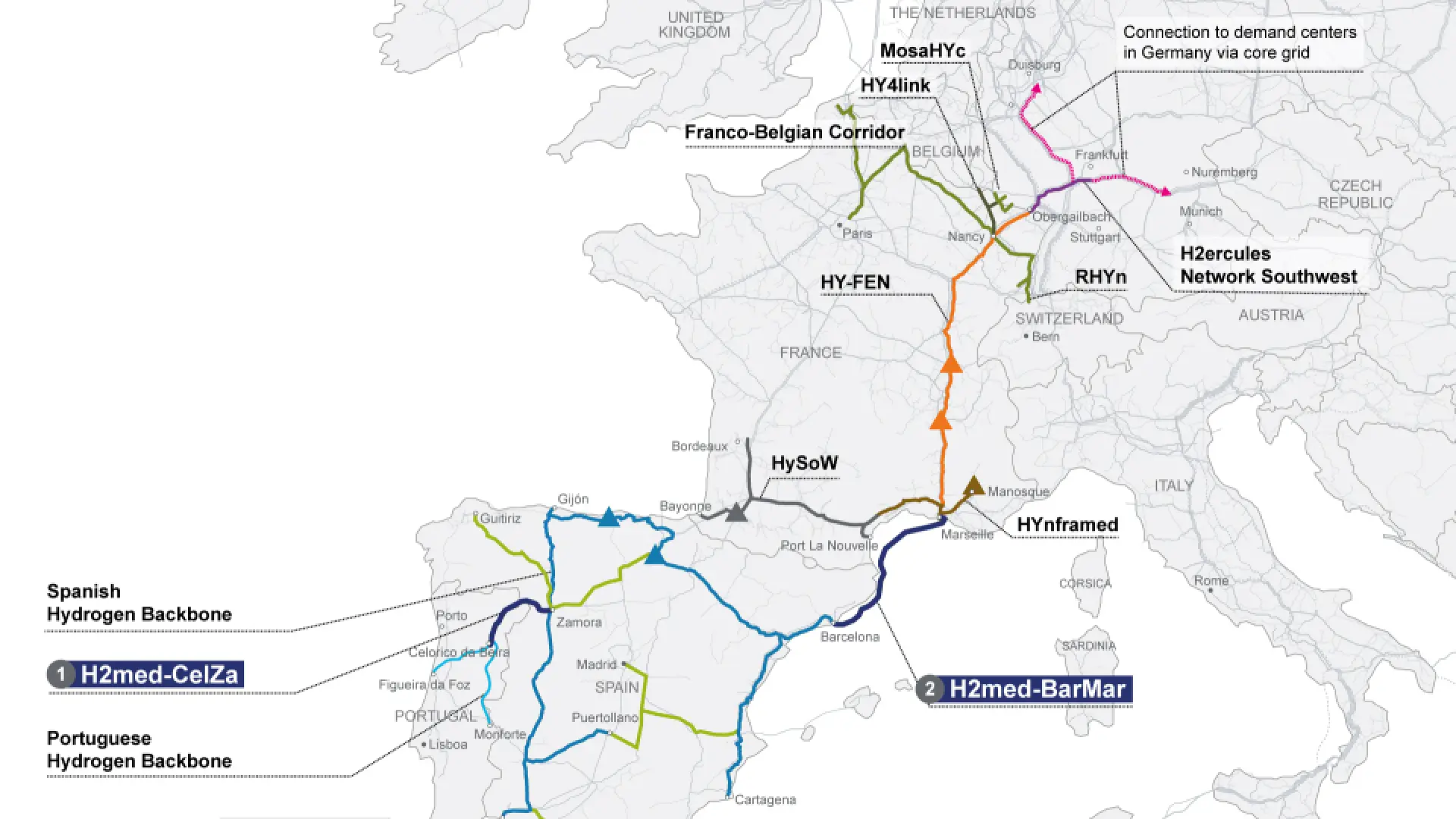
Germany and the Netherlands have activated initial sections of their hydrogen pipeline networks while Spain continues engineering work on H2Med, the planned corridor linking the Iberian Peninsula with the rest of Europe. The contrasting stages show how national infrastructure programs are moving at different speeds even as producers and industrial users seek a connected European market for renewable and low-carbon hydrogen.
According to 20minutos.es, Germany inaugurated a 400-kilometer section of its national renewable hydrogen network in December 2025. Existing pipelines previously used for natural gas were adapted for hydrogen, and the infrastructure has since been available to the market. Reusing gas assets can allow operators to establish initial transport capacity without building every section from scratch.
The Netherlands followed in May with the activation of the first 32 kilometers of its national hydrogen pipeline system. Dutch media cited by 20minutos.es said the section was ready to transport renewable hydrogen between different parts of the Port of Rotterdam. The location is commercially significant because Rotterdam combines energy infrastructure, industrial demand and access to maritime supply chains.
Spain remains in the pre-construction phase
Spain’s network has not yet reached construction. Enagás, the gas infrastructure operator responsible for developing the country’s renewable hydrogen backbone, is working on engineering, environmental studies and permits. The domestic corridors are expected to cross 13 autonomous communities and affect as many as 550 municipalities.
Enagás completed its territorial public participation process in Murcia in mid-June after holding meetings across all 13 communities. The process began in Castilla-La Mancha in April 2024 and ended in Murcia 15 months later, according to 20minutos.es. It was intended to explain proposed routes and gather comments from public authorities, companies and residents before construction decisions are finalized.
The schedule presented when H2Med was launched assigns engineering, environmental studies and permitting to 2025 and 2026. Applications for financing from the EU’s Connecting Europe Facility are also planned for 2026. Equipment and materials are due to be purchased in 2027 and 2028, followed by construction between 2028 and 2030. The backbone is scheduled to enter operation in 2030.
BarMar studies move toward front-end design
The offshore BarMar pipeline, which would connect Barcelona and Marseille, is a central part of the corridor. Geophysical studies completed in November 2025 confirmed the technical feasibility of the subsea route, 20minutos.es reported. Public participation in Spain and France and the launch of front-end engineering design were planned for 2026. Enagás says the project remains on schedule.
Other European projects could become operational earlier. France plans to commission the first section of a cross-border hydrogen network connecting with Luxembourg in 2027. France describes the gas as low-carbon hydrogen because its production plans include nuclear power, rather than limiting the system to renewable electricity.
Infrastructure determines when contracts can advance
Enagás CEO Arturo Gonzalo said infrastructure was essential to creating a European hydrogen market and that many contracts were waiting for pipelines capable of supporting them. He also pointed to China’s first 1,000-kilometer section as evidence that pipeline development is accelerating outside Europe.
For Iberian producers, the timing of H2Med will determine when prospective large-scale output can reach industrial customers elsewhere in the EU. Germany and the Netherlands now have operating assets, but those initial sections do not by themselves create a fully integrated market. Spain’s opportunity as a production center therefore depends on completing domestic corridors and BarMar in step with generation projects, customer commitments and downstream networks.