Germany installs 24,800 industrial robots in 2025 as automotive demand falls 8%
German factories installed 24,800 new industrial robots in 2025, an 8% decline, according to the IFR's World Robotics 2026 report. The automotive sector's share of national installations dropped to 23% from 40% in 2020, while German robot production fell 24% and exports 37%. China installed 354,000 units, 59% of the global market.
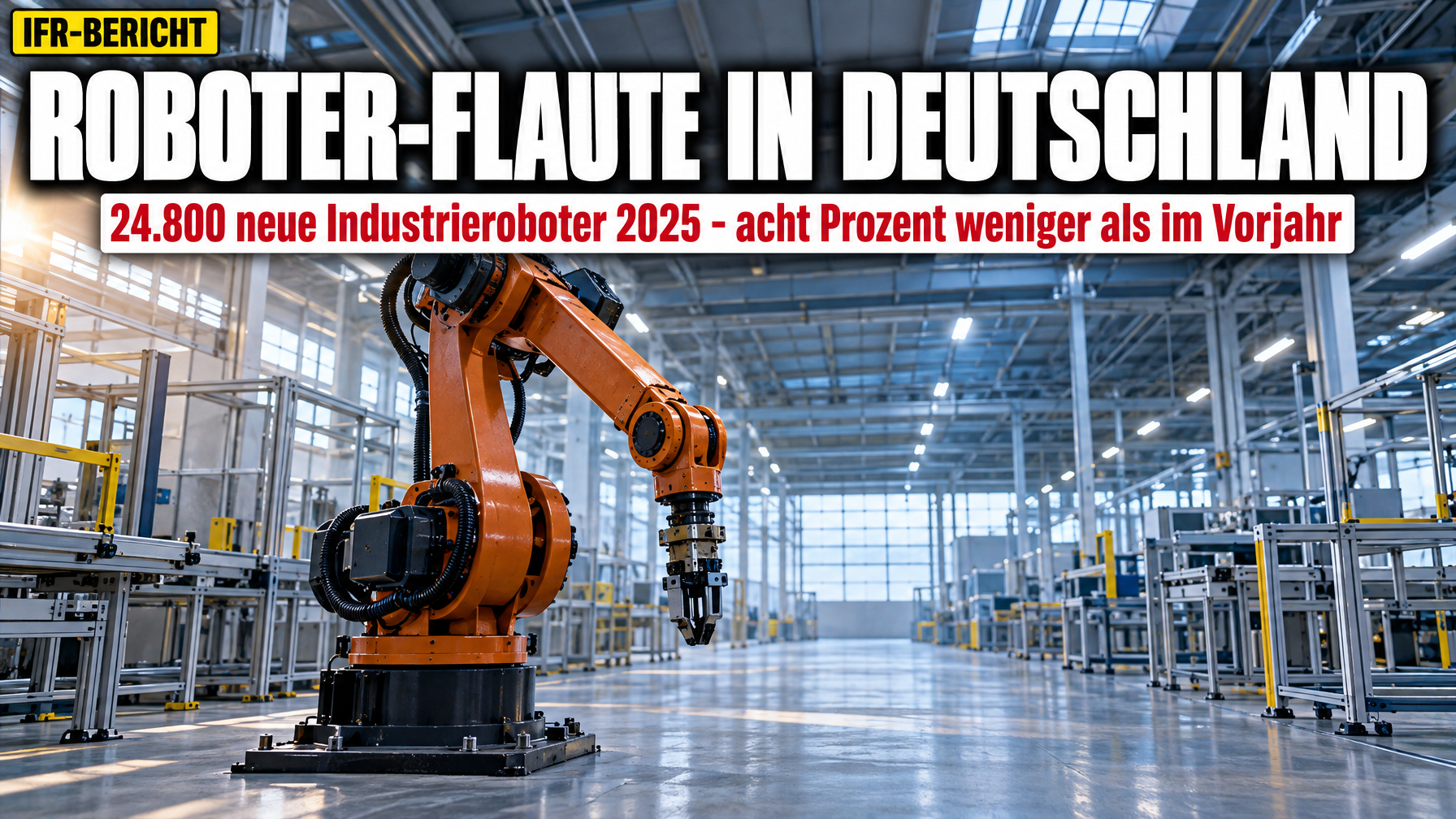
Germany's manufacturing sector installed 24,800 new industrial robots in 2025, an 8% decline from the previous year, according to the World Robotics 2026 annual report published by the International Federation of Robotics (IFR). The result keeps Germany as Europe's largest robotics market while separating it clearly from the growth recorded in China, the United States and India.
Germany accounted for 41% of all new industrial robot installations in the European Union (EU-27). The EU market as a whole contracted by 11% in 2025, ingenieur.de reported, so the German decline was shallower than the regional average. Globally, Germany ranked fifth in annual installations, behind China, the United States, Japan and the Republic of Korea. Between 2020 and 2025, German installations grew at an average annual rate of just 2%. In 2024, around 27,000 units were newly installed in the country, according to IFR figures cited by kettner-edelmetalle.de.
Automotive demand is the main drag
The automotive industry remained the largest single buyer of robots in Germany in 2025, taking 5,800 new units, but its share of national installations fell to 23% from 40% in 2020. The IFR attributes the decline to electric vehicle sales coming in below expectations and to domestic and international political uncertainty, which prompted manufacturers to postpone investment projects and readjust capacity. Germany ranks fifth worldwide in passenger car production.
Other buyer industries also retreated:
- Metalworking: 5,300 units installed, down 13%, a 21% market share
- Chemicals and plastics: 3,000 units installed, down 5%, a 12% market share
"Industrial automation in Germany is at a high level," said IFR President Jane Heffner, noting that installations fell 8% in 2025 "mainly due to declining demand from the manufacturing sector."
Production and exports move closer to customers
The supply side weakened faster than demand. German production of industrial robots reached 23,700 units, a drop of 24%. New suppliers have entered the German market in recent years, but their contribution did not offset the losses caused by the shift to decentralised production, under which manufacturers build as close as possible to their local markets.
Exports of industrial robots from Germany fell 37% to 15,100 units in 2025. Alongside relocated production, the IFR points to the large number of international robot suppliers that use Germany as their European distribution hub. Weak European demand is now reducing both re-exports to other European markets and imports into German distribution centres.
China extends its lead
China installed 354,000 industrial robots in 2025, a 20% year-on-year increase that lifted its share to 59% of global installations and exceeded the previous year's record by almost 60,000 units. Domestic Chinese suppliers installed 195,000 units, up 15%, for a home-market share of 55% in 2025 against 57% in 2024. According to kettner-edelmetalle.de, 295,000 robots were installed in China in 2024 — more than half the global total and almost eleven times the German market that year — and Chinese manufacturers outsold foreign competitors at home for the first time.
The United States overtook Japan to become the second-largest market. Installations grew 12% to almost 38,500 units, the third-highest figure on record, ingenieur.de reported, while kettner-edelmetalle.de cited preliminary IFR data showing an 11% rise to around 38,000 units. Japan fell to third place with 36,219 units, down 19%. The Republic of Korea installed 30,000 units, down 1%, remaining fourth. India took sixth place with almost 10,500 units, up 15%, having grown at a 27% average annual rate since 2020.
In the Americas, Mexico declined 7% to fewer than 5,200 units in a third consecutive down year, Canada rose 5% to almost 4,000 units, and Brazil installed almost 4,300 units, up 38%. Brazilian automotive installations reached almost 2,100 units, a 212% increase that the IFR links most probably to investment by Chinese carmakers.
Outlook to 2029
The global operational stock of industrial robots rose 9% in 2025 to a record 5 million units, more than double the level of seven years earlier, on annual installations that grew 11% to more than 600,000 new units. The IFR expects installations to rise 9% to 655,000 units in 2026 and to reach 806,000 units by 2029.
German demand is projected to fall again in 2026, with experts expecting installation numbers to rise again from 2027. The IFR identifies small and medium-sized enterprises as the main growth potential, citing user-friendly robots that require less programming knowledge, lower-cost machines, and Robot-as-a-Service (RaaS) business models that reduce total cost of ownership.