German paper industry sees no turnaround in first half of 2026
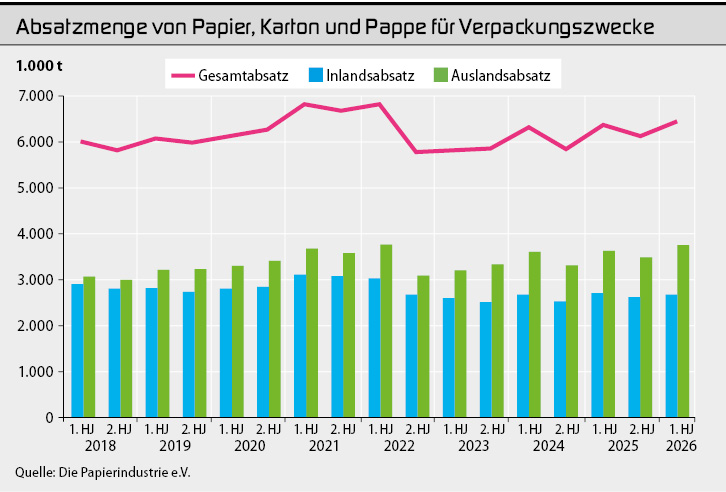
Germany’s paper and pulp industry recorded lower production and revenue in the first half of 2026. Packaging paper and board remained the largest segment, producing 6.4 million tonnes, but its output was unchanged year on year.
Production and revenue remain under pressure
Germany’s paper and pulp industry failed to achieve a turnaround in the first half of 2026. According to figures reported by EUWID Verpackung and attributed to the industry association Die Papierindustrie, total production declined by 1.4% from the first half of 2025 to 9.4 million tonnes. Industry revenue fell more sharply, decreasing by 7.1% to €6.9 billion.
The difference between the changes in output and revenue indicates continued pressure on the value generated from each tonne sold. Die Papierindustrie linked the sector’s performance to Germany’s weak economy, which weighed on both demand and prices. For paper producers, converters and suppliers, the figures show that broadly stable physical demand has not been sufficient to protect sales in monetary terms.
Packaging segment holds output at 6.4 million tonnes
Paper, board and cardboard intended for packaging remained the industry’s largest segment by volume. Production reached 6.4 million tonnes in the first six months of 2026, accounting for more than 67% of total German paper and pulp output. Unlike the industry as a whole, the segment recorded neither growth nor contraction compared with the same period of 2025.
This flat performance gives packaging producers a relatively stronger position than other parts of the sector, but it does not amount to a recovery. Packaging grades represented more than two-thirds of national output and therefore prevented a steeper decline in total volumes. At the same time, unchanged production suggests that demand from consumer goods companies, retailers, logistics operators and industrial customers was not strong enough to generate expansion.
Industry calls for faster reforms
Die Papierindustrie said the economic slowdown was not the only factor affecting companies. The association also pointed to deteriorating operating conditions in Germany and called on policymakers to implement previously announced reforms without delay. Its priorities include faster expansion of electricity grids, more effective infrastructure and substantially shorter approval procedures.
Association president Hans-Christoph Gallenkamp said economic policy reforms needed to gain momentum and warned against another year of stagnation. He reaffirmed that companies supported the transition toward climate neutrality but argued that essential conditions were often missing. Gallenkamp also said additional regulatory requirements under the current conditions could endanger investment and accelerate deindustrialisation.
Investment outlook remains constrained
The sector’s demand for grid expansion and faster permits reflects the capital- and energy-intensive nature of paper production. Mills considering upgrades, energy projects or lower-emission technology need predictable infrastructure and approval schedules. Falling revenue may make such investment decisions harder even where packaging output remains stable.
For market participants, the first-half figures point to continued caution rather than an immediate change in capacity. Packaging paper and board remains the central volume base of the German industry, while the wider sector is still contracting. A sustained recovery will depend on stronger demand and prices as well as the domestic operating conditions identified by the association.