French wine output forecast near 70-year low after heat and drought
France is expected to produce 33.9 million hectolitres of wine in 2026, down 6% from 2025 and 17% from the 2021–2025 average. Drought, repeated heatwaves, lower yields and shrinking vineyard area have pushed the forecast close to a 70-year low.
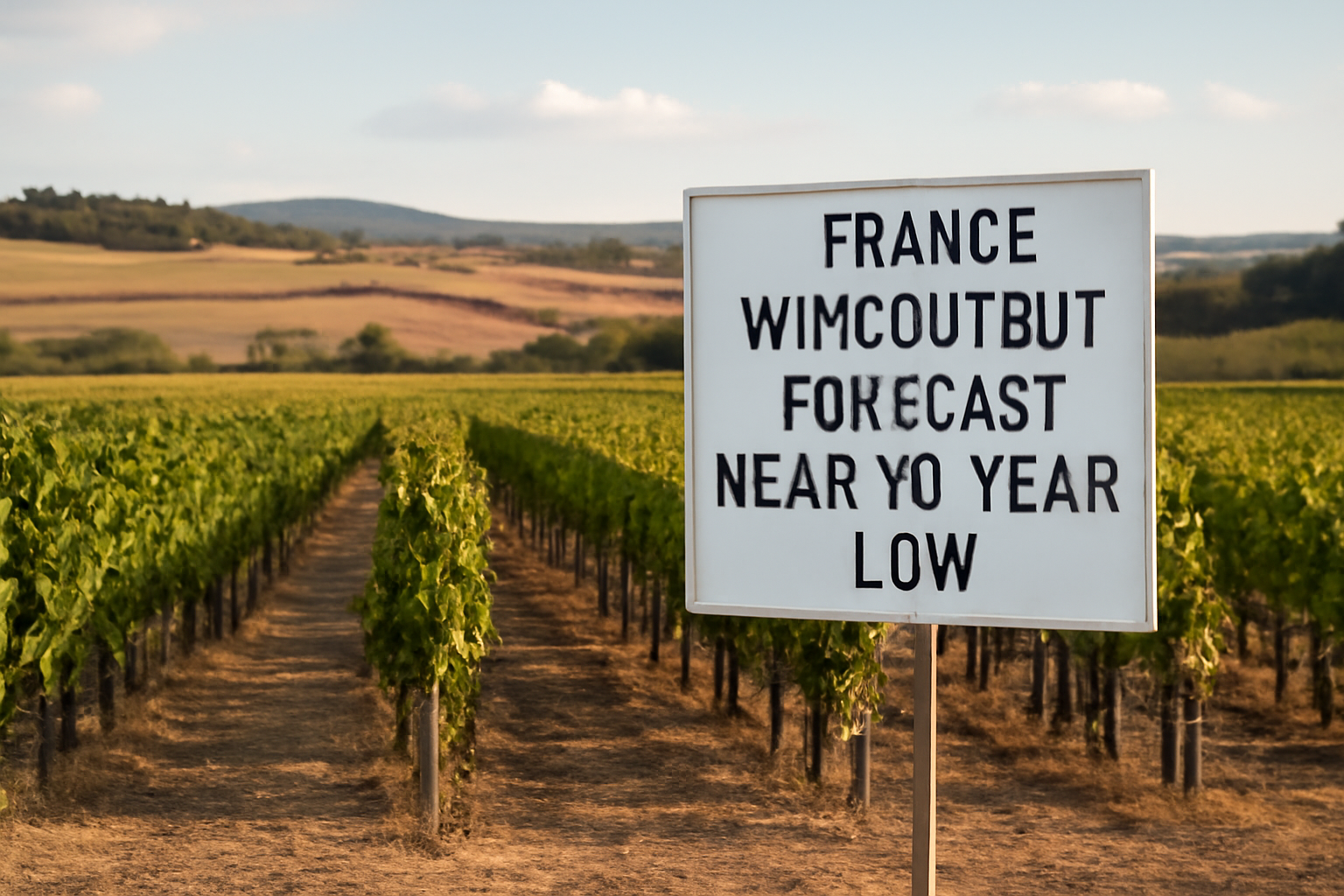
Output forecast at 33.9 million hectolitres
French wine production is expected to fall to nearly 33.9 million hectolitres in 2026 after severe drought and repeated summer heatwaves damaged vines and reduced grape yields. France’s Agriculture Ministry estimates that output will decline 6% from 35.9 million hectolitres in 2025 and stand 17% below the 2021–2025 average.
The projected volume, equivalent to about 4.5 billion standard bottles, would place the harvest close to its lowest level in roughly 70 years. AFP reported that the International Organisation of Vine and Wine classified France’s 2025 production as its lowest since 1957. The 2026 forecast therefore points to a third consecutive weak harvest following reduced production in both 2024 and 2025.
Heat compounds the loss of vineyard area
The ministry’s statistics service, Agreste, attributed the national decline to two forces: shrinking vineyard area and lower yields caused by drought and summer heatwaves. Conditions earlier in the growing season had supported grape development, but the later heat caused sunscald, scorching, defoliation and wilting in some vineyards. Soil moisture deficits intensified across the country as the summer progressed.
Extreme temperatures also brought harvesting forward. Reuters reported that producers in much of France, as in other European wine regions, began picking unusually early. Earlier harvesting can help growers protect grapes from further heat damage, but it narrows the time available to balance ripeness, acidity and vineyard logistics. The volume forecast does not by itself determine wine quality, which will vary by location, grape variety and harvest timing.
Champagne faces the sharpest contraction
The national figure conceals major regional differences. Champagne production is forecast to fall 49% from 2025 and 47% below the five-year average, according to Agreste figures reported by industry publications. That decline is materially steeper than the contraction expected for France as a whole and will reduce the amount of new wine entering the region’s production system from the 2026 harvest.
Languedoc-Roussillon is moving in the opposite direction. Production in France’s largest wine-producing region is expected to rise 5% from the weak 2025 crop as yields improve. Even so, its output would remain 8% below the 2021–2025 average, showing that the regional recovery does not offset the broader national shortfall.
Availability and pricing effects will differ by segment
Lower production tightens the supply of newly harvested wine, but the commercial effect will not be uniform. Producers with inventories can use older vintages to moderate short-term availability, while growers and wineries more dependent on the current crop face greater volume pressure. Champagne’s particularly large decline makes that region more exposed than areas where yields recovered.
For merchants, importers and distributors, the main issue is the uneven allocation of reduced 2026 volumes rather than a single change across all French wine. Contracts, inventories and demand will determine how quickly the smaller harvest reaches wholesale and retail prices. France announced more than €1 billion in emergency support for farmers after the summer’s drought and heatwaves, although agricultural groups said the package did not meet the sector’s needs. The forecast also reinforces the production risk created when declining vineyard area coincides with increasingly damaging heat and water shortages.