French sugar-beet industry faces pressure on acreage, costs and processing capacity
France’s sugar-beet industry supplies nearly 90% of domestic sugar demand and remains the EU’s largest sugar producer. Falling acreage, expensive imported fertilizer, tighter crop-protection rules and the cost of cutting factory emissions are testing its competitiveness.
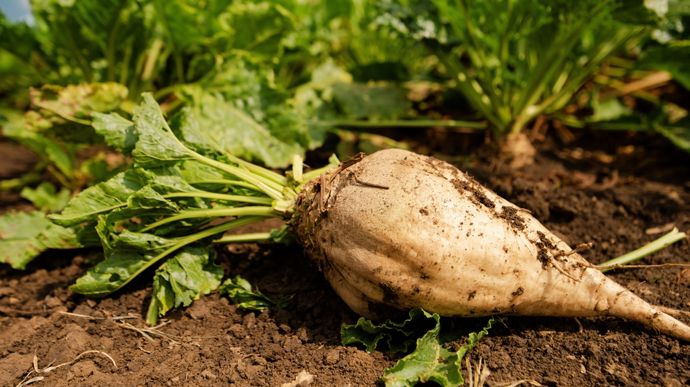
High yields offset a gradual decline in acreage
France’s sugar-beet industry remains one of Europe’s strongest, but a combination of agronomic, regulatory and industrial pressures is making that position harder to defend. According to Terre-net, the sector supplies nearly 90% of French sugar demand, while France remains the European Union’s largest sugar producer and the world’s second-largest producer of beet sugar.
French growers planted 400,000 hectares of sugar beet in 2025, compared with a ten-year average of 422,000 hectares. Yield reached 89.4 tonnes per hectare, above the ten-year average of 82 tonnes per hectare. This combination has made France an exception within Europe, where acreage has contracted more sharply and yield improvements have been weaker. Terre-net nevertheless reports that the 2026 harvest is expected to be exceptionally low because of historic weather conditions during the summer.
Domestic consumption provides the industry’s main outlet. Agreste, the statistical service of France’s agriculture ministry, puts national sugar demand at an average of about 2.6 million tonnes over five years. Domestic production covers close to 90% of that volume. The sector also generated an annual foreign-trade surplus of €1 billion in 2024/2025, underlining its importance beyond the French market.
Input costs and trade policy test competitiveness
The industry has already undergone extensive restructuring over the past two decades. Support prices for beet and sugar were progressively reduced, public intervention and export refunds ended, and production quotas were abolished. Growers have also lost access to neonicotinoid seed treatments. Together, these changes have increased exposure to market prices, weather and crop-health risks.
Agreste warns that the industry is sensitive to competitive distortions within the EU and under trade agreements. Acetamiprid, for example, has been prohibited in France since 2019 but remains authorized in some other member states. Meanwhile, numerous free-trade agreements include sugar concessions through import quotas or tariff reductions. Each volume may appear limited on its own, but processors view their accumulation as additional pressure on the wider European sugar industry.
Imported mineral nitrogen fertilizer is another major vulnerability. Beet-growing areas are concentrated in the arable regions of northeastern France, where fertilizer expenditure is among the country’s highest. Agreste reports costs of €196 to €302 per hectare, rising to €400 per hectare in 2022/2023 and €593 per hectare in 2023/2024 as fertilizer prices surged. Such increases directly affect growers’ margins and the area they are willing to commit to beet.
Factories face a costly emissions challenge
The sugar industry emits 2 million tonnes of carbon dioxide annually, making it the most emissions-intensive branch of France’s food-processing industry. Emissions fell by 30% between 1990 and 2012 and by a further 15% between 2017 and 2022, but processing remains heavily dependent on carbon-based energy. Sugar factories need heat throughout production, while the seasonal campaign requires three times the power capacity of comparable plants operating continuously over the year.
The sector has proposed cutting greenhouse-gas emissions by 35% by 2030, partly through anaerobic digestion and the combustion of beet pulp. Both routes involve trade-offs. Using pulp as fuel can compete with its use in animal feed, while digestate from anaerobic digestion is produced when crops make limited use of nitrogen. Storage would therefore be needed until the material can be applied at an agronomically suitable time.
Crop protection presents a parallel challenge. France’s national research and innovation plan has identified companion plants, biocontrol products, biological control and preventive measures as ways to limit aphid attacks and virus yellows, but combining these tools effectively remains difficult. Emergency legislation also provides for the possible return of flupyradifurone as a beet-seed treatment. The insecticide, prohibited in France in 2020, has the same mode of action as neonicotinoids. The sector’s ability to maintain acreage and processing capacity will increasingly depend on whether these agronomic tools can protect yields while factories absorb the cost of decarbonization.