French pork market firms as output falls and carcass weights drop to 94.63 kg
Ouest-France reports a renewed rise in French hog market values against a backdrop of declining production. Average carcass weight at slaughter has fallen to 94.63 kilograms, 1.7 kilograms below the 2025 level, an indicator the paper reads as market tension.
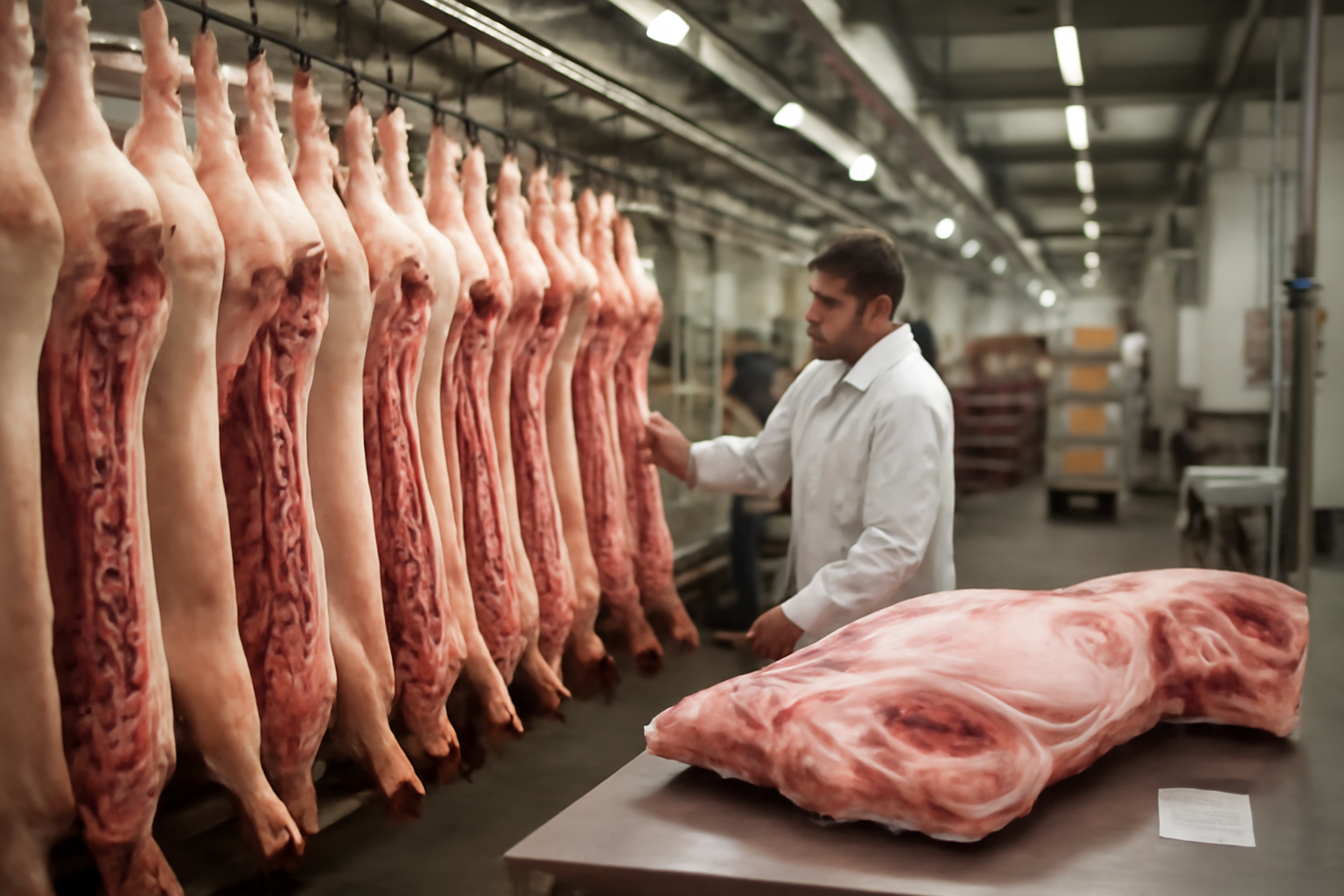
Values on the French pig market are rising again while production declines, according to Ouest-France. The publication points to average carcass weight at the slaughterhouse as a second indicator of tension: it now stands at 94.63 kilograms, significantly below the 2025 level, with a gap of 1.7 kilograms.
Carcass weight as a supply gauge
Carcass weight is one of the quickest-reacting numbers in the pig sector. When animals are plentiful and buyers are unhurried, finishers keep pigs longer and average weights drift upward. When abattoirs compete for supply, animals are booked and killed earlier, and the average weight falls. A decline of 1.7 kilograms per carcass therefore does more than describe an animal: it removes meat from the market without any change in the number of pigs slaughtered.
The arithmetic is unforgiving at scale. Relative to a base above 96 kilograms a year earlier, 1.7 kilograms is close to 2% less meat from every animal that passes the line. Where the number of animals is also falling, as Ouest-France indicates for French production, the two effects compound into a tonnage shortfall larger than either factor suggests on its own. For cutting plants, the change is not only quantitative: lines are calibrated for weight bands, and lighter carcasses alter the size of primal cuts, the lean-to-fat ratio and the yield of the pieces that carry the most value.
Prices firm as output contracts
The recovery in market value described by Ouest-France is consistent with that supply picture. Pig prices in Europe are set week by week against available volumes, and a market short of both animals and kilograms per animal tends to reprice quickly upward. The publication does not quantify the scale of the production decline or the size of the price gain, and those two figures determine whether this is a seasonal adjustment or the start of a longer tightening. French pig meat competes directly with Spanish, German, Danish and Dutch product inside the single market, so a domestic supply gap is rarely filled by domestic animals alone — it is filled by intra-EU flows, at whatever price the shortage sets.
What changes along the chain
- Fewer kilograms per animal means processors must slaughter more head to fill the same order book, raising cost per tonne of finished product.
- Lighter carcasses shift cutting yields and can push buyers of specific heavy-weight cuts toward imported supply.
- Rising quotations move through to secondary processors and charcuterie manufacturers with a lag, compressing margins until contracts reset.
- Sustained firmness attracts pigs and cut meat from other EU producers, which is how a national shortage becomes a cross-border trade movement.
For the production side, the picture is more favourable than it has been. Higher market values against falling supply improve the margin on each animal sold, though the response is slow: rebuilding output depends on sow numbers and piglet availability, and the biological lag between a breeding decision and an extra pig at the abattoir runs to roughly a year. Nothing in the Ouest-France report indicates that herd rebuilding is under way. Until the weight indicator turns back up and average carcasses move toward their 2025 level, buyers should assume the tension in French pig supply is a continuing condition rather than a passing one, and plan procurement on that basis.