France requires full country and percentage disclosure on blended honey labels
Since 14 June 2026, blended honey marketed in France must identify every country of harvest and its percentage by weight. The rules increase traceability and label-management requirements for packers, while stocks labelled before the deadline may be sold until exhausted.
Origin percentages become mandatory
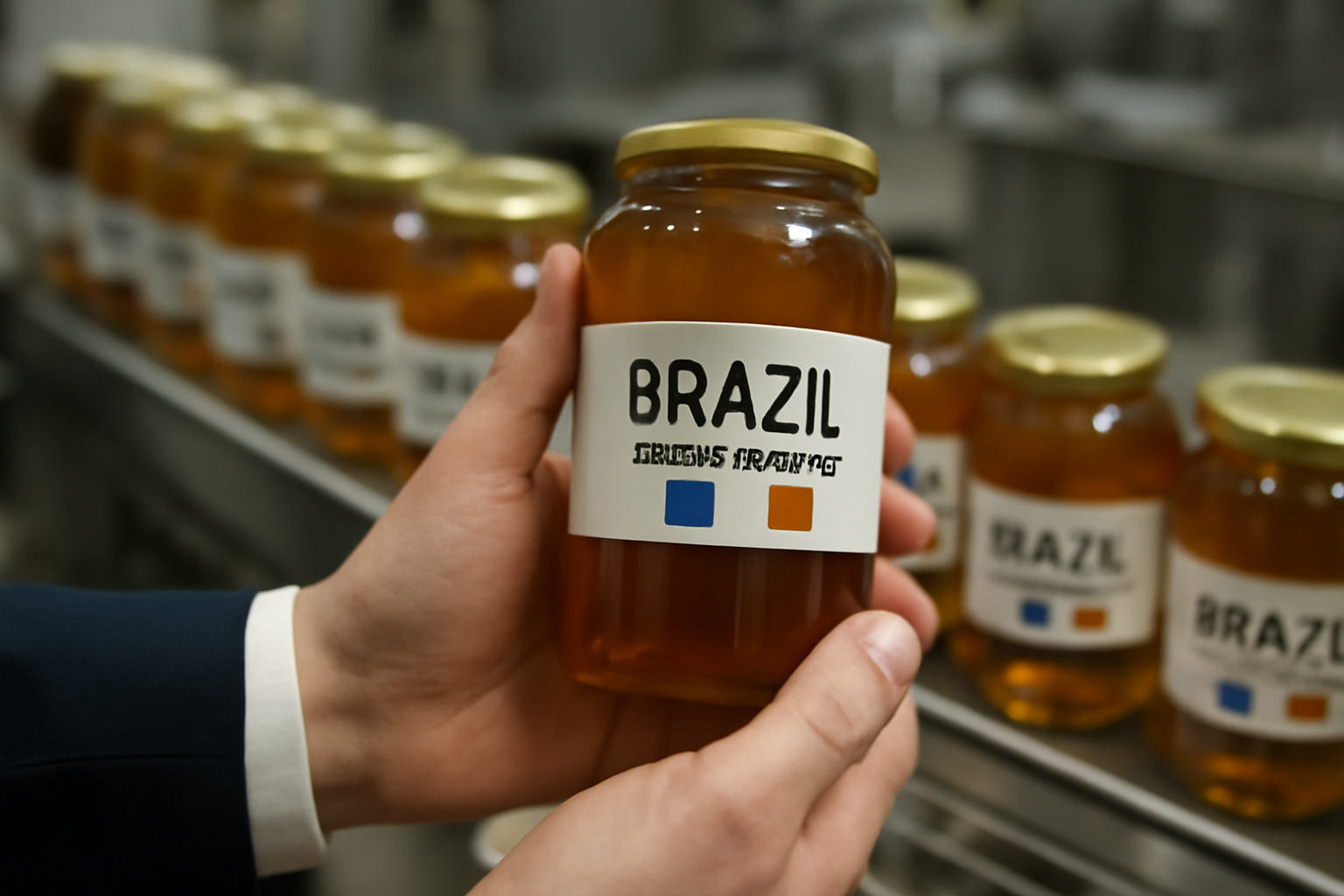
Blended honey placed on the French market from 14 June 2026 must disclose every country in which the honey was harvested, together with the percentage by weight represented by each origin. Countries must appear in descending order in the principal field of vision on the label. The requirements follow European Union Directive (EU) 2024/1438, known as the “Breakfast Directive,” and were transposed into French law through Decree No. 2026-312 of 24 April 2026.
The French consumer protection authority, the DGCCRF, says the rule applies to all honey marketed in France. It replaces the less detailed approach under which blends could carry broad statements such as “blend of EU honeys,” “blend of non-EU honeys” or “blend of EU and non-EU honeys.” Honey from a single country must still identify that country, although France does not prescribe where the origin statement must appear on a single-origin product.
Traceability records determine label claims
Percentages must be calculated from the operator’s traceability documentation. A tolerance of 5% of each declared share is allowed; the DGCCRF stresses that this is a relative tolerance, not five percentage points. Its guidance gives the example of a 1-kilogram blend containing 450 grams from France, 350 grams from Hungary and 200 grams from Romania. The label should therefore state France 45%, Hungary 35% and Romania 20%, with the three shares adding up to 100%.
The authority recommends whole-number percentages for readability. Packages containing less than 30 grams may use two-letter country codes under ISO 3166-1 instead of writing country names in full. The origin obligation also extends to honey portions served at hotel breakfasts, although qualifying information supplied to catering businesses may, in specified circumstances, appear in delivery notes or accompanying commercial documents.
- Every harvest country must be listed for a blend sold in France.
- Origins must be ranked by weight and accompanied by percentages totaling 100%.
- Each declared share is supported by traceability records and receives a 5% relative tolerance.
Implications for packers and sourcing
For packers, the change links every retail label more closely to the composition of the corresponding batch. A shift between supplier countries or a change in blending ratios can require revised packaging data, tighter segregation of lots and more precise information from upstream suppliers. Operators handling drums of honey in business-to-business transactions remain subject to general EU food-information rules and must give buyers enough information to meet their own obligations.
The transition does not require compliant products already marketed or labelled before 14 June 2026 to be withdrawn. France permits those stocks to remain on sale until exhausted. However, products newly placed on the market after that date must follow the new regime. The DGCCRF said it would conduct an investigation in 2027 to assess implementation and publish the results. Violations remain punishable as fifth-class offences, while deliberate deception over a product’s nature or origin may trigger proceedings for misleading commercial practices.
Le Monde noted that French supermarket shelves contain honey sourced from countries including Bulgaria, Romania, Ukraine, Argentina, Mexico and Spain, illustrating the international supply base behind many blends. The new labels do not restrict those sourcing options, set import quotas or establish minimum domestic content. They instead make the composition visible, giving buyers and consumers a clearer basis for comparing blends and making origin changes more apparent across batches.