Four countries control 53% of global fertilizer exports, exposing food supply to disruption
Russia, Canada, Morocco and China supplied 53% of global fertilizer exports in 2024, according to Kathimerini. Concentrated fertilizer supply and Europe’s dependence on a limited group of energy suppliers leave agricultural costs and food prices exposed to market disruptions.
Fertilizer trade concentrated among four exporters
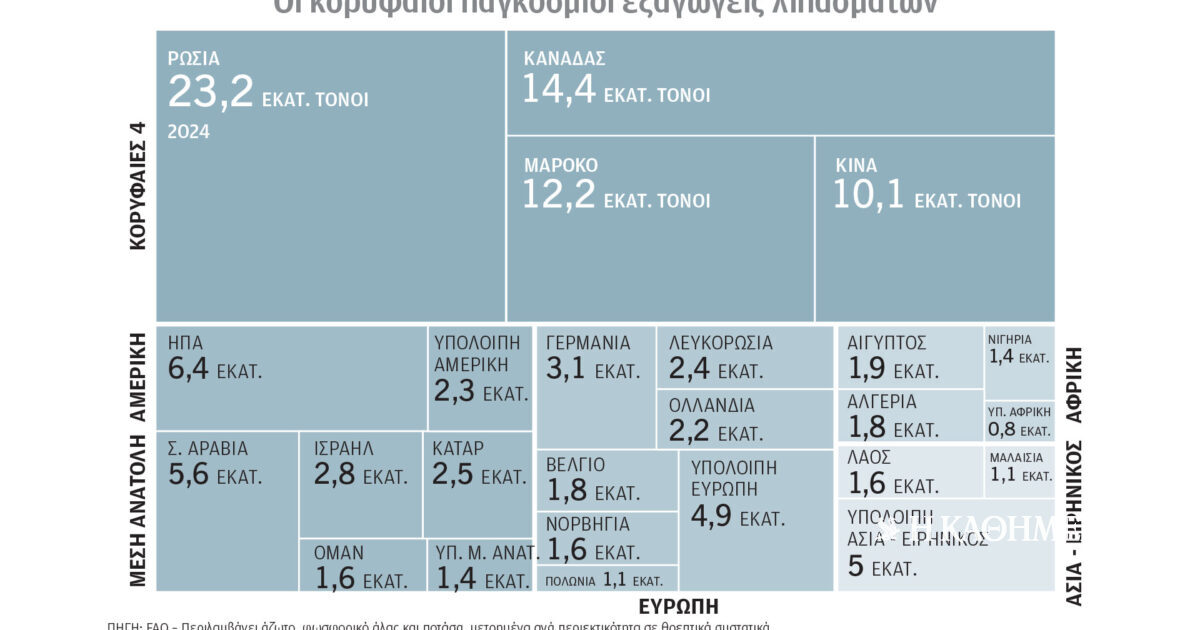
Global food production remains heavily dependent on a small group of countries that dominate international fertilizer shipments. Total fertilizer exports exceeded 113 million tonnes in 2024, according to research published by Kathimerini. Russia ranked first with 23.2 million tonnes, followed by Canada with 14.4 million tonnes, Morocco with 12.2 million tonnes and China with 10.1 million tonnes.
Together, those four countries accounted for 53% of global fertilizer exports. Their position is linked primarily to access to the natural resources needed to manufacture key fertilizer products. This concentration gives producers in importing markets limited room to replace supply quickly when sanctions, trade restrictions, transport problems or other disruptions affect a major exporter.
Supply shocks feed directly into farm economics
Fertilizer is a major production input for crop farmers, making availability and cost relevant across grain, oilseed, fruit and vegetable supply chains. A disruption affecting one of the leading exporters can raise procurement costs for importers and farmers well beyond the country where it originates. Higher input costs can then influence planting decisions, application rates, yields and ultimately food prices.
The figures also show that exposure is not tied to a single supplier. Russia is the largest exporter, but Canada, Morocco and China collectively ship a substantial share of internationally traded fertilizer. Importing countries therefore face different sources of risk, including geopolitical tensions, national export policies and logistical constraints. Buyers seeking greater supply security may need to diversify origins, maintain inventories or secure longer-term contracts, although each option carries additional costs.
Energy concentration adds another layer of risk
Fertilizer markets are also connected to energy prices because energy is an important component of production and transportation costs. Kathimerini reported that in the second quarter of 2026 the United States was the European Union’s largest oil supplier, with an 18.8% share. Norway supplied 14.3% and Kazakhstan 13.4%. Imported oil volumes remained almost stable, but their value increased by 55.8% compared with the monthly average for 2025 amid higher prices and disruption in international oil markets.
Concentration was even greater in European gas supply. The United States covered 63.2% of EU liquefied natural gas imports, while Russia accounted for 17.3%. For pipeline gas, Norway held a 51.2% share, followed by Algeria with 18.2% and the United Kingdom with 11.1%. These figures concern Europe’s energy market, but their implications extend to fertilizer plants, agricultural processors and transport operators exposed to fuel and gas costs.
Food supply depends on two concentrated input markets
The overlap between concentrated fertilizer exports and concentrated energy supply creates a broader vulnerability for global agriculture. A fertilizer trade restriction can reduce physical availability, while an energy shock can raise the cost of manufacturing and moving the same product. When both pressures occur together, producers and traders have fewer inexpensive alternatives.
For farmers, the immediate issue is the price and timing of fertilizer purchases. For importers and distributors, it is access to cargoes and financing inventories. Food processors and consumers encounter the effects later through crop availability and prices. The 53% export share held by four fertilizer suppliers does not mean that every disruption will cause a food shortage, but it shows how decisions and events in a limited number of countries can influence production costs across many agricultural markets.