Greece and four EU states seek emergency livestock support from Brussels
Greece and four other EU member states have submitted a joint non-paper to the European Commission calling for urgent action on the livestock sector. The document requests financial support for producers and greater flexibility in the application of EU animal-health rules. The co-signatory states have not been identified and no figure has been attached to the request.
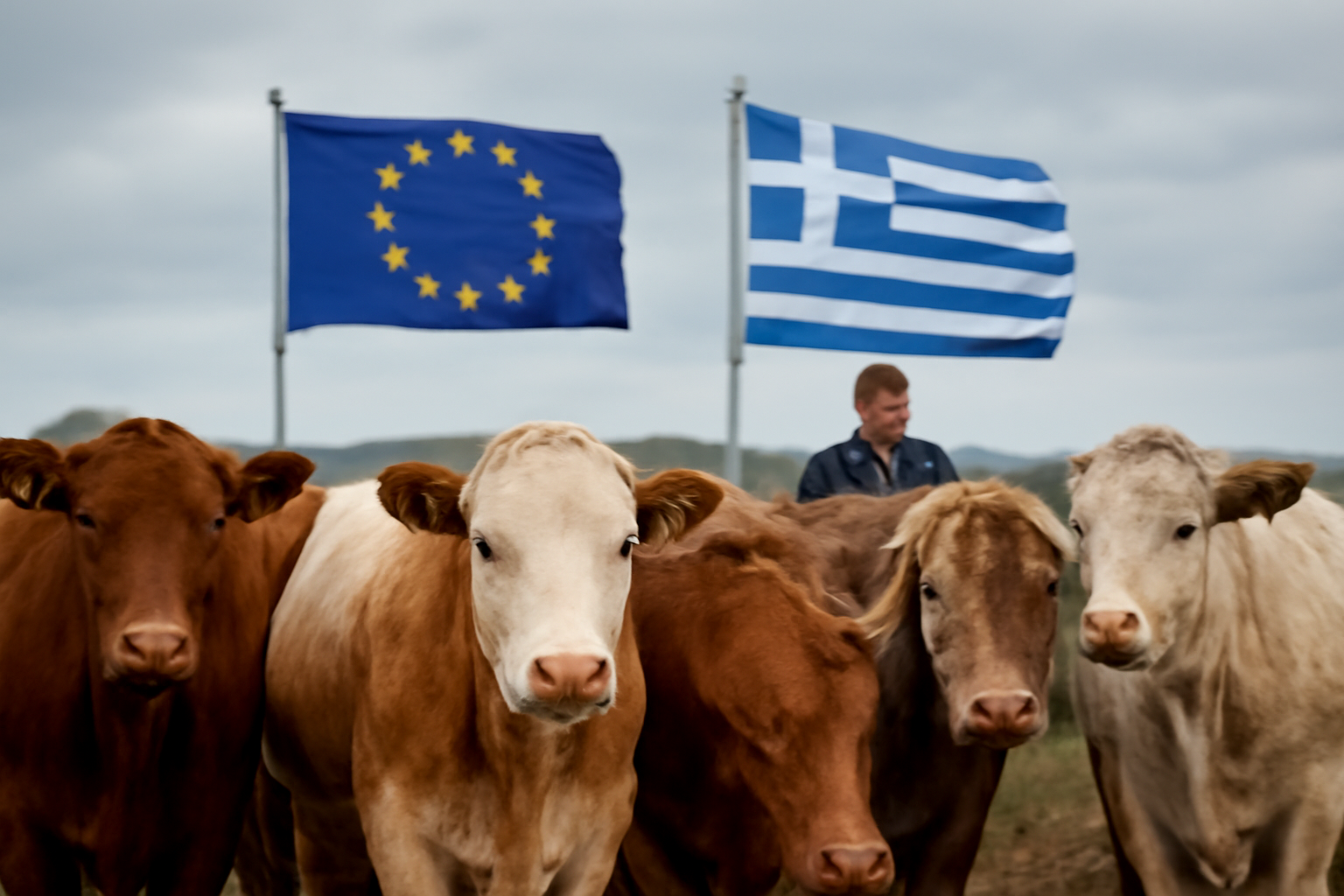
Greece and four other European Union member states have asked the European Commission for financial support for their livestock sectors and for greater flexibility in the application of EU animal-health rules, in a joint non-paper presented as a call for "urgent action".
A non-paper is an informal, unattributed position text used in EU practice to circulate a proposal before it is tabled through formal channels. It carries no legal force and commits neither its authors nor the Commission, but it is the standard way for a group of capitals to test support ahead of a meeting of the Agriculture and Fisheries Council.
The four member states backing Greece have not been identified, and no figure has been put on the support requested. The document sets out two separate demands: money for producers, and latitude in how veterinary rules are enforced on the ground.
Two demands in one document
The funding request concerns producers affected by animal disease and by the control measures that follow an outbreak. Requests of this type in the EU generally cover:
- compensation for animals culled under official disease-control orders;
- income lost to movement restrictions and standstill zones;
- the cost of biosecurity upgrades, testing and carcass disposal;
- market losses where regional export bans cut producers off from buyers.
The second demand targets the EU veterinary framework built around the Animal Health Law, which prescribes mandatory responses to listed diseases: culling obligations, protection and surveillance zones, movement bans, cleaning and disinfection requirements, and certification for intra-EU trade. Once a listed disease is confirmed, national authorities have limited discretion over the measures they apply.
Why flexibility is contentious
Those same rules are the basis on which the EU's disease status is recognised by trading partners. Third countries accept regionalisation — restricting import bans to affected zones rather than whole territories — only where they trust that zoning and enforcement are applied consistently. If enforcement is perceived to loosen in one member state, importers tend to respond at national or bloc level, which is why the Commission has traditionally resisted country-specific derogations. The counter-argument, familiar from earlier disputes over veterinary enforcement, is that rules written for large intensive units fit poorly with the extensive, mountain and transhumant systems common in southern Europe, where holdings are small, fragmented and harder to trace.
Which instruments could be used
Several channels exist if the Commission decides to act. The agricultural reserve, replenished each year within the Common Agricultural Policy budget, is the fastest route and has been used repeatedly for sector crises. Exceptional market support measures under the common market organisation allow targeted payments to affected producers. National aid schemes require state-aid clearance from Brussels. Member states can also amend their CAP strategic plans to redirect rural development money towards biosecurity, restocking and herd rebuilding. Veterinary eradication and surveillance programmes are already co-financed from the EU budget. None of these has been confirmed in connection with the non-paper.
What happens next
No Commission response has been reported and no timetable has been set. Non-papers typically surface publicly shortly before an issue reaches the Agriculture and Fisheries Council, where a group of five member states can force a discussion even without a formal legislative proposal on the table. For producers and traders, the practical questions are the size of any support envelope, whether it would be paid from EU or national funds, and whether any relaxation of control measures would affect the disease status that underpins exports of live animals, meat and dairy from the countries involved.