European car plants halt as EV demand overshoots battery supply
Stellantis is suspending production at several plants in France partly because it lacks batteries for electric vehicles already ordered, Reuters reported. ACEA data show the EU share of battery-electric and plug-in hybrid cars rose to 26.8 percent in 2025 from 20.8 percent and neared 32 percent in January–August. Hungary's large cell capacity has yet to benefit.
European carmakers are dealing with an unfamiliar disruption on their electric vehicle lines: demand that is running ahead of what they planned for. Hungarian business outlet Telex, in its G7 section, reported on 1 October that the industry has been on a rollercoaster. After several years in which weaker-than-expected electric vehicle demand was the core problem, the bottleneck has flipped to the opposite side.
The clearest symptom is at Stellantis. The group is suspending production at several of its plants in France, partly because it does not have enough batteries to build the electric vehicles customers have already ordered, Reuters reported. The stoppages illustrate how tightly European final assembly is now tied to cell supply: when the order book fills faster than planned, the immediate result is idle lines rather than additional output.
What the ACEA figures show
Data from the European Automobile Manufacturers Association (ACEA) describes a market that changed direction. The combined share of cars fitted with larger batteries — battery-electric and plug-in hybrid models — in the EU new car market fell between 2022 and 2024. In 2025 it climbed to 26.8 percent from 20.8 percent a year earlier. Between January and August this year it came close to 32 percent.
- 2024: 20.8 percent of the EU new car market
- 2025: 26.8 percent
- January to August this year: almost 32 percent
In less than two years, models carrying significant battery content added roughly 11 percentage points of market share. Each of those vehicles needs far more cell capacity than a conventional hybrid, so the change in the mix hits battery demand harder than the registration totals alone suggest.
Policy was loosened as demand turned
European regulation moved in the opposite direction at the same time. At the end of 2025 the European Commission relaxed the rule banning sales of internal combustion engine vehicles from 2035, and weaker-than-expected demand was the stated justification. Through 2024 and 2025 practically every major carmaker announced that it was slowing its electrification plans. Procurement volumes, cell contracts and shift patterns were sized against that cautious scenario, which is why current order intake cannot be served immediately.
Hungary's battery capacity has yet to benefit
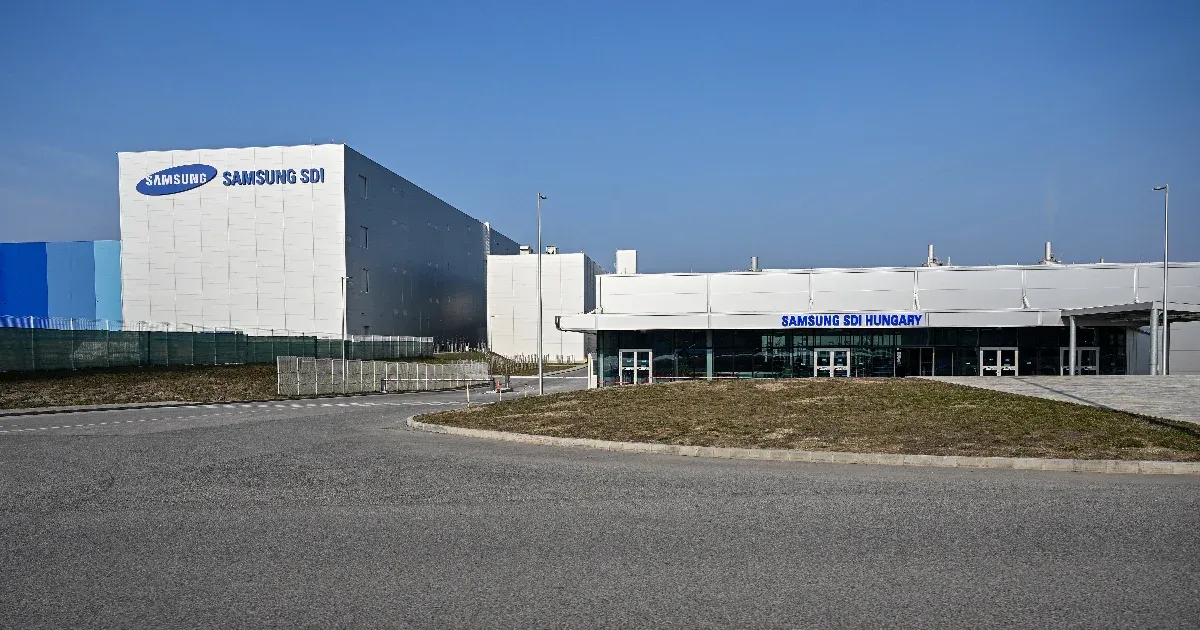
Stronger battery demand should in principle be good news for Hungary, where substantial cell manufacturing capacity was built in recent years. According to Telex, it is not yet visible in the statistics and the country's plants are not benefiting so far. The likely explanation is that the upturn has not reached the larger domestic factories, although there are signs their output may slowly begin to rise.
Where the pressure lands next
For the supply chain, a shortage driven by demand is a better problem than idle capacity, but it is not a cheap one. Suspended assembly in France means lost volume within the quarter, delivery dates that slip and customers waiting longer for ordered cars. Cell suppliers with qualified, running lines hold the strongest position, because validating a cell for a specific pack and vehicle programme takes quarters rather than weeks. The open question is whether European and Hungarian plants can lift utilisation fast enough to convert the demand into deliveries, or whether assemblers keep absorbing the gap through stoppages.