EU sheep and goat meat production keeps falling while lamb prices stay above year-ago levels
European Commission data show EU sheep slaughterings down 1.9% and goat slaughterings down 1.2% in the first four months of 2026, with the bloc's sheep flock more than 14% smaller than in 2015. Heavy lamb held at €903.1 per 100 kg, up 4.5% year on year, while EU self-sufficiency slipped to 83.6%, the lowest in a decade. Greece remains the largest goat meat producer in the EU with a 34% share.
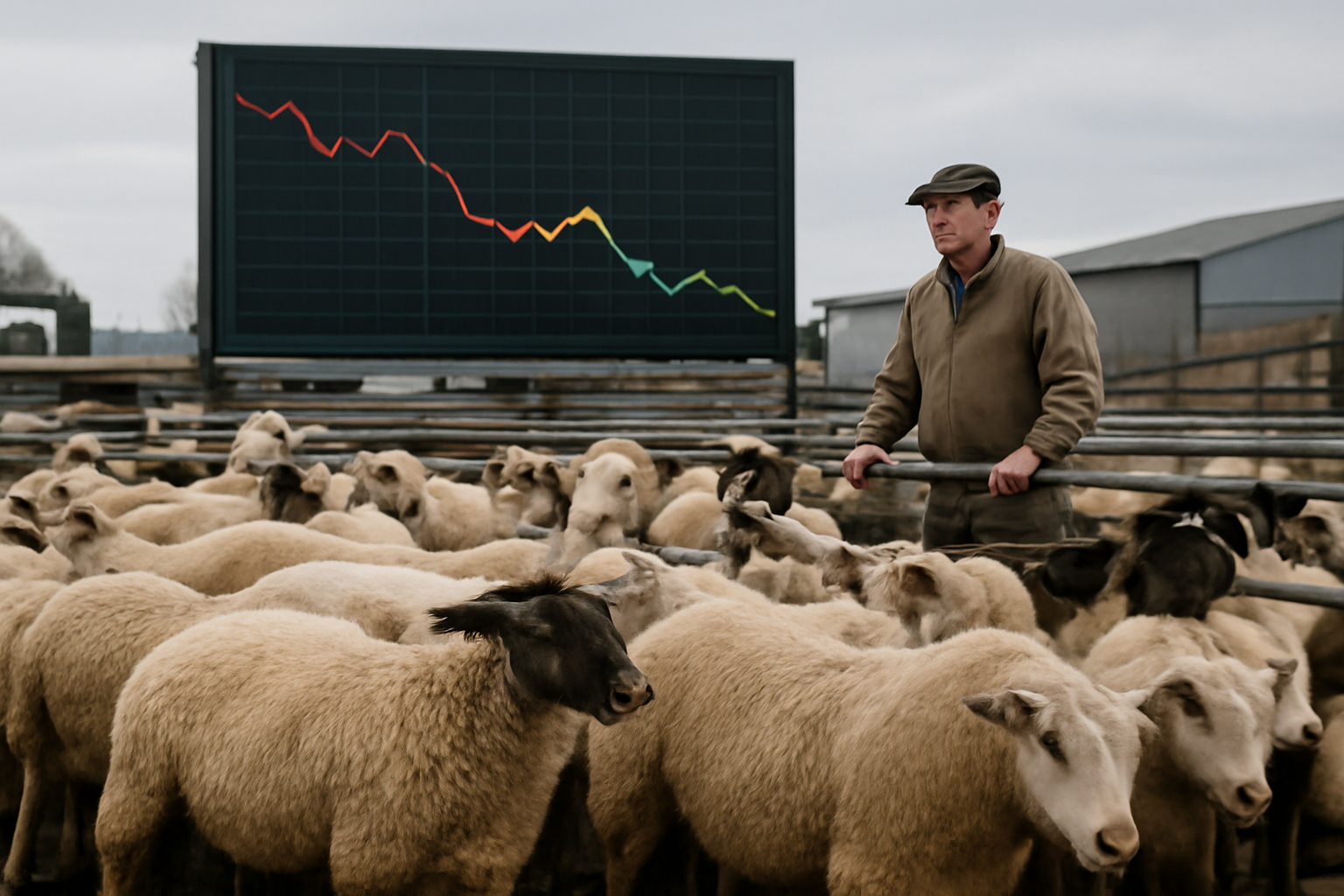
High prices have failed to halt the long-term contraction of the European Union's sheep and goat sector. According to the European Commission's weekly Sheep Meat Dashboard, with figures updated on 12 August and reported by the Greek agricultural outlet ypaithros.gr, EU sheep slaughterings in the first four months of 2026 fell 1.9% year on year, while goat slaughterings were down 1.2%. Lamb quotations, meanwhile, remain well above their year-earlier levels.
Greece leads on goat meat, third on sheep
Greek sheep slaughterings reached 17,100 tonnes through April 2026, up 2% on the same period of 2025, placing the country fourth in the EU behind Spain, France and Ireland. In goat meat Greece remains by far the bloc's largest producer, with 7,100 tonnes to April despite a 1% annual decline. France followed with 2,800 tonnes and Spain with 2,600 tonnes.
Full-year 2025 shares confirm that position: Greece accounted for 15% of EU sheep meat production, third in the bloc, and for 34% of goat meat, well ahead of Romania at 19% and Spain at 18%.
Prices firm, output falling
The heavy lamb price, for carcasses above 13 kilograms, stood at €903.1 per 100 kilograms of carcass weight, down 0.1% on the week and 1.4% on the month but 4.5% higher than a year earlier. Light lamb, up to 13 kilograms of carcass weight, was quoted at €947.3 per 100 kilograms, up 0.6% on the week, 0.2% on the month and 5.3% on the year. Greece has notified no price since week 22 of 2026, leaving a gap in the picture of its domestic light lamb market at a time when European quotations are unusually strong. In Great Britain and Northern Ireland prices at times exceeded €1,000 per 100 kilograms before easing in recent weeks, while New Zealand, Australia and Uruguay trade lower.
Slaughter volumes tell a different story. Through April 2026:
- Spain: 30,500 tonnes, down 8%, still the largest EU producer
- France: 23,400 tonnes, up 2%
- Ireland: 17,800 tonnes, down 1%
- Greece: 17,100 tonnes, up 2%
- Italy: 10,500 tonnes
- Germany: 5,800 tonnes
- Romania: 5,500 tonnes
Goat slaughterings fell in Greece, France and Spain, with particularly sharp declines in Austria and Portugal. Behind the flow numbers lies an erosion of the breeding base. December 2025 data put the sheep flock of the 17 member states covered at 52.42 million head, against 60.92 million in 2015, a fall of more than 14% in a decade. The goat herd across 16 member states dropped to 9.72 million head from 12.17 million. Production costs, difficulty in renewing stock and an ageing farming population limit the sector's ability to respond to price signals.
Import dependence at a decade high
EU exports of sheep and goat meat fell 4% in January-April 2026 to 35,035 tonnes carcass weight equivalent, from 36,435 tonnes a year earlier, while imports rose 6% to 67,580 tonnes. New Zealand supplied 31,846 tonnes, up 13%, and the United Kingdom 30,184 tonnes. Shipments from Australia rose 18% and those from North Macedonia 9%.
On the export side, Algeria increased purchases of EU sheep and goat meat by 65% to 15,667 tonnes, with gains also recorded to Israel and the United Kingdom, while volumes to Jordan and Saudi Arabia fell significantly.
Net EU production is forecast at 471,200 tonnes in 2026, against 572,000 tonnes in 2016, a decline of almost 18%. Consumption has also fallen, from 701,200 tonnes to 621,900 tonnes over the same period, but more slowly. As a result EU self-sufficiency has slipped to 83.6%, from 88.9% in 2016 and 95.5% in 2021, the lowest level of the decade under review.
Trade with the United Kingdom illustrates the imbalance. In the first four months of 2026 the EU exported 4,087 tonnes of sheep and goat meat to the British market and imported 29,566 tonnes. In live animals the gap is wider still: EU exports to the United Kingdom totalled 10 head, against imports of 795,369 head, almost all of them from Northern Ireland.