EU food-waste directive brings restaurants into 30% reduction target by 2030
EU Directive 2025/1892 sets a binding 30% per capita food-waste cut by 2030 for retail, distribution, catering and households, measured against the 2021-2023 average. Italian household waste fell to 554 grams per capita per week in 2026, while Waste Watcher data for IIAS put frozen products at 2.2% of measured waste.
Food waste costs the European Union more than €130 billion a year and is associated with roughly 16% of the greenhouse gas emissions of the food system, according to Italia a Tavola. EU Directive 2025/1892 converts that cost into a binding obligation, setting reduction targets for 2030 that for the first time place restaurants and catering services inside the same perimeter as retail and households.
A binding 30% cut by 2030
The directive requires a 30% per capita reduction in food waste by 2030, calculated against the 2021-2023 annual average. The target applies to retail trade, distribution, food service and households alike, which makes professional kitchens a formal part of the compliance chain rather than a peripheral contributor.
Italy enters the period from an improving position. Domestic food waste fell to 554 grams per capita per week in 2026, 63.9 grams below the previous survey, Italia a Tavola reported. That figure covers households only; the directive's scope runs across the whole chain, from families to professional kitchens.
Frozen products at 2.2% of measured waste
Frozen food sits among the categories with the lowest waste incidence. The Waste Watcher survey carried out for IIAS, the Italian frozen food institute, in 2025 found that of 667.4 grams of food wasted weekly by each Italian, 14.9 grams were frozen products — 2.2% of the total. The same research recorded waste 37.6% lower than for fresh vegetables.
The survey attributes the gap to three product characteristics:
- long shelf life, which removes the deadline pressure that pushes fresh produce into the bin;
- portionability, allowing a kitchen to take only the quantity needed and keep the rest;
- the absence or reduction of preparation waste, since the product arrives washed, trimmed and ready to cook.
“Frozen products prove a valuable help thanks to their intrinsic qualities,” said Giorgio Donegani, president of IIAS. “Vegetables, for example, when frozen keep for a long time, are available all year round, have no waste, are already washed, trimmed and ready to be cooked, and are easily portioned.”
Catering procurement and the menu-labelling question
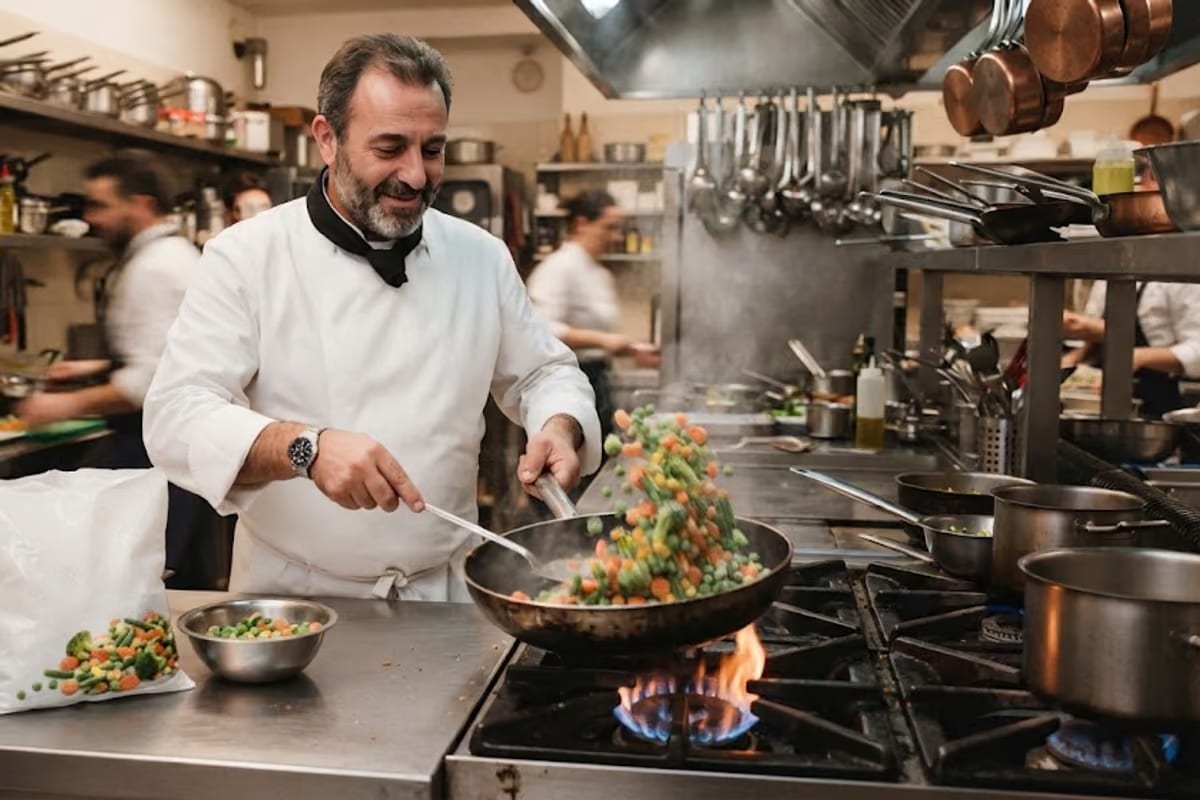
For restaurants, canteens and other catering operations, the programmability of purchases and the ability to dose quantities become waste-management tools under the new rules. The point carries particular weight in collective catering, where meal forecasting and continuity of service have to be reconciled with the volumes bought and actually used.
IIAS is also pressing for a revision of the rules governing the use of frozen products in public catering and of the obligation to declare that use on menus. Italia a Tavola notes that these are positions expressed by the trade association, not changes already introduced by the European legislation.
Nutrient retention studies
IIAS links the waste question to nutritional value, citing two studies commissioned respectively from the Italian Society of Food Science (SISA) and from SSICA, covering fish and vegetable products. The SISA literature review analysed 52 studies, with particular attention to species including cod, hake, gilthead sea bream, plaice, salmon and sea bass, and found stability in components such as proteins, lipids and Omega 3 during storage.
The SSICA study examined peas, green beans, broccoli and spinach, assessing the capacity of rapid freezing to preserve nutrients and bioactive compounds over time. Taken together, the two lines of research reframe waste as more than what ends up in the bin: it also covers how much of a food's value is lost before it reaches the plate, and how far preservation techniques can limit that loss.