EU’s €48.1 million Cameroon banana program raised yields but failed to diversify exports
European Union support helped Cameroon’s banana producers improve yields, reduce post-harvest losses and upgrade infrastructure between 2013 and 2024. However, 98%-99% of exports still go to Europe, leaving the industry dependent on one regional market.
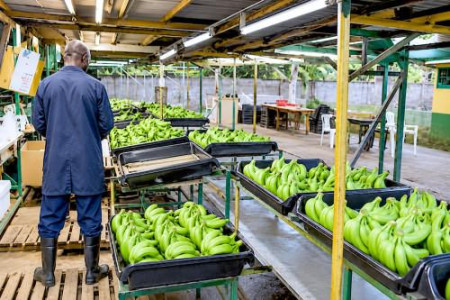
Thirteen years of support raised farm performance
The European Union provided €48.1 million, about CFAF 31.6 billion, to Cameroon’s banana industry between 2013 and 2024 as producers faced stronger competition following the erosion of European tariff preferences. Business in Cameroon reported that the Banana Accompanying Measures Program helped improve yields, reduce post-harvest losses and modernize part of the sector’s infrastructure. The initial funding allocation was €48.29 million.
The program was designed to help Cameroon adjust to the European market after the 2009 Geneva Agreement provided for gradual tariff reductions on bananas imported under most-favored-nation terms. Cameroonian bananas continued to enter the European Union duty-free under the Economic Partnership Agreement, but lower tariffs for competing suppliers increased pressure from Latin American producers.
Most support went to Plantations du Haut Penja, or PHP, Cameroon Development Corporation, or CDC, and Boh Plantations Limited, or BPL. The Association bananière du Cameroun and the Centre africain de recherches sur bananiers et plantains also received funding. According to the final evaluation, Cameroon exported 2.533 million tonnes of bananas during the program period.
Yields and employment improved unevenly
At PHP, yields stabilized at 46 tonnes per hectare and post-harvest losses declined to 11% from 22%. Export prices rose by 15%, while the company added 1,703 direct jobs, an increase of 31%. Female employment increased by 66%. PHP used about 99% of its allocated funding.
BPL increased export volumes by 96%, created 250 direct jobs and generated more than 1,000 indirect jobs. Private capital covered 95% of its investment, while the company used about 95% of the program funding allocated to it. At CDC, yields increased to 40 tonnes per hectare from 27 tonnes and losses fell to 8% from 21%, although only 71% of allocated funding was used.
CDC also recorded the program’s largest social setback. The security crisis in Cameroon’s Northwest and Southwest regions led to the loss of more than 3,500 jobs and the temporary layoff of more than 2,000 employees. Its operating area contracted by 65%, prompting evaluators to recommend an externally led restructuring of the state-owned producer.
Market diversification remained unfinished
The program expanded shared logistics infrastructure at Douala’s mixed fruit terminal, where refrigerated power outlets increased by 169% and a 3-megawatt power plant was installed. Yet the component covering alternative logistics, new markets and a joint “Banane Afrique” label was never implemented, despite an allocation of €2.73 million. Consequently, 98%-99% of Cameroon’s banana exports still go to Europe.
Research support was also interrupted after CARBAP’s grant agreement ended on October 6, 2018, with about €329,147 disbursed. This curtailed work on Tropical Race 4 fusarium wilt, a soil-borne disease that is extremely difficult to eradicate after contamination. The evaluation recommends urgent research into resistant varieties and cooperation with Côte d’Ivoire and Ghana.
Infrastructure proposed for the next phase
Evaluators recommend shifting future European support from direct production subsidies toward infrastructure. Proposed projects include a feasibility study for a banana quay in Limbé, a high-voltage connection for plantations formerly operated by BPL and rehabilitation of roads linking the Southwest region and Moungo to Douala. Logistics represented 40% of BPL’s costs.
The report also calls for assessing markets in CEMAC, ECOWAS, North Africa and the Middle East, supported by a “Banane du Cameroun” label and existing producer certifications. Since the evaluation period, BPL’s assets have been divided between PHP and Compagnie des bananes de Mondoni. Cameroon now has three exporters—PHP, CDBM and CDC—controlled by two corporate groups. Business in Cameroon reported that PHP, despite supplying 67.3% of national export volumes in 2025, accumulated about CFAF 10.4 billion in losses during 2024 and 2025.