EU blocks and tightens curbs on Brazilian meat and honey imports
The European Union has imposed an import veto and tightened restrictions on meat and honey from Brazil, two categories that had been gaining share in the European market. Meat access depends on plant-level veterinary approval, honey on authenticity controls, so a measure covering both points to the sanitary side of the relationship. The move adds friction to EU-Mercosur trade ties, where agricultural access is the most contested issue.
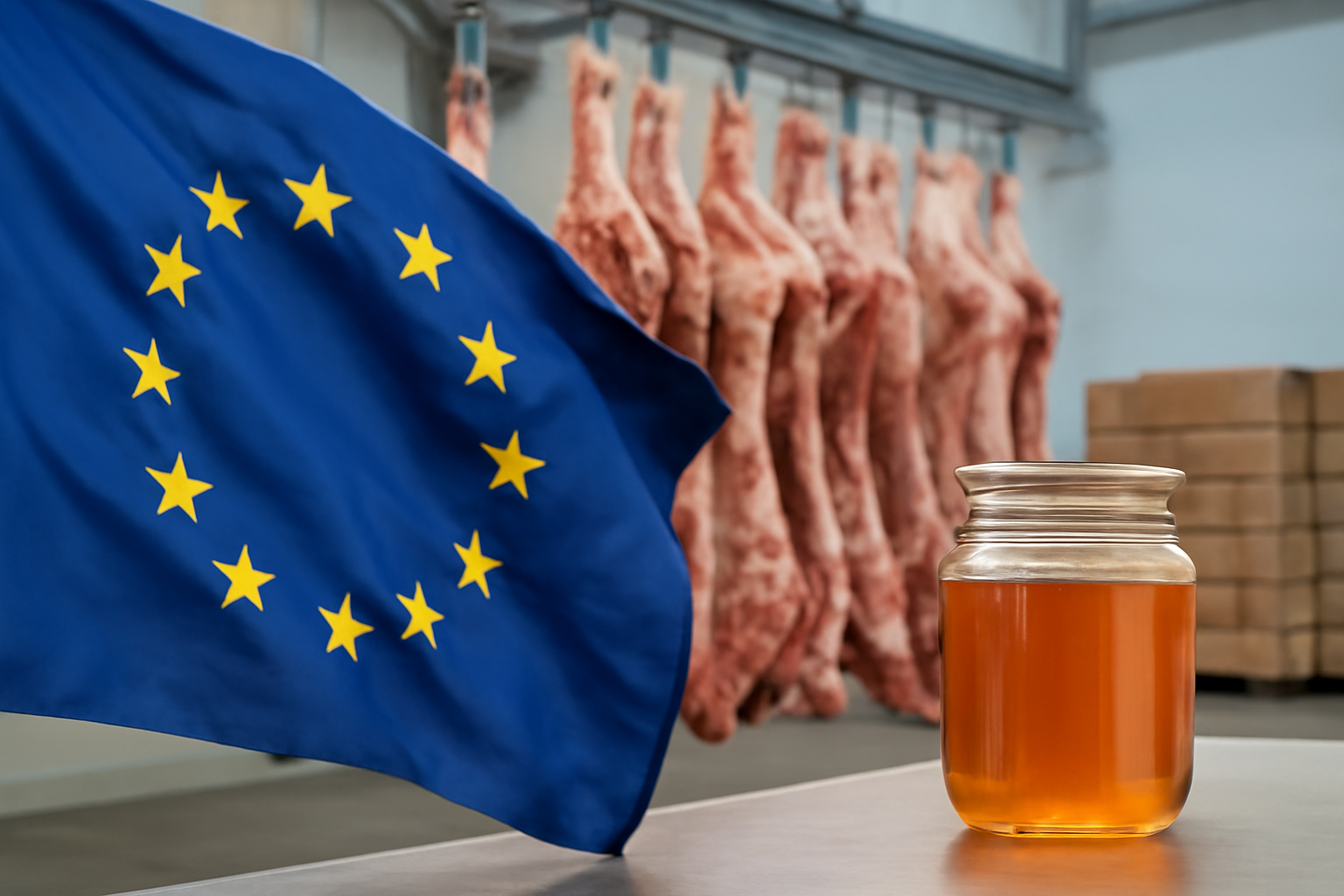
Brussels closes the door on two growing export lines
The European Union has introduced an import veto and tightened restrictions on Brazilian meat and honey. The measure hits two product lines that had been gaining share in the European market and adds a new point of friction to trade relations between the bloc and Mercosur.
Meat and honey normally sit in separate regulatory files in Brussels. Access for meat depends on veterinary approval of individual slaughterhouses and processing plants, on national residue-monitoring plans and on tariff-rate quotas. Honey is controlled mainly through authenticity and adulteration testing, together with country-level residue programmes. An action touching both categories at once points to the sanitary and control side of the relationship rather than to commercial policy alone.
Two supply chains, two sets of consequences
For meat exporters, the immediate problem is redirection. Chilled beef and poultry have short shelf lives and are shipped against contracts already priced for European buyers. Product that cannot enter the bloc has to be moved to alternative destinations at short notice, usually at a discount, or diverted into the domestic market. Establishments that had invested in EU-specific certification lose the premium that certification was meant to secure.
Honey is a smaller trade by value but a more volatile one. European packers blend honey from several origins, and switching suppliers requires new authenticity testing and requalification. Because honey stores well and substitutes across origins, buyers can cover short-term needs elsewhere, but a prolonged restriction reshapes sourcing patterns for entire seasons.
Another strain on EU-Mercosur ties
The restrictions arrive while the European Union and Mercosur are working through ratification and implementation of their trade agreement, in which agricultural access has been the most contested chapter. European farm organisations have argued that South American production standards are not equivalent to their own, while Brazilian agribusiness has repeatedly described EU sanitary and environmental requirements as non-tariff barriers.
Each side reads a measure of this kind through that lens. For Brussels, a veto is a technical instrument applied to imports that fail to meet the bloc's rules. For Brazilian exporters and their government, it lands as a commercial signal at a moment when Brazilian product was displacing other origins on European shelves.
What exporters and buyers are watching
The commercial impact depends on details that determine how much volume is actually affected and for how long:
- whether the veto covers all Brazilian establishments or a defined list of plants;
- the duration of the measure and the conditions Brazil must meet for it to be lifted;
- the treatment of consignments already in transit or held in EU cold stores and bonded warehouses;
- which origins step into the gap in Europe, and where redirected Brazilian volumes land.
Until the technical scope is published, price effects will be difficult to isolate. European wholesale quotations for beef and poultry respond quickly to supply gaps, while honey prices move more slowly because stocks buffer the market. For Brazilian producers, the risk is less an immediate volume shock than the loss of a premium outlet at a time when the cost of EU compliance has already been incurred at plant level.