El Niño could lift cocoa prices toward $10,000 a tonne and raise Peru’s export earnings
Possible El Niño damage to crops in Ghana and Côte d’Ivoire could push cocoa prices back toward $10,000 a tonne, according to Peru’s App Cacao. Peru expects cocoa exports to exceed $1 billion this year, but its own producers also face weather and logistics risks.
West African supply faces renewed weather risk
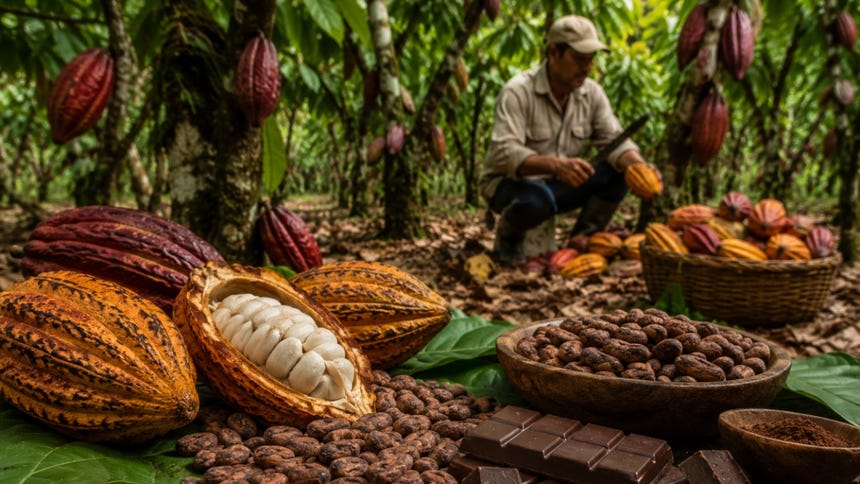
El Niño could drive international cocoa prices back toward $10,000 a tonne if adverse weather reduces production in Ghana and Côte d’Ivoire, according to Luis Mendoza, manager of the Peruvian Association of Cocoa Producers, or App Cacao. The two West African countries account for more than 60% of global cocoa supply, making their harvests central to prices paid by chocolate manufacturers and processors worldwide.
Mendoza told RPP that cocoa currently averages about $6,000 a tonne after reaching historic highs during 2024 and 2025 because of African supply problems. Prices fell as low as $4,000 a tonne during the first four months of 2026, but the association expects a more favorable market during the remainder of the year.
Peruvian cocoa exports exceeded $1.5 billion last year as international prices traded between $6,000 and $10,000 a tonne amid lower production in Ghana and Côte d’Ivoire. App Cacao expects exports to surpass $1 billion this year. A renewed price increase would raise foreign-currency revenue even without a comparable expansion in shipment volumes.
Peru’s export sector could benefit
About 85% of Peru’s cocoa production is exported as beans, paste, powder and other products, leaving growers and exporters highly exposed to international quotations. National output is increasing by between 10% and 12% annually, supported by new cultivation areas and stronger foreign demand.
Foreign Trade and Tourism Minister Berthin Gómez said Peru supplies 70 markets and is Latin America’s second-largest exporter of cocoa beans and the sixth-largest worldwide. In production terms, Peru ranks fourth in Latin America, behind Ecuador and Brazil, while Colombia also has a significant domestic market. Peruvian cocoa and chocolate already reach Europe, the United States and Asia.
China remains an important gap in that market coverage. Peru can ship cocoa derivatives and chocolate there, but not cocoa beans because sanitary access has yet to be secured. Mendoza called on the government to accelerate phytosanitary work, arguing that access for beans would broaden demand for a sector dominated by small farming families in rural and Amazonian areas.
Domestic weather and logistics remain risks
El Niño would not benefit every Peruvian producer. Heavy rain could directly damage crops in northern coastal areas such as Piura. In the Amazon, which supplies most of the country’s cocoa, wetter conditions could encourage pests and diseases, while landslides and damaged roads could disrupt the movement of beans.
Producers using synthetic fertilizers are also exposed to higher fertilizer and fuel costs linked by Mendoza to geopolitical conflicts and disruptions affecting diesel and other petroleum products. Peru’s substantial organic cocoa segment has some protection because it relies more heavily on inputs produced by farmers themselves, although other growers remain vulnerable.
Peru is seeking additional commercial opportunities at the XVII International Cocoa and Chocolate Show, held from July 16 to 19. PROMPERÚ expects its international business round to generate about $10 million in agreements. The program brings together 33 Peruvian companies and 22 international companies, with buyers from Germany, Belgium, Canada, Argentina, Italy, the Netherlands, Portugal, France, Austria, the United States, Chile and Denmark.