Egypt in Talks to Join Turkey's KAAN Fifth-Generation Fighter Programme
Ankara and Cairo are exploring Egyptian participation in Turkey's KAAN fifth-generation fighter programme and the joint production options attached to it, according to a report by the US-based publication Al-Monitor. The discussions coincide with the 2nd El Alamein International Airshow, where TUSAŞ, ASELSAN and MKE are exhibiting. No contract, workshare or delivery schedule has been announced.
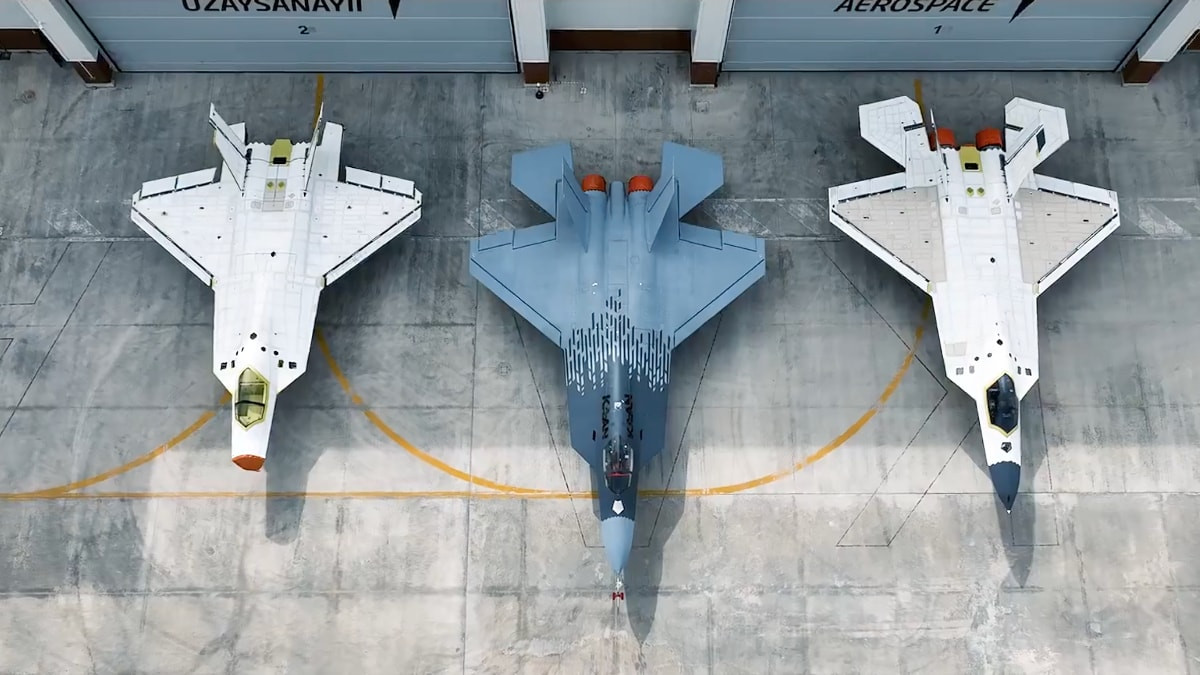
Egypt is preparing to become a partner in Turkey's KAAN fifth-generation fighter programme, the US-based publication Al-Monitor reported, in an account carried by the Turkish news site ensonhaber.com. Ankara and Cairo are examining Egypt's possible participation in the programme and the joint production options tied to it. The talks remain exploratory: no contract, workshare, price or delivery schedule has been made public.
The reported KAAN opening sits inside a broader push by Ankara to widen arms sales to Cairo and raise defence export revenue. Egypt, which fields one of the largest armed forces in the region, is described as a potentially significant market for Turkish defence companies, offering not only direct sales but also joint production and technology transfer.
Three Turkish manufacturers at El Alamein
Turkey's three leading defence manufacturers are exhibiting their newest systems at the 2nd El Alamein International Airshow in Egypt this week. According to Egypt's Ministry of Defence, the event runs from Tuesday to Thursday and brings together more than 250 participants from 50 countries. Egyptian authorities expect around 12,000 visitors, more than 100 aircraft and over 50 flying displays at what they describe as one of the largest aerospace events in Africa and the Middle East.
The Turkish presence is built around TUSAŞ, the country's largest aerospace manufacturer, defence electronics group ASELSAN and state-owned weapons and ammunition producer MKE. TUSAŞ is showing KAAN, the domestically developed next-generation fighter expected to enter operational service with the Turkish Air Force in the 2030s. MKE is displaying TOLGA, a domestically produced close-in air defence system designed to detect, track and neutralise cruise missiles and other low-altitude air threats. ASELSAN is presenting radar, air defence, electronic warfare, communications and precision-guided weapons technologies.
From naval drills to a letter of intent
Military cooperation between the two countries gained momentum in September 2025, when Turkey and Egypt held their first joint naval exercise in the Eastern Mediterranean in 13 years. In July, Turkish special forces trained alongside Egyptian airborne and special forces in Egypt in an exercise designated Golden Eagle 2026. Turkish Defence Minister Yaşar Güler and his Egyptian counterpart Eşref Salem Zaher signed a letter of intent on defence cooperation during Zaher's visit to Ankara on 13 July. That letter remains the highest-level document publicly confirmed between the two ministries, and the KAAN discussion currently sits beneath it as an option under study rather than a signed commitment.
Eastern Mediterranean calculus
Beyond the commercial dimension, closer security coordination with Cairo carries strategic weight for Ankara. Egypt is a significant power in the Eastern Mediterranean, and a working defence relationship with it could help Turkey balance the deepening military cooperation between Greece, Israel and the Republic of Cyprus. That regional arithmetic is one reason the KAAN option is being examined at all, alongside the industrial logic of spreading development cost across more than one national budget.
A parallel track with Saudi Arabia
Turkey's regional opening is not limited to Egypt. According to the newspaper Asharq Al-Awsat, a broad cooperation period has begun between Saudi Arabia and Turkey spanning the economy and the defence industry. The paper reports that economic ties between the two countries are moving beyond growth in trade volume and traditional investment towards long-term industrial partnerships in renewable energy, defence, tourism and logistics, combining capital, expertise and technology. Energy and defence stand out as the two most strategic pillars, with the two sides working towards an economic model based on joint investment, technology transfer and the localisation of industry. In defence specifically, Asharq Al-Awsat describes a shift away from product sales and export agreements alone towards the development of joint production capacity.