Crete livestock farmers face €0.50 milk discount as feed costs rise 25%
Cretan sheep and goat milk is fetching barely €1.40 per kilogram, compared with reported agreements of up to €1.90 elsewhere in Greece. Producers also face a 25% additional burden on feed and delays in receiving their 2026 support payments.
A €0.50 gap in sheep and goat milk prices
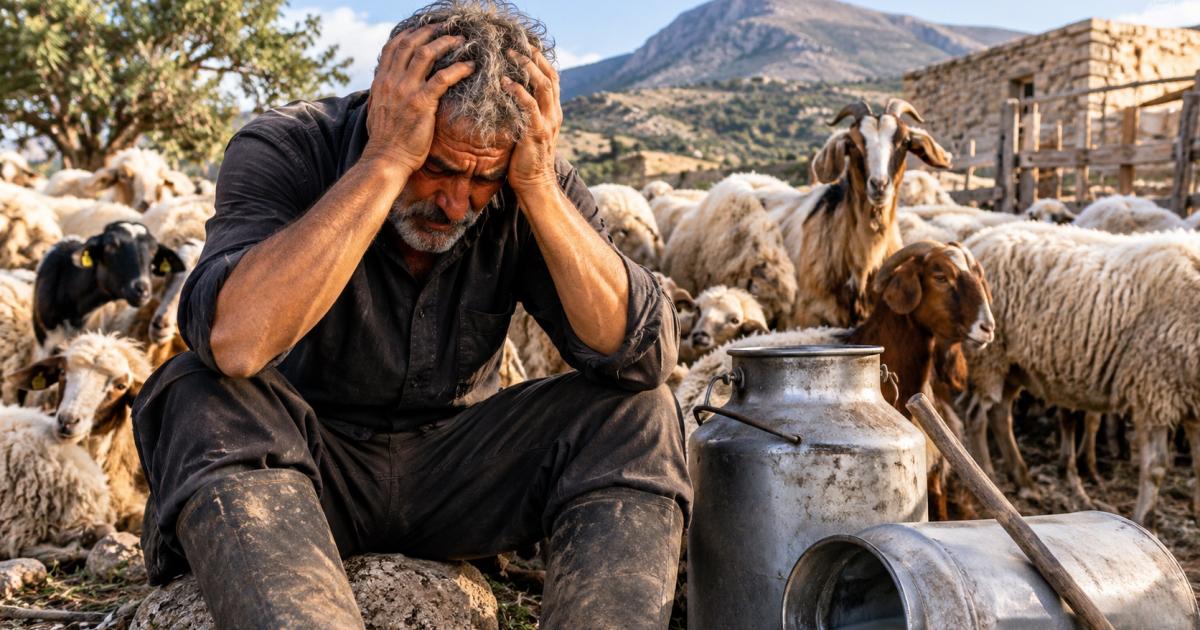
Livestock farmers in Crete are facing a widening gap between the price paid for sheep and goat milk on the island and reported levels elsewhere in Greece. According to the Heraklion Livestock Farmers’ Association, milk in the rest of the country is selling for as much as €1.90 per kilogram, while the Cretan price barely reaches €1.40 per kilogram.
The difference of €0.50 per kilogram represents a discount of more than a quarter against the reported higher price. The association says the disparity is not a one-off event but a persistent problem for the island’s livestock sector. Nea Kriti reports that farmers are questioning whether the gap reflects different processing, marketing and demand conditions or practices that weaken their negotiating position.
Fresh milk is difficult to transport beyond the island, while freight costs and the dependence of many small farms on a limited group of buyers can put downward pressure on prices. Nea Kriti notes that no sufficient evidence has been presented to prove coordination among buyers. It nevertheless argues that the market requires scrutiny, including the number of effective purchasers, price-setting methods, written contract terms and the producer’s share of the final value of dairy products.
Feed and energy costs tighten liquidity
The milk-price gap comes as farms contend with rising operating expenses. Creta One reports that the existing costs of diesel, electricity and transporting feed from mainland Greece have been compounded by an additional 25% burden on corn, soy and other feed products. Veterinary services and general transport expenses are also adding to producers’ bills.
These costs are especially difficult to absorb when the principal farm output is sold at a lower price than comparable production elsewhere in the country. The combination reduces the cash available for feed purchases, animal care and routine operations. If margins remain compressed, producers may have less capacity to maintain herds, which would create risks for the future supply of local milk to Cretan dairies and processors.
The island’s geography limits farmers’ ability to redirect perishable raw milk quickly to competing buyers on the mainland. That gives local processing capacity, purchasing competition and contract conditions an important role in farm-gate price formation. The dispute therefore concerns not only the current milk price but also the resilience of Crete’s regional dairy supply chain.
Support payments and land rules add pressure
Following a general assembly on 18 November 2026, the Heraklion association said in a statement issued on 19 November that its members had not received any of the 2026 support payments to which they were entitled. It also criticised plans to pay a portion on 30 November, describing the expected transfer as only a small part of the money due and saying it remained unclear which farmers would receive it before year-end.
Producers also raised concerns about pasture eligibility and property registration. According to Creta One, the association says Cretan pastures continue to be treated as ineligible, forcing farmers to use the so-called Technical Solution. It also objects to land being recorded as belonging to an unknown owner or treated as forest where farmers consider it their property.
The association sent its statement to the responsible ministry and the Independent Authority for Public Revenue, with copies to the prime minister and deputy prime minister. It also decided to seek meetings with the Region of Crete, the island’s members of parliament and other producer organisations. For farmers, faster support payments could ease immediate liquidity pressure, but the longer-term issue remains the interaction between feed costs, limited buyer competition and a milk price reported at €0.50 per kilogram below the upper level available elsewhere in Greece.