Cocoa futures rise after Ghana proposes 6% higher farmgate price for 2026/27
Ghana's cocoa regulator has proposed raising the price paid to farmers by roughly 6 per cent for the 2026/27 season. Cocoa futures strengthened on the news as traders covered short positions and reassessed the supply outlook from one of the world's two largest producers.
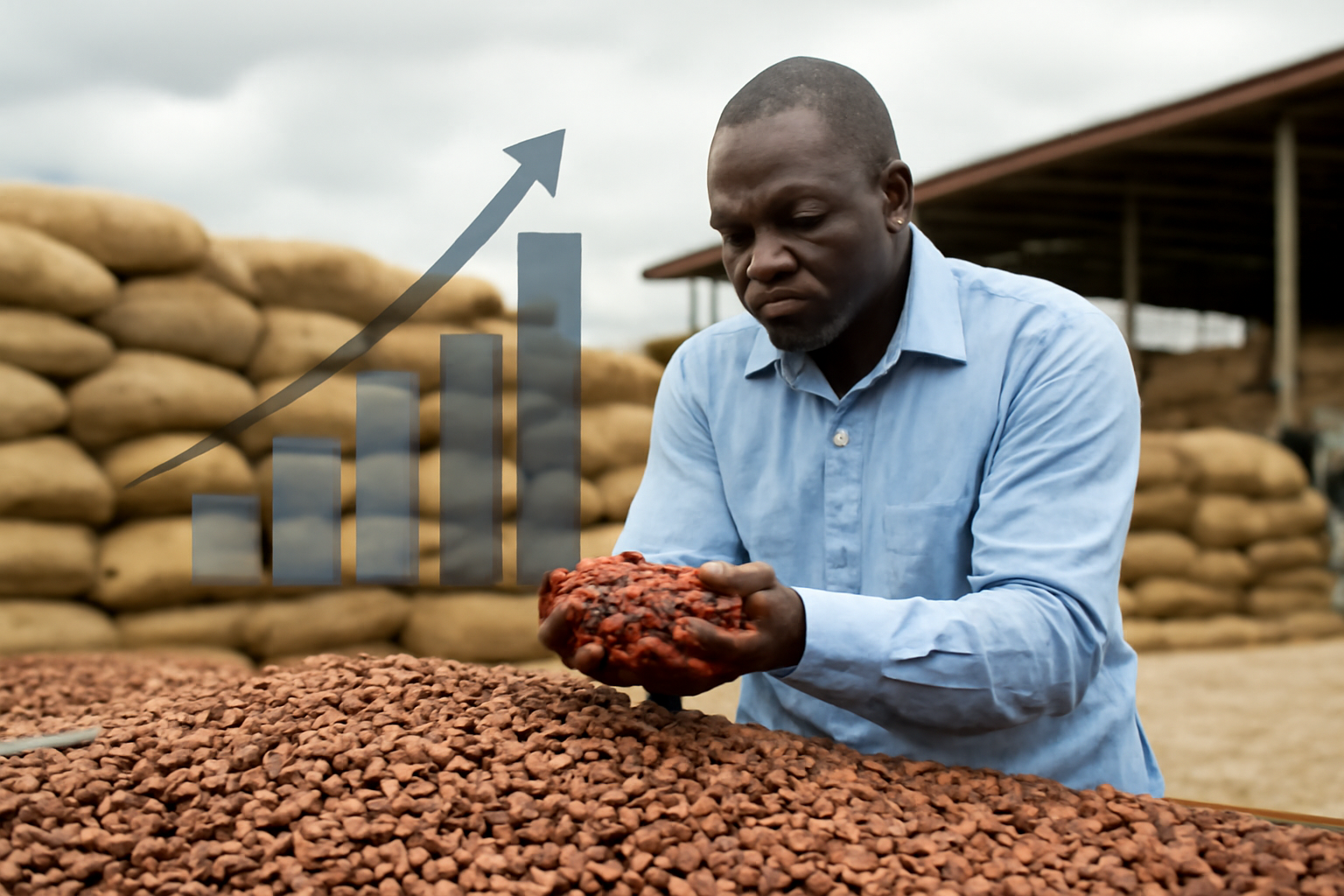
Cocoa futures strengthened after Ghana's cocoa regulator proposed raising the price paid to the country's farmers by roughly 6 per cent for the 2026/27 season. The move prompted short covering in the futures market as traders reassessed the supply outlook from one of the world's two largest cocoa producers.
What the regulator has proposed
The proposal concerns the farmgate price — the fixed rate at which Ghanaian cocoa farmers sell their beans into the state-controlled marketing system. Unlike growers in most agricultural markets, Ghanaian farmers do not negotiate against world prices directly. The regulator sets a single price for the season, buys the crop through licensed companies and channels it into the export market, which makes the annual price decision one of the most closely watched policy events in the soft commodities calendar.
At this stage the roughly 6 per cent increase is a proposal rather than a confirmed figure, and it applies to the 2026/27 season. That timing matters. The price would govern beans harvested and delivered in the next marketing year, not volumes already moving through the current one. Traders therefore read the announcement as a signal about future planting and delivery behaviour rather than as an immediate change to available supply.
Why futures moved
The immediate price reaction was driven by positioning. Participants holding short positions in cocoa futures bought contracts back to close out exposure, a mechanical flow that tends to amplify upward moves in a market where liquidity is thin and open interest is concentrated among a relatively small group of commercial and financial players. Short covering of this kind says more about how traders were positioned before the news than about physical tightness.
West African farmgate announcements are treated as supply information because the administered price shapes farmer behaviour over the following season. A higher price improves the return on farm maintenance, fertiliser and replanting, and reduces the incentive to move beans informally across borders to neighbouring countries offering better returns. A price seen as too low tends to produce the opposite: under-investment in ageing tree stock and leakage of beans out of the official system.
Supply from a top-two producer
Ghana sits alongside Côte d'Ivoire as one of the two dominant origins in world cocoa, so its pricing decisions carry weight well beyond domestic policy. Grinders, trade houses and manufacturers track the farmgate level as an input into their expectations for the volume that will reach official buying stations in the following season, and for the credibility of forward sales made against that crop.
The proposal does not, on its own, change production estimates. Output depends on weather through the main and light crop cycles, disease pressure in ageing plantations and the pace of rehabilitation work. What a higher farmgate price does change is the economics facing the farmer at the point where those decisions are made.
What it means for buyers
For chocolate manufacturers and industrial buyers, the relevant question is the trajectory of origin costs. Higher administered prices at source raise the floor under physical cocoa and feed through into the differentials paid over futures, even when the exchange price itself is moving on positioning flows. Buyers with hedged coverage for the near term are less exposed, but forward cover for 2026/27 is priced against exactly this kind of policy signal.
- Whether the proposed increase is confirmed at the level indicated and on the expected timetable.
- How the Ghanaian price compares with rates set by neighbouring producing countries, which determines cross-border flow incentives.
- Arrivals at official buying stations once the 2026/27 season opens, as the practical test of whether the price is high enough to keep beans inside the system.
Until the figure is confirmed, the market is trading an intention rather than a policy. The futures reaction reflects that distinction: a positioning-driven move on a forward-looking signal, in a market that has become highly sensitive to any news out of West Africa.