Industry Group Says Chinese Imports May Supply a Third of Russia’s Black Caviar
Chinese supplies may account for about one-third of black caviar sold in Russia, according to the head of the Russian Sturgeon Breeders’ Union. The industry claim raises questions about labeling, production costs and competitive pressure as domestic output rises but consumption falls.
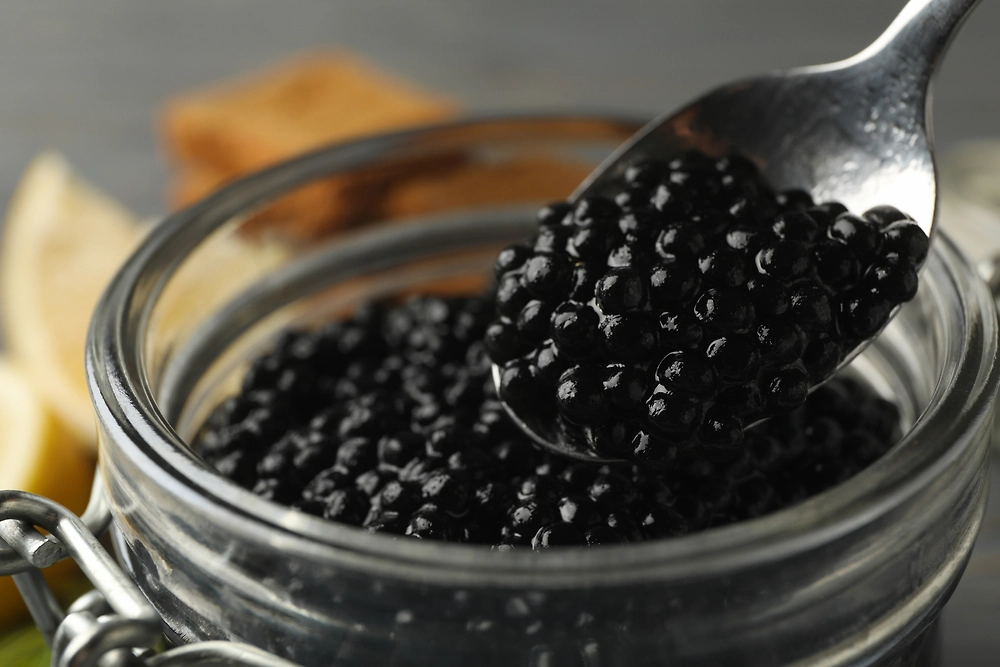
Industry group estimates a one-third import share
Chinese black caviar may account for approximately one-third of the product sold on the Russian market, Alexander Novikov, president of the Russian Sturgeon Breeders’ Union, told URA.ru in comments reported by Life.ru. He also said that some imported caviar may be presented to consumers as Russian-made, although the published account did not provide company names, shipment data or evidence identifying specific mislabeled products.
The allegation matters because origin is a central part of black caviar’s market positioning. Domestic producers compete on provenance, farming standards and product quality, while buyers may associate Russian labeling with local sturgeon farms and Russian production requirements. If imported caviar enters the same retail segment under a domestic identity, legitimate Russian farms face price competition without consumers necessarily seeing the difference in origin.
The available source does not establish whether the estimated Chinese share refers solely to officially declared imports or also includes products that Novikov believes have been relabeled after entering Russia. It therefore remains an industry estimate rather than a complete accounting of the market. Still, a share of around one-third would make Chinese supply a significant factor for processors, distributors and retailers.
Feed costs widen the price gap
Novikov attributed the lower cost of Chinese caviar partly to differences in sturgeon feed. He said Russian farms are prohibited from using genetically modified products in feed for sturgeon and rely on higher-cost ingredients. According to his account, Chinese producers can use genetically modified soybean meal, which lowers their feed bill.
Russian farms also use high-quality fishmeal formulated for sturgeon, and its price is continuing to increase, Novikov said. Chinese farms can avoid part of that expense by using cheaper meat-and-bone meal and products made from processed poultry feathers. He estimated that the price difference between those ingredients and fishmeal can reach threefold.
Novikov further said that some Chinese farms may replace natural fish oil with cheaper alternatives, including rapeseed oil, and that individual producers use processed food waste. These claims were presented as explanations for the cost difference; the source did not include responses from Chinese producers or independent comparisons of feed formulations, product quality or food-safety compliance.
Domestic production rises as sales weaken
Official statistics cited by Life.ru show that Russian black caviar production reached 69.4 tonnes in 2025, an increase of 9% from the previous year. The expansion indicates that domestic aquaculture capacity is still delivering more product despite pressure from input costs and imported competition.
Demand moved in the opposite direction. Russians bought 20% less black caviar in the first half of the year, according to the same report. The source did not specify whether the decline was measured by volume or another sales indicator, so the figure should not be used to calculate market size without additional data.
Novikov linked weaker demand partly to concerns that imported caviar is being sold as Russian, which he said can undermine buyer confidence. For domestic sturgeon farms, clearer origin labeling and product traceability would make production standards and cost differences more visible. For importers and retailers, closer scrutiny of documentation could become commercially important if regulators or customers demand stronger proof of origin.