China's share of world pork imports falls from 43% to 23% as supplier competition sharpens
China's share of global pork imports dropped from 43% in 2021 to 23% in 2025, according to Agri.BG, roughly halving the country's weight in the trade in four years. The European Union remains the leading pork exporter but is under pressure as suppliers compete for a smaller pool of demand.
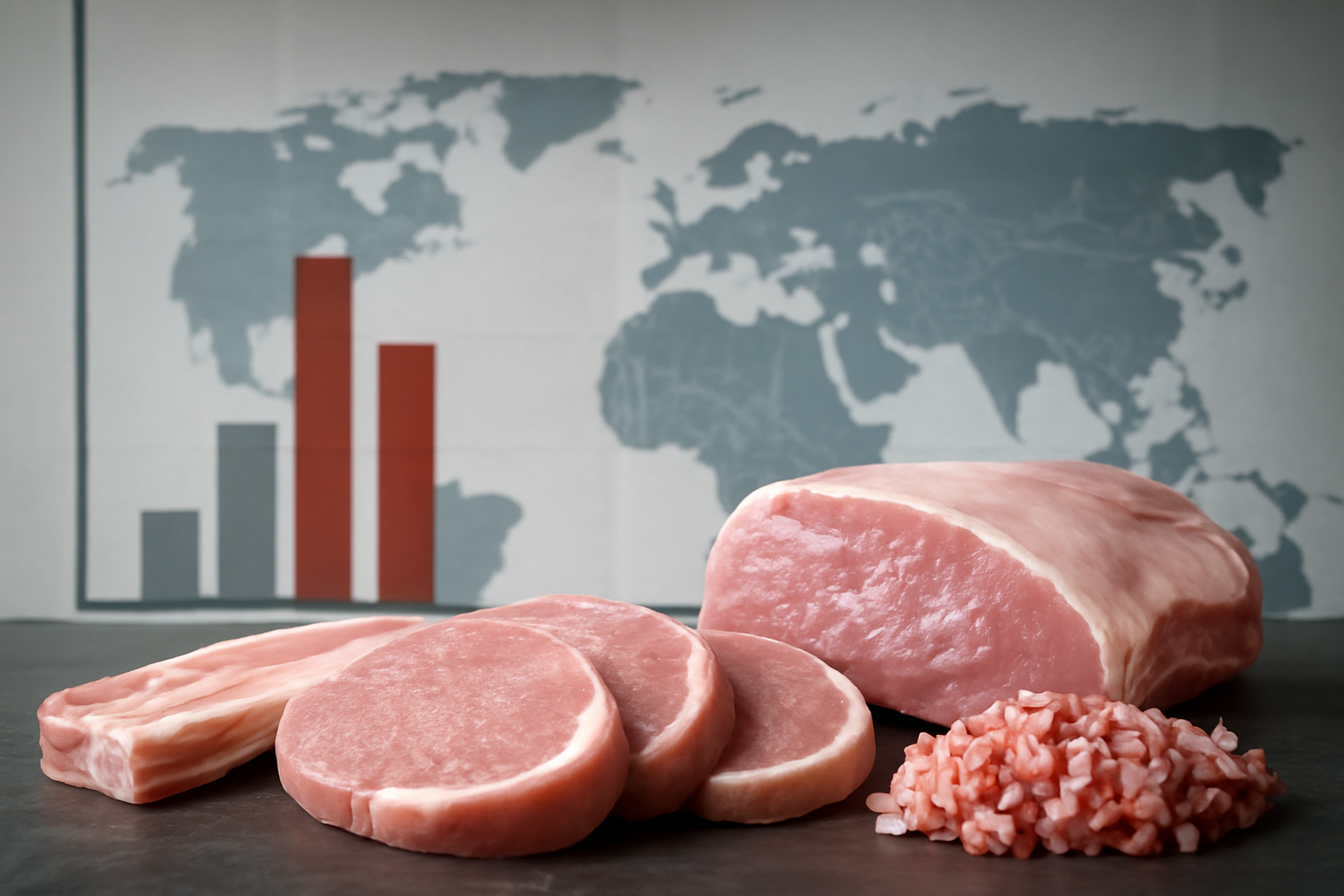
China's import share halves in four years
China's weight in the global pork trade has contracted sharply since the start of the decade. Agri.BG reports that the country's share of world pork imports fell from 43% in 2021 to 23% in 2025. In four years China has moved from taking more than four out of every ten tonnes of internationally traded pork to fewer than one in four.
The drop of 20 percentage points spans four consecutive years rather than a single weak season, which makes it a planning assumption for anyone setting export volumes rather than a one-off to be ridden out. Agri.BG does not break the decline down by supplier country or product category, and the published figures describe shares rather than tonnages. The share data still carries a clear message: China continues to import pork, but its purchases now account for a far smaller portion of world trade than they did in 2021.
The EU keeps its lead, but under pressure
The European Union remains the leading exporter of pork, according to Agri.BG, while the outlet reports that the bloc's position is under pressure as competition among suppliers intensifies. That pressure follows directly from the import numbers. A destination that accounted for 43% of world imports was by definition the single largest outlet available to exporters; at 23% it commands far less of the trade, and the volume it no longer absorbs has to be placed elsewhere.
Three consequences follow for European producers and processors:
- Volume: every tonne that once moved to China has to find another buyer abroad or stay on the domestic market.
- Price: a buyer taking 43% of world imports sets much more of the tone than one taking 23%, and competition for the demand that remains is settled on price.
- Capacity: slaughter and processing capacity, plus supply contracts sized against 2021 levels of Chinese buying, now work against a smaller external outlet.
Competition sharpens across the exporter field
Agri.BG frames the development as intensifying competition rather than a collapse in trade, and the distinction matters. Pork still crosses borders in large volumes; what has changed is where the demand sits and how many sellers chase each remaining tonne. The same arithmetic applies to exporters outside the European Union: their surplus volume is also looking for third markets, including the destinations the EU serves.
For importers in those third markets, the shift works the other way. More sellers competing for the same orders generally improves the terms available to buyers, in price and in the flexibility of contract conditions. For processors that use imported pork as a raw material, a more contested supply field reduces the risk of being outbid by a single dominant buyer, a risk that was material when one destination accounted for 43% of world imports.
What the numbers do and do not say
The Agri.BG figures set out a share trend, not the reasons behind it. No tonnage, price or per-country data accompany the percentages in the published report, and the outlet does not state whether the fall reflects weaker Chinese consumption, higher domestic output, or both. Analysts should treat the move from 43% to 23% as the headline indicator and wait for volume data before sizing the effect on individual suppliers.
What is already usable for planning is the direction and the scale. China is not the swing buyer it was in 2021. The European Union is defending an export lead in a smaller and more contested arena. And exporters that built volume around a single destination now have to rebuild it across several, at whatever price the competition allows.