Electric and plug-in hybrid cars reach record 60.4% share of China’s July sales
New energy vehicles accounted for a record 60.4% of new passenger-car sales in China in July. Domestic NEV sales fell 2.8% year on year, but exports surged 145% to 553,000 units, making overseas demand increasingly important for Chinese manufacturers.
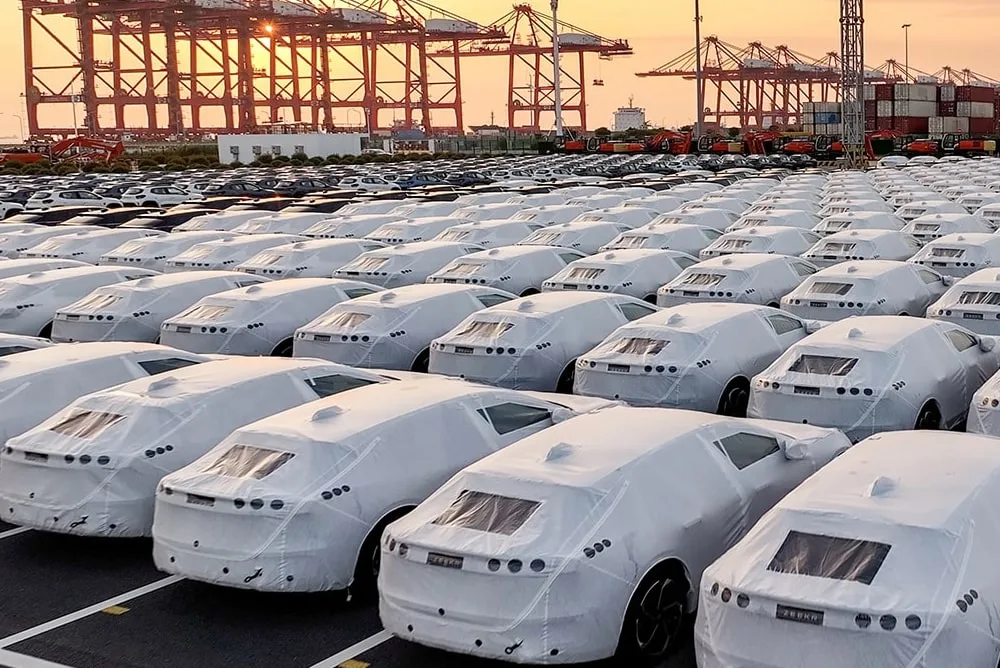
NEVs pass a new market threshold
Electric and plug-in hybrid vehicles accounted for a record 60.4% of new passenger-car sales in China in July, according to e-cars.hu. Their combined share also exceeded 50% across the first seven months of the year for the first time, marking a change in the composition of the world’s largest automotive market.
Data from the China Association of Automobile Manufacturers cited by the publication showed that 1.561 million new energy vehicles, or NEVs, were sold in July. That was 23.7% more than a year earlier but 5% below June. The monthly decline did not prevent the segment from gaining share because the wider market weakened at the same time.
China’s total passenger-car market was broadly unchanged year on year at 2.59 million vehicles. Beneath that headline, domestic sales across all powertrains fell 23.6% to 1.541 million units, while total vehicle exports jumped 81% to 1.043 million. Domestic sales of internal-combustion cars dropped 45.7%, showing that the pressure was particularly severe in the conventional segment.
Exports offset weaker domestic demand
The record NEV share did not reflect uniformly strong demand inside China. Domestic NEV sales declined 2.8% year on year to 1.008 million vehicles in July. By contrast, NEV exports rose 145% to 553,000 units, giving Chinese manufacturers an increasingly important outlet beyond their home market.
China produced 1.576 million NEVs during the month, up 26.8% from a year earlier. Exports were equivalent to about 35% of that output, meaning roughly one in three electric or plug-in hybrid vehicles manufactured in China was shipped abroad. The figures indicate that export markets are absorbing a substantial part of the industry’s expanding capacity.
This growing dependence on overseas sales has implications for automakers, battery suppliers, logistics companies and distributors outside China. Chinese producers must secure foreign sales channels as domestic purchasing weakens, while manufacturers in destination markets face a larger volume of competing vehicles from Chinese factories.
Battery-electric vehicles lead growth
Battery-electric vehicles recorded faster growth than plug-in hybrids. July BEV sales reached 1.072 million units, up 32% year on year, although they fell 6.1% from June. Plug-in hybrid sales totaled 489,000 vehicles, an increase of 8.4% from a year earlier and a decline of 2.2% month on month.
Production data reinforced the shift toward fully electric models. China manufactured more than 1 million battery-electric vehicles for a second consecutive month. Total NEV production reached 9.014 million units in the first seven months, nearly 10% above the corresponding period a year earlier.
According to the calculation published by e-cars.hu, extending that seven-month pace over the full year would put China’s 2026 NEV production at about 15.4 million to 15.5 million vehicles. That is a projection rather than an official forecast, but it illustrates the scale of capacity that Chinese manufacturers may need to place at home and abroad. The July record therefore reflects two parallel developments: electrified cars are displacing conventional models in China, while exports are becoming critical to sustaining production growth.