China, India and Indonesia dominate global coal production as demand reaches 166 EJ
China produced 4,663 million tonnes of coal in 2025, followed by India with 1,084 million tonnes and Indonesia with 790 million tonnes. Global demand increased 0.7% to 166 EJ, supported by Asian consumption and a weather-driven rebound in the United States.
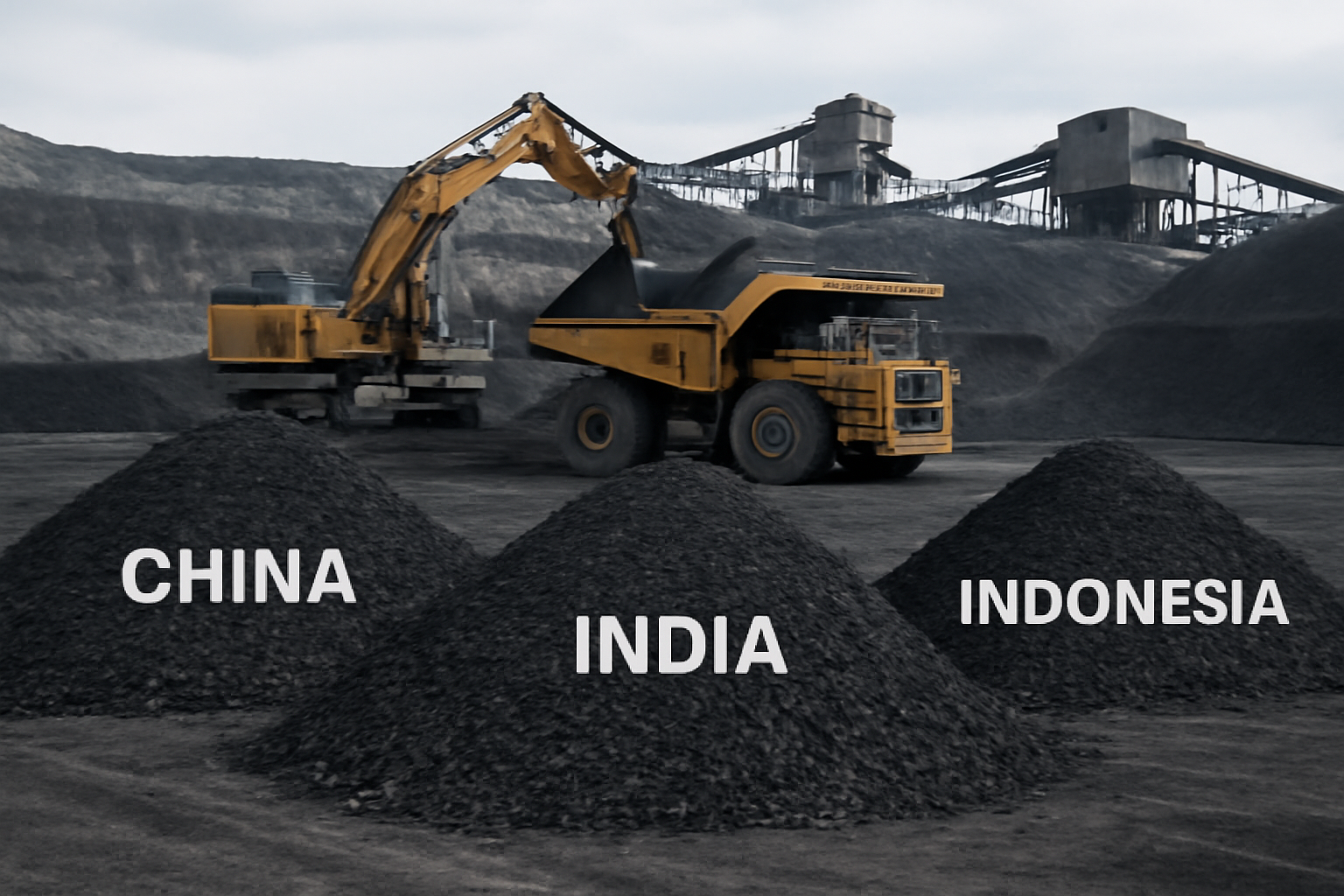
Asia anchors global coal production
China retained its position at the center of the global coal market in 2025, producing 4,663 million tonnes, according to a TAdviser compilation based on Energy Institute data. That volume represented more than half of worldwide output. India ranked second with 1,084 million tonnes, while Indonesia produced 790 million tonnes and placed third.
Russia was the sixth-largest producer, with output of 429.2 million tonnes and a 4.7% share of the global total. The rankings underline the concentration of supply in Asia, where large domestic power systems, steelmaking industries and export-oriented mines support production. Indonesia is a major source of internationally traded coal, while China and India consume much of their output within their own economies.
China and India account for most demand
Power generation and metallurgy remained the principal uses of coal in China. Coal supplied about 40% of the country’s total energy consumption in 2025. India was considerably more dependent on the fuel, which accounted for 72% of its energy mix, although its annual consumption of 1.3 billion tonnes remained below China’s.
Together, China and India generated 70% of global demand for thermal coal and 75% of demand for coking coal in 2025, TAdviser reported. This concentration makes power demand, steel production and domestic mining policy in the two countries decisive for producers and traders across the wider market. China had also accelerated construction of coal-fired power plants in 2022, according to the Centre for Research on Energy and Clean Air and Global Energy Monitor, illustrating the continuing role of coal capacity despite decarbonization policies.
Global demand rises as US consumption rebounds
Worldwide coal demand increased by 1.1 EJ in 2025 to 166 EJ, a year-on-year rise of 0.7%. Global production reached 180.8 EJ. The growth rate was similar to that recorded in 2024 and exceeded the average pace of the preceding decade.
The United States recorded a markedly different trend from the previous year. Coal consumption rose 10% to 8.73 EJ after a cold winter pushed natural gas prices up by more than 50%. Coal-fired electricity generation consequently increased by 93.2 TWh, while gas-fired generation fell by 61.8 TWh. The shift shows how fuel-price movements and weather can temporarily reverse the long-term decline of coal in mature power markets.
Europe cuts coal use but remains import-dependent
Europe continued to reduce its coal footprint in 2025: production declined 6.3% and consumption fell 3.1%. Nevertheless, imports covered 41% of the region’s coal use. Inbound supply increased 0.8% year on year to 3 EJ, leaving European buyers exposed to international availability and logistics even as aggregate demand contracted.
Kazakhstan’s earlier response to changing European sourcing patterns demonstrated how quickly trade routes can adjust. From January through May 2022, the country supplied 1.5 million tonnes of coal to the European Union, almost twice its deliveries for the whole of 2021, amid sanctions on Russian supply. Historical price data also show the market’s volatility: high-quality Asian coal exceeded $400 per tonne in January 2023, while prices had climbed from $186 to $462 per tonne between February 23 and March 14, 2022.