China and India cut green hydrogen costs to €3/kg as Spain remains Europe's only price-competitive producer
Green hydrogen produced in China and India has fallen to around €3 per kilogram, roughly half the level available in the European Union, according to EL ESPAÑOL-Invertia. Spain is the exception in Europe at €5.5/kg against €9.4/kg elsewhere on the continent, and holds 65% of European projects that have reached a final investment decision. Rising European gas prices are narrowing the gap between green and grey hydrogen in industrial applications.
Green hydrogen produced in China and India has fallen to around €3 per kilogram, roughly half the level available inside the European Union, according to sources cited by EL ESPAÑOL-Invertia. The Spanish outlet reports that prices below €6/kg are hard to find in the EU, splitting the global hydrogen race into two speeds.
The divergence matters because electrolyser technology itself is available to any country willing to deploy it. What separates producers now is the cost of the electricity that runs the equipment, the cost of capital behind the renewable assets, and the scale of the supply chain that builds them.
China's 40-45% cost advantage
According to the International Energy Agency, producing renewable hydrogen in China already costs between 40% and 45% less than in Europe or the United States. The IEA attributes the advantage to lower electricity costs, a reduced cost of capital for renewable installations, and an electrolyser supply chain developed at large scale.
Beijing is also setting increasingly aggressive price targets. The Chinese government has brought the average end-consumer price of hydrogen below 25 yuan per kilogram, around €3.16/kg, and is considering 15 yuan — about €1.90/kg — in regions with particularly favourable conditions. EL ESPAÑOL-Invertia notes that this figure refers to a targeted final price and does not necessarily equal the production cost of green hydrogen.
India pushes prices down through auctions
India is following a similar trajectory with a different instrument. In February, an auction run by Numaligarh Refinery awarded renewable hydrogen production at 279 rupees per kilogram, about €2.68/kg, the lowest price recorded in the Indian market up to that point. Nine companies took part in the tender and two other final bids came in only slightly above the winning offer, pointing to broad competitive pressure rather than a single outlier.
Europe's internal spread
European costs remain considerably higher. In the second auction of the European Hydrogen Bank, the average levelised cost of participating projects stood at €7.1/kg. The spread between countries, however, is wide:
- Spain: average cost of €5.5/kg
- Rest of Europe: average cost of €9.4/kg
- European Hydrogen Bank second auction: €7.1/kg average
- China and India: down to around €3/kg
Spain's solar and wind resources give projects access to renewable electricity at prices most European neighbours cannot match. According to data published by the French fund Hy24, Spain accounted for 65% of European projects that had reached a final investment decision.
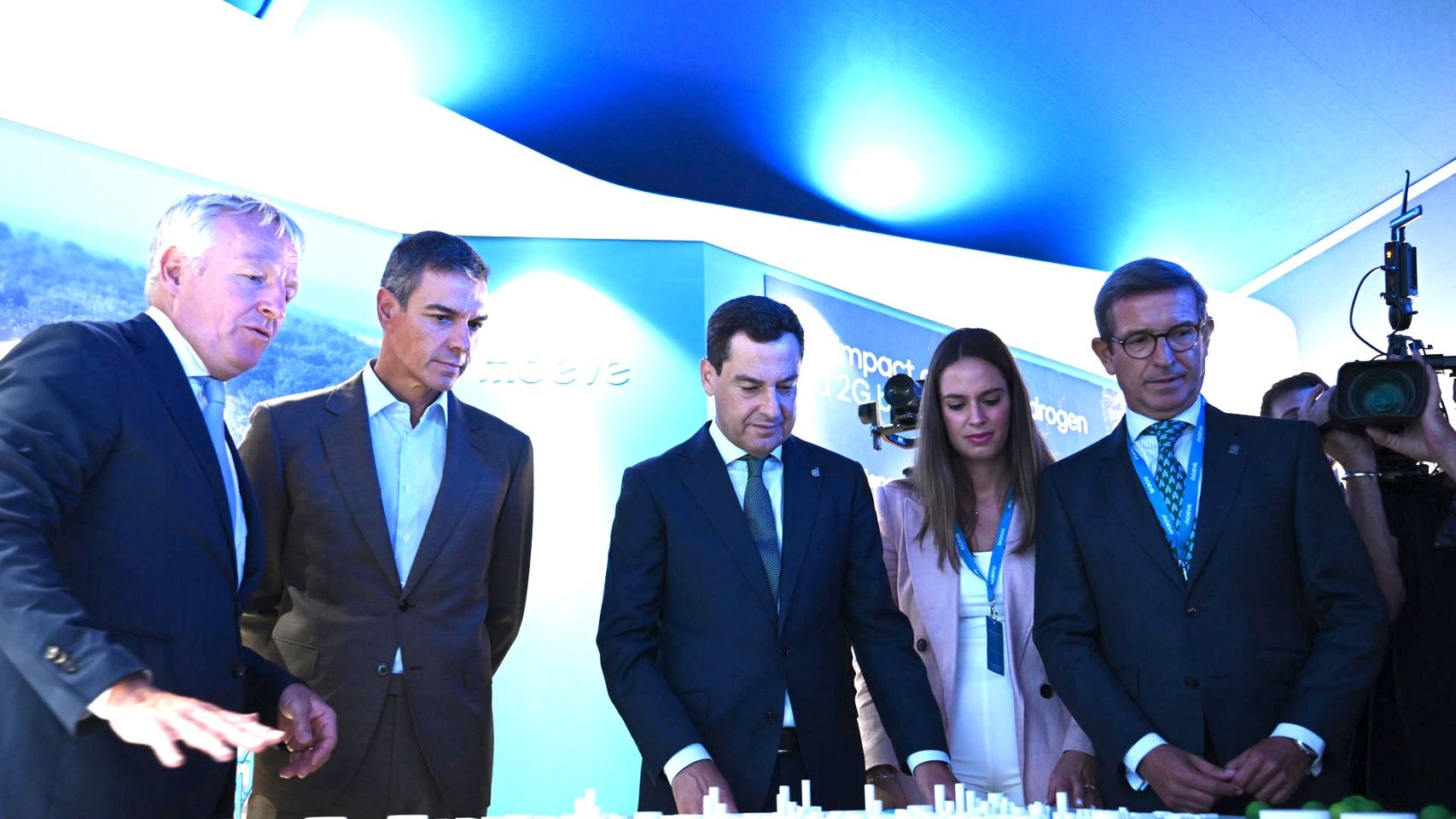
The reference project is Moeve's Onuba development at the Palos de la Frontera energy park in Huelva, described by EL ESPAÑOL-Invertia as the largest renewable hydrogen project under construction in Europe. The company laid the first stone of the 300 MW plant, and all of the hydrogen produced there will be used in its own refinery — a captive outlet rather than a merchant market, but a first step towards a market that is currently almost non-existent. The Spanish state-backed Cofides and the French fund Ardian have entered the project, while Repsol is among the other companies moving from announcements to construction.
Gas prices narrow the gap with grey hydrogen
Rising European gas prices are adding a new variable. With the Dutch TTF benchmark trading at around €80-85/MWh, the economic difference between using green molecules and continuing to rely on fossil ones is narrowing in certain industrial applications. Moeve chief executive Maarten Wetselaar said at the start of construction in Huelva that green hydrogen is competitive against grey hydrogen again because of high natural gas prices. Grey hydrogen remains the benchmark for much of European industry.
The IEA warns that cost is still one of the main obstacles to the global deployment of low-emission hydrogen. Global demand exceeded 100 million tonnes in 2025, but low-emission output remains concentrated in a relatively small number of projects. The competition is therefore no longer about who announces the most gigawatts of electrolysers: China has industrial capacity and low costs, India is using auctions to compress prices, and Europe needs sites where renewable electricity can close the gap.