China targets 28 Bcm of coal-to-gas capacity to curb reliance on imported LNG
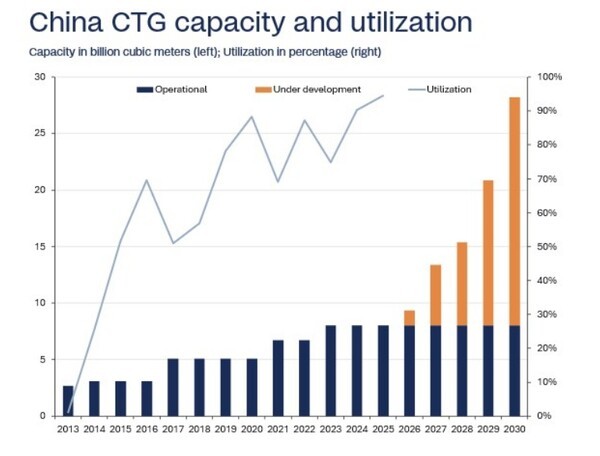
China plans to expand coal-to-gas capacity from 9.4 Bcm at the end of 2026 to 28 Bcm by 2030, according to Rystad Energy. Competitive production in Xinjiang could moderate growth in Chinese LNG demand, although water use, emissions and capital costs remain major constraints.
Coal-to-gas enters China’s national energy strategy
China is positioning coal-to-gas, or CTG, as a strategic component of its domestic energy supply, seeking to turn abundant coal reserves into synthetic natural gas and reduce exposure to imported liquefied natural gas. Energy Daily, citing a recent Rystad Energy report, said CTG has been identified as a core element of the national energy system under China’s 15th Five-Year Plan for 2026-2030.
Rystad Energy expects Chinese CTG production capacity to rise from 9.4 billion cubic metres a year at the end of 2026 to 28 billion cubic metres by 2030. The projected volume would exceed Austria’s annual natural gas consumption and establish the world’s largest coal-based synthetic gas production system.
Wei Xiong, Rystad Energy’s vice-president for gas and LNG markets, described CTG as one of several safeguards China is building against geopolitical uncertainty. The policy does not envisage replacing LNG completely. Instead, CTG will sit alongside LNG imports, pipeline gas, renewable energy and nuclear power in a more diversified supply portfolio.
Xinjiang provides the cost base for expansion
Xinjiang is emerging as the centre of the programme because of its large coal resources and low mine-mouth prices. Between April 2025 and May 2026, coal near mines in the region averaged 214 yuan, or about $30, per tonne. That was approximately 40% of the level in Inner Mongolia, according to Energy Daily’s account of the Rystad analysis.
CTG produced in Xinjiang can be delivered to eastern consumption centres for $9.1-$9.6 per MMBtu, below China’s average imported LNG price. Existing plants are operating at utilisation rates above 90%, while about 20 billion cubic metres of new CTG projects are under development, mostly in Xinjiang. Approval times have also fallen from more than three years to less than one year, accelerating investment decisions.
The expansion nevertheless carries significant environmental and financial costs. CTG requires large volumes of water and produces high carbon emissions, while plants demand substantial upfront capital. Water scarcity in northwestern China and the absence of a unified national carbon-management standard could constrain the pace and location of new capacity.
LNG exporters and CCUS suppliers face a changing market
China is pairing some CTG investment with emissions-reduction technology. CHN Energy’s Zhundong project combines a 2 billion-cubic-metre annual CTG plant with electrolytic hydrogen, wastewater recycling and carbon capture, utilisation and storage capacity of 550,000 tonnes a year. Eryu Wang, a CCUS analyst at Rystad Energy, said permanent-storage CCUS remains at an early stage in China, although industrial-use applications already have a substantial market base.
If the 28 billion-cubic-metre target is realised, Chinese LNG import growth could become more moderate. That would affect investment planning and long-term supply contracts among exporters including Australia, Qatar and the United States. Lower incremental Chinese demand could also reduce some volatility in the international spot LNG market, benefiting import-dependent buyers such as South Korea in the short term.
The effects would extend beyond gas producers and traders. Slower Chinese LNG import growth could temper the pace of new LNG-carrier orders, while broader deployment of carbon capture at CTG plants could create demand for CCUS equipment and engineering. CTG is unlikely to displace LNG entirely, but its cost advantage and expanding capacity mean exporters, shipbuilders and infrastructure investors will need to incorporate it into their expectations for Chinese gas demand through 2030.