Cheongsong Apple Output Reaches 71,000 Tonnes as Smart Cultivation Offsets Climate Losses
South Korea's Cheongsong County harvested 71,000 tonnes of apples from 4,603 farms across 3,360 hectares, generating 337.25 billion won in gross farm revenue. The county expects 80,000 tonnes this season and average prices above the 4,750 won per kilogram recorded previously, driven by a staggered premium variety mix and disaster-resistant orchard designs.
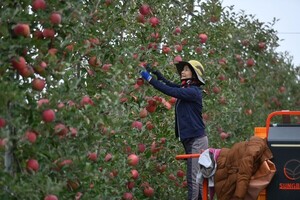
Cheongsong County in North Gyeongsang Province has posted its strongest apple performance on record, with 4,603 farms working 3,360 hectares to produce 71,000 tonnes and 337.25 billion won in gross farm revenue, according to county indicators compiled on a 2025 basis and reported by Straight News. The result comes as fruit growers across South Korea contend with poor colouring and sharp yield losses linked to warming and weather volatility.
Volume, price and farm economics
The revenue figure corresponds to an average of 4,750 won per kilogram, the price level the county cites for the previous year. Implied in the same data is a yield of roughly 21 tonnes per hectare and an average holding of about 0.73 hectares, which puts gross revenue per farm at approximately 73 million won. Cheongsong's apple economy is therefore built on small plots monetised through price rather than scale.
The county expects a total harvest of 80,000 tonnes this year, an increase of close to 13 percent, and says quality has improved further, with average per-kilogram prices running above the 4,750 won benchmark. Repeating last year's average price across 80,000 tonnes would imply gross revenue of around 380 billion won.
A staggered variety portfolio
Rather than concentrating on a single cultivar, Cheongsong has built a portfolio matched to harvest timing and consumer segment, according to Straight News.
- Cheongsong Fuji, the backbone of plantings, is grown above 250 metres of elevation, where heavy sunlight and diurnal temperature swings of more than 13 degrees Celsius push sugar content above 14 to 15 Brix.
- Shinano Gold, a yellow apple eaten with the skin on, balances sweetness and acidity, has found demand among younger consumers, and dominates the premium gift segment.
- Hongro covers the summer window, while newer domestic cultivars hold colouring and flavour through high-temperature periods.
Shinano Gold also cuts labour directly: it sharply reduces the need for leaf removal and reflective ground sheets used to drive colouring, which is why grower uptake is high. Together the mix supports uninterrupted premium shipments from late August through to the following spring.
Orchard design against weather risk
To neutralise spring frost damage from abnormal cold, localised torrential summer rain and frequent hail, the county rolled out disaster-response greenhouse apple orchards combining micro-sprinkler systems with windbreak and bird netting. In parallel, it accelerated adoption of multi-axis flat orchards, a smart high-density planting system that flattens the tree framework to maximise light penetration and allow mechanisation. Straight News reports labour savings of more than 30 percent alongside a substantially higher share of first-grade fruit.
Festival and the sorting bottleneck
The harvest culminates in the Cheongsong Apple Festival, running five days from 4 to 8 November around Hyeonbiam on the Yongjeoncheon in Cheongsong-eup, with farm-gate direct sales of freshly picked Fuji and Shinano Gold, a variety pavilion, a processed-food competition and family programmes.
County head Yoon Kyung-hee said the recognition of Cheongsong apples at 4,750 won per kilogram and the 337.2 billion won revenue result were owed to farmers who joined the shift to variety differentiation and smart cultivation technology, and pledged to defend the brand's standing. Industry specialists cited by Straight News set out two conditions for making the gains durable: a major expansion of smart production-area packing and distribution centre capacity able to certify the honey core content of Fuji and the sugar-acid ratio of Shinano Gold, and a move beyond appearance-based grading to data-backed guarantees of taste and freshness. They also called for strict management of county quality-assurance stickers and production traceability, and for exclusive supply partnerships with department stores and large-format retailers to be put on a regular footing.