Central Java Orders Rice-Market Intervention Despite 1.5 Million-Tonne Surplus
Central Java has ordered market intervention after rice prices rose despite a reported surplus of 1.5 million tonnes. The provincial government will focus on distribution oversight and subsidized food markets to move available stocks toward consumers.
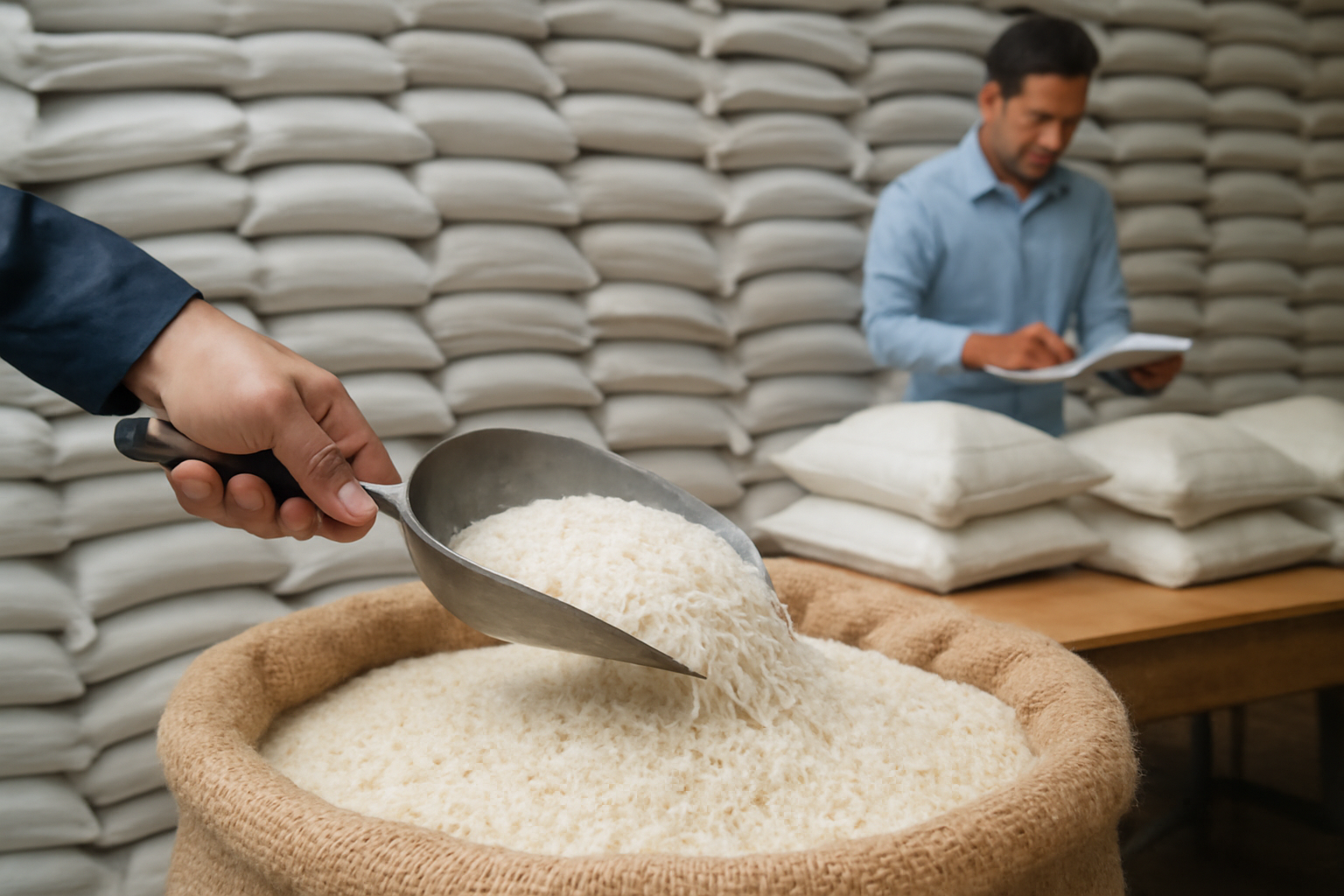
Prices rise while provincial stocks remain ample
Central Java Governor Ahmad Luthfi has instructed provincial agencies to intervene in the rice market after consumer prices increased despite a substantial supply surplus. The central issue is not the headline availability of rice but whether stocks are moving smoothly through the distribution system and reaching consumers at affordable prices.
Media Indonesia reported that Central Java’s rice availability through August 2026 stood at 4,348,101 tonnes, compared with public requirements of 2,809,248 tonnes. The provincial balance therefore shows a surplus of about 1.5 million tonnes. Semarang Bisnis also reported the 1.5 million-tonne surplus and said the provincial administration considered stocks secure even as it moved to suppress prices.
Government focuses on the distribution gap
According to Detik, Luthfi asked the relevant agencies to ensure that available rice could be distributed smoothly to consumers. The instruction indicates that provincial officials see market access and product movement as central to the price problem. A large aggregate surplus does not by itself guarantee that supplies are available in the right locations, at the required time or through channels accessible to households.
The provincial government has therefore ordered closer supervision of distribution. Semarang Bisnis reported that officials will also optimize the Gerakan Pangan Murah, or Cheap Food Movement, a subsidized-market initiative intended to make essential food available at lower prices. Together, these measures are designed to move rice into consumer markets and contain price pressure without suggesting that Central Java faces an overall production shortage.
Surplus figures put execution under scrutiny
The scale of the reported stocks raises a practical question for the rice sector: why are retail prices increasing when availability exceeds estimated requirements by roughly 1.5 million tonnes? The supplied reports do not identify a single cause. They instead place the immediate policy emphasis on distribution, supervision and the use of subsidized sales. No specific intervention volume, target retail price or timetable for the measures was disclosed in the provided material.
For producers, processors and traders, the intervention may affect how quickly stocks move through regional supply chains and which sales channels receive priority. For consumers, its effectiveness will depend on whether lower-priced rice becomes consistently available where price increases are being recorded. The contrast between a 4,348,101-tonne supply and demand of 2,809,248 tonnes also makes implementation measurable: authorities will need to show that an ample provincial balance can translate into improved physical availability and lower prices at the point of sale.
Market monitoring remains essential
The episode illustrates the limits of relying only on aggregate supply data. Provincial totals can indicate that enough rice exists across Central Java, but they do not show how inventories are divided among districts, warehouses, processors and retailers. Distribution oversight is consequently important for identifying where rice is being delayed or failing to reach consumer markets.
The Cheap Food Movement can provide short-term relief by offering subsidized supplies, while stronger monitoring may help officials track the path from existing stocks to retail outlets. The decisive indicators will be the volume actually distributed, the geographical reach of the program and the subsequent movement of consumer prices. Until those results are available, Central Java’s reported surplus and rising prices will remain evidence of a disconnect between statistical availability and market access.