CarbonBridge wins EU antitrust clearance for Germany’s first CO2 export terminal
Ambrian Energy and Messer have received European Commission antitrust clearance for their CarbonBridge joint venture. The Bremen terminal is scheduled to begin operating in 2031 with annual handling capacity of about 2.3 million tonnes of captured CO2, rising eventually to approximately 4 million tonnes.
European Commission clears CarbonBridge venture
Ambrian Energy GmbH and Messer SE & Co. KGaA have received European Commission antitrust approval for CarbonBridge, a joint venture planning what the companies describe as Germany’s first operational carbon dioxide export terminal. According to their announcement distributed through Presseportal, the clearance allows the partners to advance development of the facility in Bremen, with operations scheduled to begin in 2031.
The project is intended to connect German industrial emitters with permanent geological storage sites. CarbonBridge will provide intermediate storage, transport and loading services for recovered CO2, covering a part of the carbon capture, utilization and storage chain that the partners identify as a major obstacle for industrial projects. The terminal is designed particularly for sectors with substantial process emissions, including cement, glass and steel production and waste incineration.
Capacity could reach 4 million tonnes annually
CarbonBridge is expected to start with maximum handling capacity of around 2.3 million tonnes per year. The partners plan eventually to increase that figure to approximately 4 million tonnes annually. No investment value, construction timetable or binding customer commitments were disclosed in the announcement.
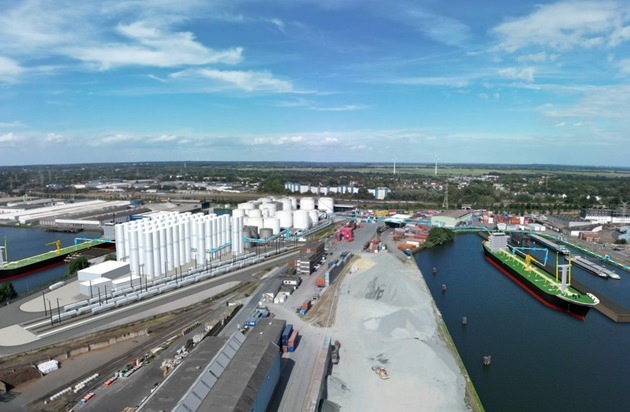
Ambrian Energy will contribute a strategically located three-hectare site in Bremen. The property already has a rail connection, allowing captured CO2 to arrive by train, as well as a port berth capable of receiving vessels with capacity of up to 30,000 tonnes. From Bremen, ships are expected to carry the recovered carbon dioxide to geological storage sites in the North Sea. The combination of rail access, temporary storage and maritime loading is intended to create a continuous route from industrial plants to permanent storage.
Partners combine logistics and CO2 processing
Ambrian Energy brings experience in energy logistics, while Messer contributes expertise in CO2 recovery and processing. Messer also links the venture to ZeCarb, its Carbon Capture as a Service offering, under which the company and its partners can manage the process from carbon recovery at an industrial site through to final storage.
Ralph Spring, Senior Manager Commercials CCUS at Messer, said logistics to the final storage location are the largest challenge in most projects and described CarbonBridge as a flexible solution spanning the chain from source to sink. Ambrian Energy Managing Director Daniel Pätzold said industrial companies need reliable export infrastructure for captured CO2 and that the venture aims to close that gap.
The clearance removes a competition-law hurdle, but the terminal’s commercial role will depend on the development of capture projects, rail and shipping arrangements and access to North Sea storage capacity. For German producers facing emissions that cannot be eliminated easily within manufacturing processes, the planned facility offers a prospective alternative to transporting CO2 through a dedicated pipeline network. Its initial 2.3-million-tonne capacity would also establish a measurable logistics platform that could be expanded as industrial demand develops.