Cameroon rises in rubber, cocoa paste and banana rankings as total exports fall
Cameroon improved its global rankings for natural rubber, cocoa paste and bananas in 2025, even as total export revenue fell 5.2% and volumes declined 10.7%. Cocoa paste recorded the clearest expansion, while conflicting rubber and banana datasets complicate the assessment of underlying trade performance.
Commodity gains contrast with weaker national exports
Cameroon moved up one place in the global export rankings for natural rubber, cocoa paste and bananas in 2025, according to the country’s Report on the Competitiveness of the Cameroonian Economy. It ranked seventh for natural rubber, sixth for cocoa paste and 12th for bananas, compared with eighth, seventh and 13th, respectively, in 2024. The country remained ninth for cocoa butter.
The improved positions came as Cameroon’s overall export performance weakened. The National Institute of Statistics, or INS, put total export revenue at CFA3.084 trillion in 2025, down CFA168.1 billion, or 5.2%, from 2024. Total export volumes fell 10.7%.
The decline was not uniform across the export base. Exports excluding crude oil increased 5.7% in value, while exports excluding hydrocarbons rose 9.8%. This suggests that several non-oil industries expanded even though they were not large enough to offset the contraction in total trade.
Cocoa paste delivers the clearest growth
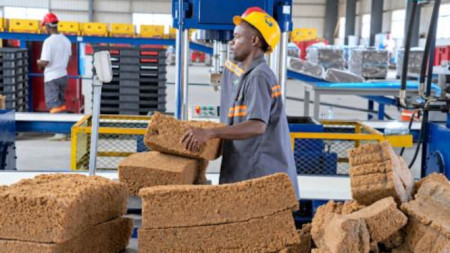
Cocoa paste showed the strongest underlying performance among the three products that gained ranking positions. The Competitiveness Committee valued exports at €442.5 million, or about CFA290.3 billion, in 2025, up from €320.2 million, or about CFA210 billion, in 2024. This moved Cameroon from seventh to sixth place worldwide.
INS data use a different export value but confirm growth in both quantity and revenue. Cocoa paste shipments increased 19.1%, from 61,527 metric tons to 73,261 tons, while their value rose 24.4%, from CFA210.05 billion to CFA261.34 billion. The average export value increased about 4.5%, from roughly CFA3,414 per kilogram to CFA3,567, indicating that higher volumes were the main driver of revenue growth.
Cocoa butter followed a different pattern. Cameroon retained ninth place, and the competitiveness report valued 2025 exports at €470.1 million. INS data show that shipments fell 13.4%, from 24,819 tons to 21,494 tons, but export value increased 16.5%, from CFA99.24 billion to CFA115.57 billion. Unit values therefore compensated for lower volumes.
Rubber and banana figures require caution
For natural rubber, the Competitiveness Committee reported exports of €23 million, or CFA15.1 billion, up from €20.7 million, or about CFA13.6 billion. INS customs data, however, recorded CFA43.46 billion in raw rubber exports, down 6.1% from CFA46.29 billion. Volumes declined 12.8%, from 58,067 tons to 50,631 tons. Differences in product coverage and statistical sources prevent a direct reconciliation.
Banana data also diverge. The competitiveness report valued exports at €251.4 million, or about CFA164.9 billion, slightly below €252.6 million in 2024. INS recorded 218,518 tons of bananas, including plantains, down 10.2%, while customs value jumped 84.7% from CFA36.67 billion to CFA67.72 billion. Assobacam, which tracks dessert bananas sold by sector producers, reported a 7% increase in volume to 225,345 tons.
Cameroon rose from 116th to 114th among global exporters, with its estimated global share increasing from 0.002% to 0.003%. Within Africa, however, it fell two places to 21st and accounted for about 1% of continental exports. Its positions in processed goods remained weak: 103rd for basic manufactured goods and 131st for processed foods. The 2025 gains were therefore concentrated in a small group of commodities rather than spread across the wider export economy.