Cameroon Cocoa Processing Falls 13% as Marketed Bean Supply Contracts
Cameroon processed 95,946 tonnes of cocoa beans in the 2025-26 season, down 13.08% from the previous year. Processing declined less sharply than marketed production and bean exports, raising the domestic processing share to 38.7%.
Processing falls below 100,000 tonnes
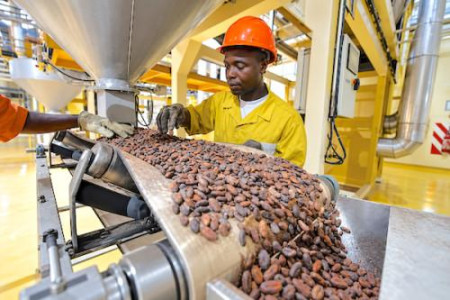
Cameroon’s cocoa processors handled 95,946 tonnes of beans during the 2025-26 season, a decline of 13.08%, according to the National Cocoa and Coffee Board (ONCC). The total was 14,442 tonnes below the 110,388 tonnes processed in 2024-25, when the country crossed the 100,000-tonne threshold for the first time.
The setback occurred amid a broader contraction in available market supply. Marketed cocoa production fell 20% from 309,518 tonnes to 247,914 tonnes, while raw-bean exports dropped 34.7% to 125,469 tonnes. End-of-season stocks moved in the opposite direction, rising from 13,947 tonnes to 40,447 tonnes. The ONCC did not identify specific causes for the lower processing volume.
Processors gain share of a smaller market
Although factories and artisanal operators processed fewer beans, their combined volume represented 38.7% of marketed production, compared with 35.7% in the previous season. The higher share does not indicate an absolute expansion in domestic transformation. It reflects the fact that marketed production contracted faster than processing.
The ONCC estimates Cameroon’s installed industrial processing capacity at 140,000 tonnes. A precise utilization rate cannot be calculated from the published figures because the total of 95,946 tonnes includes both industrial and artisanal processing. Even so, the gap between installed industrial capacity and beans supplied to processors highlights the importance of feedstock availability as companies add or plan new production lines.
Industrial deliveries remain concentrated
Three companies received 91.2% of beans delivered to industrial facilities. SIC Cacaos, the Cameroonian subsidiary of Barry Callebaut, accounted for 41.8%, followed by Neo Industry with 29.3% and Atlantic Cocoa with 20.1%. SIC Cacaos invested CFA4.8 billion in equipment in 2015, with the project expected to lift annual capacity from about 32,000 tonnes to 50,000 tonnes. Neo Industry’s Fondjomoko plant has an announced capacity of 32,000 tonnes.
Atlantic Cocoa launched an expansion project on June 27, 2025, intended to increase annual capacity at its Kribi facility from 48,000 tonnes to 64,000 tonnes. Public information does not confirm that the project was completed or available during the season. Africa Processing inaugurated a second facility in Ngolambélé on November 28, 2025, but disclosed neither its capacity nor the investment. Samen Industry began construction of a planned 32,000-tonne plant in Baré-Bakem on February 27, 2026; it remained under construction during the period reviewed.
Lower grindings put value-added exports under scrutiny
The decline follows Cameroon’s progress in exports of processed cocoa products. Business in Cameroon cited a report by the Economy Ministry’s Competitiveness Committee ranking the country seventh globally for cocoa paste exports and ninth for cocoa butter exports in 2024. Those rankings cover the calendar year and therefore do not establish Cameroon’s position after the 2025-26 processing decline.
For processors, the central issue is now the balance between physical capacity and the volume of beans reaching domestic plants. Marketed production, processing and raw-bean exports all declined, while stocks increased. Until more recent trade data and operational details from expansion projects become available, it remains unclear whether the higher processing share can be sustained or translated into greater exports of cocoa paste, butter and other higher-value products.