Bulgarian Rakia Producers Threaten Protests as Untaxed Output Is Put at 45 Million Litres a Year
A tax law expert estimates that about 45 million litres of illegal rakia are produced and consumed in Bulgaria every year. Draft rules that would fine private individuals for holding rakia distilled by someone else have been called contradictory by economists, and still owners say they may protest on a larger scale than in 2017.
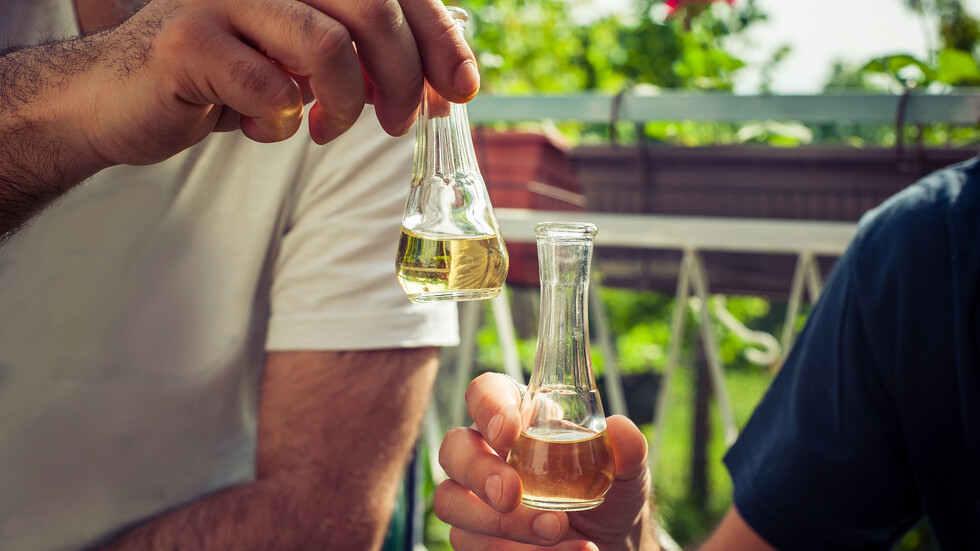
Bulgarian rakia producers have warned they may stage protests over draft legislation that would penalise private individuals for keeping fruit brandy distilled by someone else, while a tax specialist estimates that about 45 million litres of untaxed rakia are produced and drunk in the country every year.
Around 45 million litres outside the tax net
Approximately 45 million litres of illegal rakia are produced and consumed annually in Bulgaria, according to an estimate presented on Bulgarian National Radio by tax law expert Miroslav Karakashev and reported by business.dir.bg.
Bulgarian law currently allows a household to distil a set quantity of rakia for its own consumption, while the sale of homemade rakia is prohibited. The dispute now centres on what happens when that alcohol leaves the household — whether passing rakia to relatives, friends or neighbours in larger quantities could trigger sanctions.
Draft rules called contradictory
The proposal to fine individuals who hold rakia produced by another person is drafted in contradictory terms, according to leading economists and financiers cited by nova.bg. The texts are to be corrected, but that has not reassured owners of rakia stills.
“If I give you a bottle of apricot rakia, I am being very ill-intentioned towards you, because the tradition in Bulgaria is to be hospitable and generous. Under the planned changes, however, I will be giving you not rakia but a 1,000 euro fine,” said Sashko Pavlov of the National Association “Bulgarian Homemade Rakia”, himself the owner of a still, speaking on nova.bg. Financier Nikola Filipov said the proposed texts contain a contradiction: “I read the law itself and it really is written quite convolutedly; it is not clear exactly what the legislator means.” He added that it is an entirely legitimate reading that an inspector could come to check a household’s fridge.
Economics of home versus industrial output
Pavlov argued that households distilling for themselves are unlikely to move into selling, because home rakia is appreciably more expensive than retail product: “Who would sell their homemade rakia, which is considerably more expensive than what is in the shops? It is enough to work out how much grape goes into one litre of rakia, what the costs are and at what price you would sell it.” In his view the problem institutions should be solving is trade in alcohol of unclear origin, not personal-use distillation. In industrial production, he noted, the final price absorbs a series of costs:
- production
- labels, caps and bottles
- transport
- trade markup
- profit
Protest threat and the European comparison
The association says producers will first seek talks with the government, but does not rule out protests larger than those held in 2017 if there is no result. Pavlov said people in the sector had already looked at how other European states regulate farm distilling, and that fruit and grape growers there are entitled to distil 10 hectolitres of alcohol under what he described as European Union Directive 8392 of 1992, with that alcohol sold legally: “they pay everything, they obtain certificates and they sell it.”
Former economy and social policy minister Lidia Shuleva said the changes are aimed at rakia produced for commercial purposes and are not intended to penalise people distilling for themselves. Home rakia is usually double-distilled and made more carefully, she said, while rakia genuinely produced for commercial sale “is quite dangerous”, so the focus should fall on controlling composition rather than on quantity and excise. Yordan Chorbadzhiyski, a member of the management board of the National Vine and Wine Chamber, said proof of origin would be workable in practice: if inspectors visit and the holder names the person who supplied the rakia, and the Customs Agency verifies that this person has paid the excise duty, there is no problem. Nova.bg also reported that consumption of home-distilled rakia is declining and that young people are not drinking it.